INTRODUCTION
Meat and meat products are valuable sources of high-quality protein and essential nutrients; however, concerns regarding high fat and salt contents and their association with chronic diseases have increased consumer demand for healthier meat products [Grasso et al., 2014; Kausar et al., 2019; Toldrá & Reig, 2011]. There is a growing global demand for healthier meat products with reduced levels of fat, cholesterol, salt, and nitrites, as well as improved nutritional profiles [Kausar, 2019]. Accordingly, current research and industrial practices focus on reformulating meat products by reducing detrimental components and incorporating functional ingredients such as fibers, proteins, antioxidants, and polyunsaturated fatty acids [Biswas, 2011; Grasso et al., 2014; Yadav et al., 2016].
Fat plays a crucial role in determining the sensory quality of meat products, including flavor, juiciness, tenderness, and texture, and its reduction often results in increased firmness, reduced juiciness, and lower consumer acceptance [Hoffman & Wiklund, 2006; Keeton, 1994; Zhang et al., 2010]. For these reasons, fat level reduction cannot be achieved simply by using less fat in the formulation. Water, which is added from non-meat ingredients used for fat reduction, has several advantages, such as being safe and inexpensive [Hughes et al., 1998]. However, incorporating water alone into meat products may lead to undesirable effects such as discoloration and increased cooking losses [Claus et al., 1990]. To mitigate these issues, water is typically combined with fat, carbohydrate, or protein-based ingredients [Hughes et al., 1998]. Carbohydrate-based fat replacers include fibers, gums, dextrins, maltodextrins, hydrocolloids, pectin, cellulose, and starches [Nikolić et al., 2024]. There are various studies in the literature on the use of fat replacers derived from different sources, including plant-based fibers, animal-derived ingredients, and carbohydrate-based compounds, in the production of different types of fat-reduced sausages [dos Santos et al., 2021; Guo et al., 2024; Kim et al., 2019; Tomaschunas et al., 2013]. Sucuk, a dry fermented sausage, holds a prominent place among Turkey’s most cherished and widely consumed traditional meat products. Due to its high contents of fat (~35–40 g/100 g), saturated fatty acids and cholesterol, its healthier versions are developed [Ercoşkun & Demirci-Erçoşkun, 2010].
Dietary fibers are widely recognized for their health-promoting effects and functional properties, which have led to their increasing use as functional ingredients in meat products [Grasso et al., 2014; Pintado & Delgado-Pando, 2020]. Plant-derived dietary fibers exhibit diverse technological characteristics, such as water-holding and fat-binding capacities, that can influence the physicochemical and quality attributes of food products [Nieto et al., 2021; Zinina et al., 2019]. Lemon-derived fiber, which contains phenolic compounds, carotenoids, and pectin, has gained attention as a promising functional ingredient due to its antioxidant potential [Fu et al., 2015; Nieto et al., 2021].
Recent studies have shown that the incorporation of citrus fibers can improve technological properties, such as cooking yield and texture, while reducing weight loss in meat products [Chappalwar et al., 2020; Sarıcoban & Unal, 2022]. However, most studies have focused on the use of orange or mixed citrus fibers in cooked or emulsified sausages, with few studies on their application in low-fat formulations. Information on the use of lemon fiber, rich in antioxidants and pectin, in fermented or dry-cured meat products (particularly sucuk) is limited. Therefore, this study was designed to fill this knowledge gap by evaluating the effects of lemon fiber addition on the quality characteristics of low-fat sucuk, with the aim of developing a healthier and more functional traditional meat product. Accordingly, sucuk samples were produced using two different fat levels and three different lemon fiber levels. Various physicochemical analyses, including determinations of fat, protein, and moisture contents, pH, water activity (aw), residual nitrite, residual nitrate, cholesterol content, thiobarbituric acid reactive substances (TBARS) level, cooking loss, and weight loss, as well as color measurements and texture profile analyses, were performed.
The main hypothesis of this study was that reducing the amount of animal fat would improve the nutritional profile of sucuk by decreasing total fat and cholesterol levels, while the addition of lemon fiber would compensate for potential adverse effects of fat reduction on the physicochemical and textural properties of the product. Results obtained enabled identifying the most suitable formulation.
MATERIAL AND METHODS
Materials
The sucuk samples used in this study were produced in a commercial meat products processing plant located in Afyonkarahisar, Turkey. The meat and tallow used in the formulations of sucuk were obtained from cattle slaughtered in the plant’s own abattoir. Beef from the brisket region was used as the meat source. To facilitate temperature control during mincing and mixing, the meat was used as a mixture of fresh and frozen portions. All spices and additives used in sucuk production were supplied by the same production plant and from the same batch to ensure standardization. Lemon fiber (containing 5 g of protein, 1 g of fat, 90 g of total dietary fiber, and 10 g of moisture per 100 g) was supplied by Herbafood Ingredients GmbH (Werder (Havel), Germany).
Production of Turkish fermented sausage
The meat-to-fat ratio for the sucuk dough formulation was determined in collaboration with the industrial manufacturer where the trials were conducted. These ratios were selected as the lowest technologically feasible and sensorially acceptable fat levels, since further reduction in fat content would result in products that lost the characteristic properties of traditional sucuk and exhibited textural and sensory attributes similar to cooked meat. Six sucuk doughs were prepared for each experiment based on the fat level (fat level 1: 5.5 kg meat + 1.5 kg tallow, fat level 2: 5.25 kg meat + 1.75 kg tallow) and lemon fiber (0%, 1% and 2%, w/w). The following ingredients were added to sucuk batters: NaCl (15 g/kg), garlic (7.5 g/kg), red pepper (7 g/kg), hot red pepper (7 g/kg), black pepper (6 g/kg), cumin (10 g/kg), pimento (1 g/kg), cinnamon (0.01 g/kg), ascorbic acid (0.9 g/kg), ascorbate (0.06 g/kg), phosphate (0.6 g/kg), NaNO2 (0.15 g/kg), and starter culture (0.2 g/kg). The amount of lemon fiber added to doughs was calculated over the total mixture weight. After the sucuk doughs was prepared, the fat content was measured using the Foss FoodScan meat analyzer (FOSS, Hillerød, Denmark); the doughs with fat levels of 1 had 24 g fat/100 g, and the doughs with fat levels of 2 had 28 g fat/100 g.
For sucuk production, meat and fat were minced. Spices, salt, garlic, additives, and starter culture were then added and thoroughly mixed. The mixture was filled into natural beef casings (46 mm diameter) using a filling machine. After filling, fermentation was carried out at 28°C and 95% relative humidity until the pH reached approximately 5.35 (~20 h). Following fermentation, the products were placed in an oven at 72°C for approximately 4.5–5.0 h, until the internal temperature reached 68°C. They were subsequently cooled with a water shower at ~20°C for 15 min. Finally, the products were transferred to a drying room maintained at 12–15°C, where they were stored until the relative humidity decreased below 40% (~12 h).
Sucuk production and analyses were conducted in three independent batches (experimental replicates) at different time points. From each batch, two coils of sucuk were sampled, and each sample was analyzed in duplicate (technical replicates).
Lactic acid bacteria count determination
For lactic acid bacteria (LAB) enumeration, 1 g of each sucuk sample was homogenized in 9 mL of sterile peptone water, and decimal serial dilutions were prepared [ISO 15214:1998]. From each dilution, 0.1 mL was plated in duplicate onto De Man, Rogosa and Sharpe (MRS) agar and spread on the surface using a sterile spreader. Plates were incubated at 37°C for 48 h under anaerobic conditions. Colonies were counted and expressed as CFU/g.
Physical and chemical parameter analysis
Measurement of pH value and water activity
The pH value of the sucuk samples was measured with a Testo 205 pH meter (Testo SE & Co. KGaA, Lenzkirch, Germany) at room temperature (~20–25°C) by direct immersion of the electrode into the samples. The aw of the sucuk samples was measured with a Novasina LabMaster-aw device (Novasina AG, Lachen, Switzerland) following the manufacturer’s guidelines, after equilibrating the samples at room temperature.
Determination of fat, protein, and moisture contents
The fat, protein, and moisture contents of the sucuk samples were determined using a Foss FoodScan meat analyzer (FOSS, Hillerød, Denmark) based on the near-infrared (NIR) spectroscopy principle. Prior to analysis, the sucuk samples were cut into small pieces and blended until a homogeneous consistency was achieved, and then placed into the sample chamber of the device. The instrument was operated according to the calibration sets and standard protocols provided by the manufacturer. During the measurements, the ambient temperature and humidity were maintained within the ranges recommended by the device. Protein, fat, and moisture contents were obtained directly through the device software, and results were expressed as g/100 g sucuk.
Determination of residual nitrite and nitrate contents
Nitrite and nitrate contents of the sucuk samples were determined at the TÜBİTAK Marmara Research Center (Turkey) using a spectrophotometric method based on extraction following protein precipitation, according to the method described by Schormüller [1968]. Results were expressed as mg/kg sucuk.
Determination of the level of thiobarbituric acid reactive substances
To 10 g of sucuk, 30 mL of a 7.5% trichloroacetic acid solution weres added, and the sample was homogenized using a digital homogenizer (HG-15D, Daihan Scientific Co., Ltd., Wonju, Gangwon-do, South Korea) for 15–20 s, followed by filtration through filter paper [Mielnik et al., 2006]. The filtrate was mixed with a 0.02 M water solution of thiobarbituric acid at the ratio of 1:1 (v/v) in test tubes, which were kept in a water bath at 100°C for 35 min. Then, after cooling in cold water for 5 min, the absorbance was measured at 532 nm against a reagent blank containing reagent and water instead of the sample, using a UV-1800 spectrophotometer (Shimadzu, Kyoto, Japan). Subsequently, the level of TBARS was calculated using the standard curve for 1,1,3,3, tetraethoxy propane (TEP), and the result was given as μmol malonaldehyde (MDA)/g sucuk.
Cholesterol content determination
The cholesterol content of the sucuk samples was determined at the TÜBİTAK Marmara Research Center (Turkey) using a chromatographic method based on lipid extraction followed by gas chromatographic analysis, in accordance with the method described by Fenton & Sim [1991]. Results were expressed as mg/100 g sucuk.
Weight loss evaluation
The sucuk samples were first weighed immediately after being filled into casings using an analytical balance with a precision of 0.01 g. Following the drying stage, the samples were weighed again under the same conditions. The weight loss of each sample was calculated as the difference between the initial and final weights and expressed as a percentage of the initial weight.
Cooking loss evaluation
After drying, 6 slices of 3 mm thickness were cut from the sucuk samples and weighed. Each slice was grilled for 1 min on each side for a total of 2 min. The slices were weighed after they cooled. The initial and final weights of the slices were taken into account, and the percent cooking loss was calculated.
Color analysis
The color of the sucuk samples was determined using a Minolta chroma meter (CR-400, Konica Minolta, Inc., Tokyo, Japan), following the CIE Lab system. Prior to measurements, the instrument was calibrated using a white standard according to the manufacturer’s instructions. Measurements were taken at three different points on both the inner and outer surfaces of each sample to account for surface heterogeneity. The arithmetic mean of these readings was recorded as the final L* (lightness), a* (redness), and b* (yellowness) values. Ambient light and temperature were maintained constant during the measurements to minimize variability.
Texture profile analysis
After drying, samples from each sucuk group were cut into 1.5-cm long pieces using a sharp knife for texture analysis. Cylindrical samples were analyzed using a TA.XT Plus texture analyzer (Stable Micro Systems Ltd, Godalming, Surrey, United Kingdom) equipped with a 36 mm cylindrical probe. They were compressed to 40% of their original height at a test speed of 2 mm/s, with a 1 s interval between the first and second compression. Textural parameters were derived from the force–time curves as follows: hardness was determined from the maximum force recorded during the first compression, adhesiveness was calculated as the negative area under the curve, and cohesiveness was obtained as the ratio of the area under the second compression to that of the first. Springiness was assessed as the ratio of the recovered height during the second compression to the original height. Chewiness was calculated as the product of hardness, cohesiveness, and springiness, and resilience was evaluated as the ratio of the force recovered during the first compression [Herrero et al., 2007].
Statistical analysis
Descriptive statistics (mean and standard deviation) were calculated for all quantitative data. Two-way analysis of variance (ANOVA) was performed to examine the effects of fat and fiber levels and their interaction (fat×fiber) on the measured parameters. Significant differences among means were further evaluated using Duncan’s multiple range test at a 5% significance level. All statistical analyses were conducted using SPSS ver. 26 (IBM, Armonk, NY, USA).
RESULTS AND DISCUSSION
Fat, protein, and moisture contents
The fat, protein and moisture contents of sucuk samples are presented in Table 1. Obviously, fat level in the sausage recipe had statistically significant effects (p<0.01) on their fat content. In contrast, their fat level was not significantly (p≥0.05) affected by the level of lemon fiber in the dough formulation, as another primary variable. This result may be attributed to the fact that lemon fiber mainly affects water-holding capacity and textural properties, while having only a limited influence on fat retention or fat release during processing. Similar findings were reported by Yuca et al. [2019], who observed significant differences in fat content among treatments due to variations in fat levels in their study using β-glucan in sausages.
Table 1
Effect of fat and lemon fiber levels in the formulation on the pH value, water activity (aw), and contents of protein, fat, and moisture of sucuk.
Fat level and lemon fiber level had no statistically significant effect (p≥0.05) on the protein content of sucuk samples (Table 1). Although minor numerical variations were observed among formulations, these differences were not statistically significant and therefore cannot be attributed to the effects of fat reduction or fiber addition. Similar findings have been reported in previous studies, where low or moderate levels of dietary fiber incorporation resulted in no significant changes or only minor variations in protein content [Akoğlu et al., 2015; Bis-Souza et al., 2020; Sarıçoban & Unal, 2022].
The moisture content of sucuk is a critical parameter influencing texture, microbial stability, and overall product quality. In this study, fat level had a significant effect (p<0.05) on moisture content, with higher fat levels resulting in lower moisture values (Table 1). This effect can be attributed to the partial replacement of lean meat by fat in the formulation, which reduces the proportion of muscle proteins responsible for water binding. Similar effects of fat level on moisture content in fermented meat products have been reported in a recent study [Simunovic et al., 2022]. In contrast, the addition of lemon fiber did not have a significant effect (p≥0.05) on the moisture content of sucuk (Table 1). This may be attributed to the relatively low inclusion levels used in the present study, which might not have been sufficient to enhance water retention. Moreover, the water-holding capacity of dietary fibers is influenced by their physicochemical properties, such as pectin content, porosity, and surface area [Elleuch et al., 2011]. Therefore, the lack of a significant effect of lemon fiber on the moisture content observed in this study could be attributed both to the low inclusion rate and to the specific hydration characteristics of the fiber used.
pH values and water activity
No significant differences in water activity of sucuk were observed as a result of changes in fat and fiber levels in product recipe (p≥0.05) (Table 1). Similar findings were reported by Campagnol et al. [2012], García et al. [2002], and Yalınkılıç et al. [2012], who also found that variations in fat or fiber content did not markedly affect aw values of fermented sausages. The absence of a significant effect in the present study may be attributed to the limited amount of fiber added and the low water-binding potential of the matrix during drying and fermentation. On the other hand, several researchers have reported a reduction in aw values with the inclusion of dietary fibers [Aminzare et al., 2024; Eim et al., 2008; dos Santos et al., 2021; Yuca et al., 2019]. These discrepancies among studies could be explained by differences in fiber type and addition level, as well as variations in processing conditions (e.g., temperature, relative humidity, or drying duration), which strongly influence the rate of moisture migration and binding capacity of the added fiber.
In the present study, the addition of lemon fiber did not lead to a statistically significant change (p≥0.05) in pH values (Table 1). This finding is consistent with previous studies reporting that the incorporation of citrus-derived fibers at low to moderate levels did not significantly affect pH [Aleson-Carbonell et al., 2003; Fernández-Ginés et al., 2004]. The absence of a marked pH change has been attributed to the buffering capacity of the meat system [Fernández-Ginés et al., 2004]. In particular, Aleson-Carbonell et al. [2003] observed no significant pH change with raw albedo addition up to 5%, whereas its higher incorporation levels resulted in a significant decrease, indicating that pH modification depends primarily on the fiber addition level. Therefore, the absence of a significant pH change in the present study can be attributed to the relatively low level of lemon fiber used and the buffering effect of meat proteins. No statistically significant differences were observed in pH values across different fat levels (p≥0.05) (Table 1), which is consistent with the observations made by Yalınkılıç et al. [2012] for sucuk. This finding can be explained by the fact that fat acts as a neutral component in the mixture, not participating in fermentation or acid production, and therefore does not directly influence product pH.
Residual nitrite and nitrate
As shown in Table 2, lemon fiber and fat level had no significant effects (p≥0.05) on the residual nitrite and nitrate of sucuk samples. Similarly, Ruiz-Capillas et al. [2012] reported that the addition of a fat replacer at the end of the ripening period did not significantly affect the residual nitrite content of fermented sausages. In contrast, Yalınkılıç et al. [2012] found that the addition of orange fiber significantly influenced nitrite levels in low-fat sucuk formulations, which was attributed to the interaction between the active bio-compounds in the fiber matrix and nitrite. The lowest residual nitrite levels were detected in the samples containing 4% fiber, likely due to the ability of phenolic compounds to bind or reduce nitrite. The absence of a significant change in our study may be attributed to the lower level of lemon fiber used and the differences in its chemical composition compared with orange fiber. Furthermore, the relatively stable pH values of the samples may have limited the rate of nitrite decomposition during fermentation and drying. Aleson-Carbonell et al. [2003] also reported that the addition of lemon albedo reduced residual nitrite levels in sausage samples. However, the lower inclusion level of lemon fiber used in the present study likely restricted such an effect.
Table 2
Effect of fat and lemon fiber levels in the formulation on the residual nitrite, the residual nitrate, and total nitrite and nitrate values of sucuk.
Thiobarbituric acid reactive substances and cholesterol content
The effects of fat level, lemon fiber level, and their interaction on the TBARS content of sucuk samples was not significant (p≥0.05) (Table 3). In a previous study, a fat replacer was added to the formulation of dry fermented sausages with a reduced fat content and it was concluded that the TBARS values of the products were not affected by the fat content [Ruiz-Capillas et al., 2012]. Fernández-López et al. [2007] reported that TBARS values were lower in sausage samples formulated with orange fiber compared to control sausages produced without fiber addition. According to Yuca et al. [2019], lower TBARS values were determined as a result of the addition of a fat replacer and fat reduction upon β-glucan addition as a fat replacer to fermented sausage formulations. Dos Santos et al. [2021] reported that the incorporation of fat replacers in reduced-fat fermented sausages led to an increase in TBARS values. The discrepancies between the results of the present study and those reported in the literature may be attributed to differences in the type and inclusion level of fat replacers or dietary fibers used, as well as variations in formulation, processing conditions, and product type. In the present study, the relatively low level of lemon fiber addition and the absence of statistically significant changes in fat content may have limited the potential effect of the fiber on lipid oxidation, resulting in no significant differences in TBARS values.
Table 3
Effect of fat and lemon fiber levels in the formulation on the thiobarbituric acid reactive substances (TBARS), cholesterol content, weight loss, cooking loss, and lactic acid bacteria (LAB) count of sucuk.
A significant reduction in sucuk cholesterol content was observed with a decreased fat level in the formulation (p<0.05), whereas the addition of fiber did not result in a statistically significant change (p≥0.05) (Table 3). The reduction in cholesterol level with a lower fat content can be explained by the decreased proportion of animal fat in the formulation, as cholesterol is predominantly associated with lipid fractions in meat products [Jiménez-Colmenero, 2007]. Although previous studies reported that the addition of dietary fiber can also reduce cholesterol content in sausages [Campagnol et al., 2012; Candogan & Kolsarici, 2003; Cengiz & Gokoglu, 2005], the lack of a significant effect in our study may be due to the type and level of fiber used. Lemon fiber primarily affects water retention and textural properties rather than lipid content, and its content in our formulations may have been insufficient to produce measurable changes in cholesterol content [Aleson-Carbonell et al., 2003; Fernández-Ginés et al., 2004].
Weight and cooking losses
The weight and cooking loss of sucuk samples are presented in Table 3. None of the main variables (fat level, lemon fiber level, and their interaction) had significant effects on weight losses (p≥0.05). Although the addition of fiber slightly reduced weight loss in sucuk samples, this effect was not statistically significant (p≥0.05). In a study by Sarıçoban & Unal [2022], the incorporation of citrus albedo in sucuk formulations reduced weight loss, which was attributed to the high water-holding capacity of the fiber. Similarly, dos Santos et al. [2012] reported that dietary fiber addition reduced weight loss in meat products. The lack of a significant reduction in weight loss in the present study may be explained by the relatively low lemon fiber inclusion levels used, which may not have been sufficient to induce a pronounced water-binding or gel-forming effect within the meat matrix. In addition, differences in fiber source, processing conditions, and product formulation may influence the extent to which dietary fibers contribute to water retention.
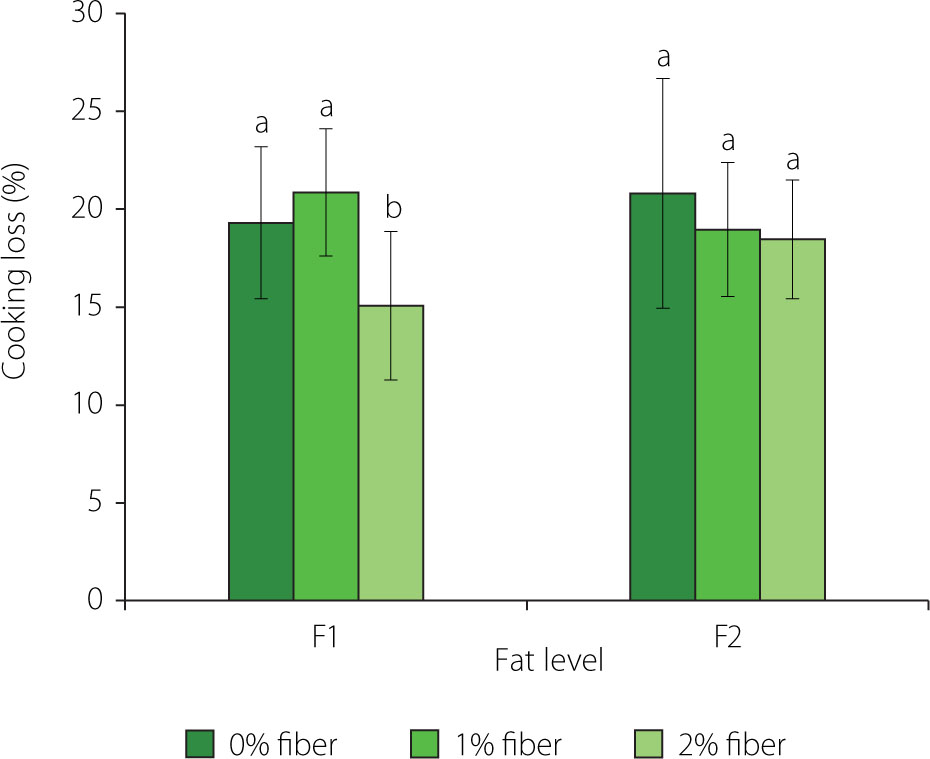
Cooking loss is a critical parameter for assessing the physicochemical properties of meat products during thermal processing and is mainly influenced by the water- and lipid-binding capacities of proteins. A low fat content can reduce the ability of the meat matrix to retain moisture, since fat contributes to the structural stability of the protein–lipid network and helps entrap water and melted fat within the matrix [Han et al., 2018; Oz et al., 2016]. In our study, a significant interaction between fat and fiber levels affecting cooking loss was detected (p< 0.05) (Table 3). The distribution of cooking loss values for different fiber levels within each formulation is illustrated in Figure 1. The F×LF interaction suggests that the water-holding effect of fiber depends on the fat level of the formulation. At the lower fat level (F1), samples with 2% (w/w) fiber exhibited the lowest cooking loss among all treatments, whereas at the higher fat level (F2), the same fiber level resulted in comparatively higher cooking loss. This tendency may be explained by the water- and fat-binding properties of citrus fiber, which have been shown to improve matrix stability and moisture retention, particularly in reduced-fat meat systems [Elleuch et al., 2011; Fernández-Ginés et al., 2004; Saha & Bhattacharya, 2010].
Figure 1
Cooking loss of sucuk samples prepared with two fat levels, F1 (24 g fat/100 g dough) and F2 (28 g fat/100 g dough), at fiber contents of 0%, 1%, and 2% (w/w, based on dough weight). Bars represent mean values and error bars indicate standard deviation (SD). Different letters above the bars indicate statistically significant differences (p<0.05).
Lactic acid bacteria count
The results showed that neither fat level, lemon fiber level, nor their interaction had a significant effect (p≥0.05) on lactic acid bacteria (LAB) counts (Table 3). Similarly, several studies have reported that the incorporation of dietary fibers into fermented meat products had no significant impact on LAB populations [García et al., 2002; Mendoza et al., 2001; Ruiz-Capillas et al., 2012]. Most plant-derived fibers are insoluble, which may curb their functional impact in meat matrices [Elleuch et al., 2011]. This, combined with the limited fermentable carbohydrate content, may explain why their addition did not significantly affect LAB counts.
In contrast, Yalınkılıç et al. [2012] reported that increasing levels of orange fiber in low-fat sucuk formulations significantly affected LAB counts, with the highest values observed in the samples containing 4% fiber. This effect was attributed to the slight pH reduction caused by the addition of orange fiber, which created more favorable conditions for LAB activity. Therefore, the lack of a significant change in LAB counts in the present study may be related to the lower inclusion level of lemon fiber and the differences in contents of fermentable carbohydrates and phenolic compounds between lemon and orange fibers [Gorinstein et al., 2001; Fernández-Ginés et al., 2004].
Color parameters
Color parameters of sucuk samples are given in Table 4. The effect of fat level, lemon fiber level, and their interaction on the outer and inner surface L* values of sucuk samples was not significant. Similarly, Araujo-Chapa et al. [2023] reported that the incorporation of soybean husk as a plant-derived dietary fiber had no significant effect on the L* values of sausage products. The outer and inner surface a* and b* values were also not affected by the variables (Table 4). Previous studies reported that fat content and dietary fiber addition did not significantly affect a* values in dry-ripened sausages, fermented sausages, and fermented cooked sausages formulated with different dietary fibers, including β-glucan and fructooligosaccharides [Bis-Souza et al., 2020; dos Santos et al., 2012; Yuca et al., 2019]. Fernández-Ginés et al. [2004] found that adding different amounts of lemon albedo to sausage samples was expected to increase b* values, but it did not cause a change. The observed effect was attributed to the potential masking of yellow pigments in the albedo by the meat emulsion matrix. Supporting this, Aleson-Carbonell et al. [2003] reported that the incorporation of lemon albedo led to significant variations in b* values, particularly at the 2.5% inclusion level. In a study, it was concluded that the effect of dietary fiber addition on b* values of sucuk samples was not significant [Akoğlu et al., 2015].
Table 4
Effect of fat and lemon fiber levels in the formulation on the L*, a* and b* values of the outer surfaces and the inner cross-sectional surfaces of sucuk.
Overall, these findings suggest that the limited impact of lemon fiber on color parameters may be explained by its relatively low inclusion level, the composition of the fiber, and interactions with the meat matrix. The water- and fat-binding capacities of dietary fibers can influence pigment visibility, which may account for the minimal changes observed in L*, a*, and b* values [Aleson-Carbonell et al., 2003; Fernández-Ginés et al., 2004].
Texture properties
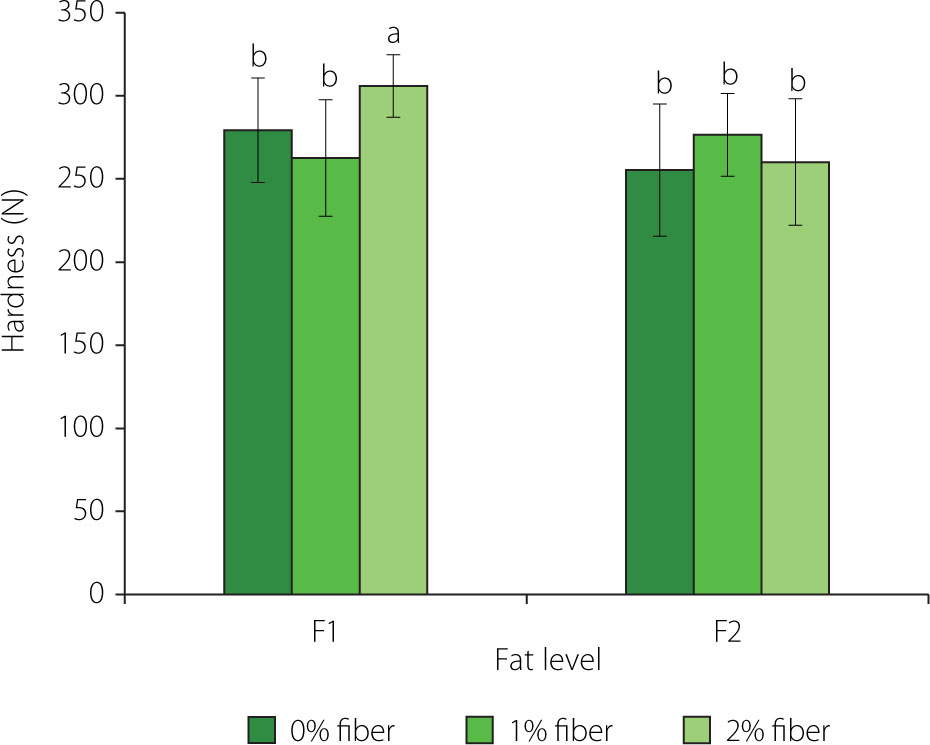
A highly significant interaction between fat and fiber levels affecting sucuk hardness was detected (p<0.01) (Table 5). This finding indicates that the impact of fiber inclusion on hardness is dependent on the fat content of the samples. Hardness values at different fiber levels within each formulation are illustrated in Figure 2. At fat level F1, the addition of 2% (w/w) fiber produced the highest hardness values, whereas at fat level F2 the same fiber level resulted in lower hardness. Conversely, the samples with 1% fiber showed an opposite trend, with hardness increasing from F1 to F2. Among all combinations, the highest hardness was observed at F1×2% (w/w) fiber. Ruiz-Capillas et al. [2012] found an increase in hardness due to the decrease in fat content. In turn, Aleson-Carbonell et al. [2003] stated that the hardness of the samples to which albedo was added increased in dry-cured sausages. In a study examining the effect of oat fiber on different types of sausages (Bologna and Frankfurter types), it was reported that the hardness of Bologna type sausages increased with the addition of oat fiber, while in Frankfurter type sausages, the added oat fiber did not affect the hardness of the samples much [Steenblock et al., 2001], while Yuca et al. [2019] reported that the incorporation of dietary fiber, such as β-glucan, increased the hardness values of fermented sausage products [Yuca et al., 2019].
Table 5
Effect of fat and lemon fiber levels in the formulation on the texture properties of sucuk.
Figure 2
Hardness of sucuk samples prepared with two fat levels, F1 (24 g fat/100 g dough) and F2 (28 g fat/100 g dough), at fiber contents of 0%, 1%, and 2% (w/w, based on dough weight). Bars represent mean values and error bars indicate standard deviation (SD). Different letters above the bars indicate statistically significant differences (p<0.05).
This effect of fat level and lemon fiber level interaction on texture (hardness) may be attributed to the opposite structural roles of fat and fiber within the meat matrix. Fat generally acts as a plasticizer and lubricant, interrupting protein–protein interactions and resulting in a softer texture [Ruiz-Capillas et al., 2012]. In contrast, dietary fibers can increase matrix compactness by binding water and reinforcing the protein network, leading to a firmer texture [Aleson-Carbonell et al., 2003; Steenblock et al., 2001]. The combined effect suggests that at low-fat levels, fiber addition enhances protein–fiber crosslinking and increases hardness, whereas at higher fat contents, fat globules may disrupt this network, thereby diminishing the fiber’s strengthening effect.
Among the variables, only the fat level had a highly significant effect on the adhesiveness of sucuk samples (p<0.01), while the effect of fiber level was not significant (p≥0.05) (Table 5). The observed differences in adhesiveness may be attributed to the structural roles of fat and fiber within the meat matrix. Fat likely acts as a lubricant and filler, weakening protein–protein interactions and thereby reducing surface stickiness. At lower fat levels, a higher amount of denatured proteins may become exposed on the surface, which could increase adhesiveness. In contrast, dietary fibers may retain water and interact with proteins, possibly leading to a more cohesive and integrated gel network. Such interactions can influence moisture distribution and surface properties depending on the formulation [Ruiz-Capillas et al., 2012; Saha & Bhattacharya, 2010; Totosaus et al., 2002].
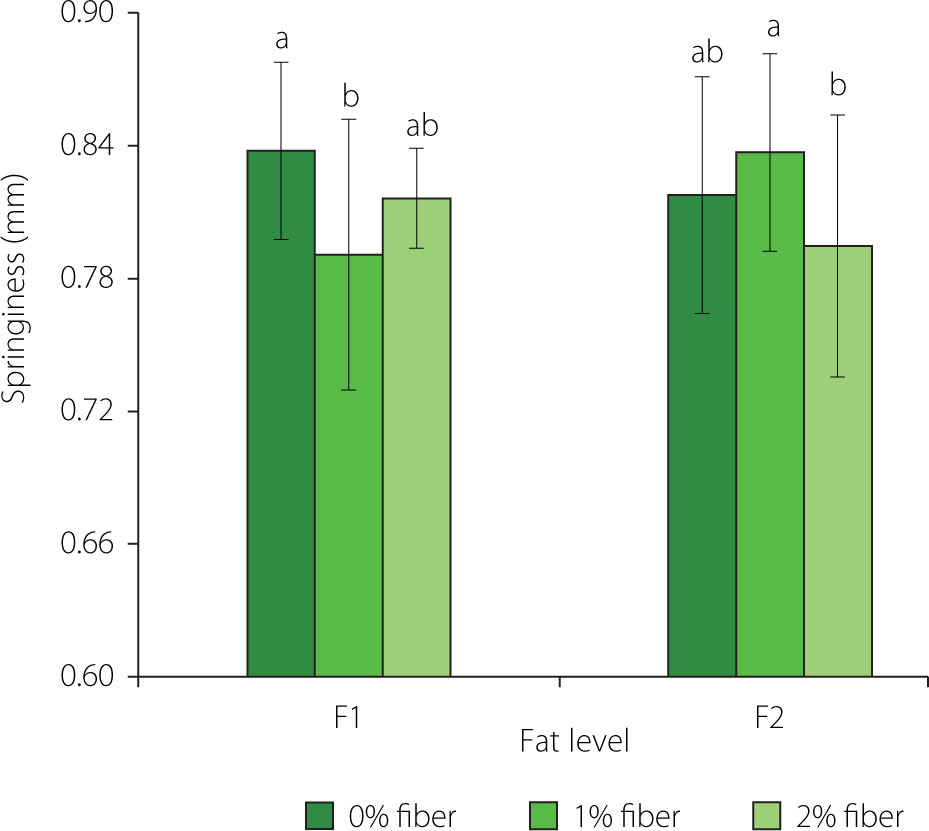
A significant interaction was detected between fat and fiber levels affecting sucuk springiness (p<0.05) (Table 5). In turn. springiness values at different fiber levels within each formulation are illustrated in Figure 3. In this case, springiness decreased with an increasing fat level when fiber was at 0% or 2% (w/w), whereas at 1% (w/w) fiber an opposite response was noted, with values increasing at F2. These findings clearly show that the effect of fiber on springiness is determined by fat content. In the study conducted by Aleson-Carbonell et al. [2003], lemon albedo was added to dry-cured sausages, reducing their springiness compared to the control sample. No difference was observed in terms of springiness among the samples with different albedo concentrations. Ruiz-Capillas et al. [2012] concluded that the use of a fat replacer in dry fermented sausages with a reduced fat content had no significant effect on the springiness of the samples.
Figure 3
Springiness of sucuk samples prepared with two fat levels, F1 (24 g fat/100 g dough) and F2 (28 g fat/100 g dough), at fiber contents of 0%, 1%, and 2% (w/w, based on dough weight). Bars represent mean values and error bars indicate standard deviation (SD). Different letters above the bars indicate statistically significant differences (p<0.05).
The significant impact of the interaction between fat level and lemon fiber level on springiness may be explained by the contrasting structural effects of fat and dietary fiber within the meat matrix. Fat tends to act as a plasticizer, weakening the protein network and thereby reducing the elastic recovery of the product. In contrast, dietary fibers can promote the formation of a denser gel matrix through water-binding and protein interaction properties, enhancing elasticity depending on their content and compatibility with the protein structure [Aleson-Carbonell et al., 2003; Ruiz-Capillas et al., 2012; Saha & Bhattacharya, 2010]. The observed pattern suggests that moderate fiber levels may optimize matrix elasticity in formulations with reduced fat, whereas excessive fiber or high fat levels may disrupt the uniformity of the protein–fiber network, leading to decreased springiness.
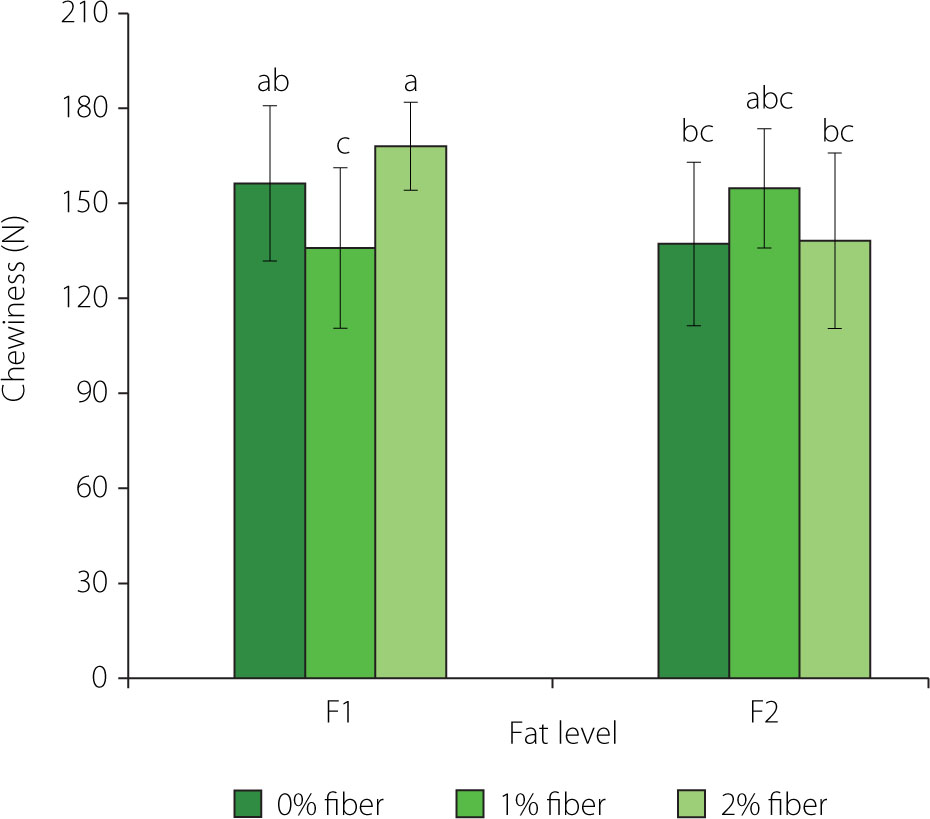
The interaction between fat and fiber levels had a highly statistically significant (p<0.01) effect on sucuk chewiness (Table 5). In turn, chewiness values at different fiber levels within each formulation are illustrated in Figure 4. Specifically, chewiness decreased from F1 to F2 when fiber was at 0% or 2% (w/w), whereas in the presence of 1% (w/w) fiber, chewiness increased under the same fat level change. The interaction yielded the highest chewiness at the F1×2% (w/w) fiber combination, whereas the same fiber level produced substantially lower chewiness at F2. Once again, the observed crossing trends emphasize that chewiness was determined by the joint influence of fat and fiber levels, and not by their main effects alone. This interaction may be attributed to the structural roles of fat and fiber within the meat matrix. The extent of this effect likely depends on the balance between fat and fiber levels, which influences water distribution and protein network density within the meat matrix [Fernández-Ginés et al., 2004; Ruiz-Capillas et al., 2012].
Figure 4
Chewiness of sucuk samples prepared with two fat levels, F1 (24 g fat/100 g dough) and F2 (28 g fat/100 g dough), at fiber contents of 0%, 1%, and 2% (w/w, based on dough weight). Bars represent mean values and error bars indicate standard deviation (SD). Different letters above the bars indicate statistically significant differences (p<0.05).
The effect of fat level, lemon fiber level, and their interaction on the cohesiveness and resilience of sucuk samples was not statistically significant (p≥0.05).
CONCLUSIONS
The study demonstrated that lemon fiber can be effectively used as a natural fat replacer in sucuk formulations. The sucuk samples with a lower fat content in the formulation (24 g fat/100 g dough) and higher lemon fiber (2%, w/w) showed the lowest cooking loss and no significant differences in physical and chemical properties or lactic acid bacteria counts compared to the other experimental formulations with different fat and fiber levels. These findings indicate that lemon fiber contributes to the development of healthier sucuk products without compromising their technological quality.
Future studies should focus on evaluating the sensory acceptability of lemon fiber–enriched sucuk using consumer panels, optimizing the level and particle size of lemon fiber for different fat levels, and investigating the synergistic effects of combining lemon fiber with other natural antioxidants or plant-based fibers. Additionally, assessing the shelf-life stability and lipid oxidation behavior under various storage conditions would provide further insights into the industrial applicability of lemon fiber in low-fat meat products.