INTRODUCTION
Whipped cream is an aerated oil-in-water (O/W) emulsion system composed of lipids, proteins, stabilizers, surfactants, and sweeteners [Zeng et al., 2022b]. The structural integrity of this foam is primarily attributed to the immobilization of air bubbles by a network of partially coalesced fat globules at the air-water interface [Goff, 1997; Turner et al., 1999]. It is widely used in bakeries as a topping for desserts, such as cakes and pies, or for hot beverages like coffee. Moreover, it also serves as a filling in pastries and imparts creaminess to parfaits and trifles [Wu et al., 2023].
Currently, the primary lipid sources for whipped cream are milk fat and hydrogenated vegetable oils. While milk fat contributes to desirable textural characteristics and structural integrity of whipped cream [Cui et al., 2025; Nguyen et al., 2015; Rybak, 2016], its high saturated fatty acid content is increasingly linked to adverse effects on cardiovascular health [Günç Ergönül & Ergönül, 2023]. Plant-based alternatives offer little improvement, as they typically rely on palm stearin or hydrogenated palm kernel oil, both of which are rich in saturated fats [Nesaretnam et al., 1993]. Furthermore, the hydrogenation process generates trans-fatty acids, a known contributor to coronary heart disease [Motamedzadegan et al., 2020]. Consequently, there is a need for alternative lipid sources that maintain the solid fat content required for partial coalescence while offering a better nutritional profile. To address this concern, the present study utilized a duck fat fraction, which was richer in unsaturated fatty acids than the fats typically used in whipped cream.
The stabilization of whipped cream rich in unsaturated fatty acids poses a significant challenge that can be overcome by using stabilizers. Inulin, the natural β (2→1) linear fructan, has gained prominence as this type of a food additive. Due to its ability to modify texture, extend shelf-life, and enhance organoleptic properties, inulin is widely utilized in products such as yogurt, ice cream, and spreads [Shoaib et al., 2016]. Its functionality is largely governed by its chain length, with shorter chains exhibiting higher water solubility than longer ones. Because of its structure, inulin easily forms hydrogen bonds and immobilizes water, which, at contents between 13% and 50%, allows the formation of a microcrystalline gel network upon shearing and cooling [Desu et al., 2025]. We hypothesize that this inulin-templated network may contribute to whipped cream stability through a dual mechanism: first, by increasing the viscosity of the aqueous phase to reduce serum drainage; and second, by forming a cohesive, three-dimensional microstructure that physically entraps and stabilizes air bubbles and fat globules. This structural reinforcement may help reduce fat globule coalescence and delay foam collapse [Athari et al., 2021; Kim et al., 2001].
Previous studies have reported that inulin can enhance the emulsification performance of protein-stabilized emulsion systems [Liu et al., 2016]. This effect has been primarily attributed to inulin’s strong water-absorbing capacity and its ability to maintain a stable hydrated network structure, which modifies water distribution in the continuous phase and modulates hydrogen bonding and van der Waals interactions among casein molecules [Nieto-Nieto et al., 2015; Xu et al., 2021]. Such interactions may induce partial unfolding of sodium caseinate structures, increasing the exposure of hydrophilic groups and thereby improving protein solubility and interfacial activity. These physicochemical modifications have been associated with improved emulsion stability in protein-polysaccharide systems, without inulin acting as a classical surface-active emulsifier [Liu et al., 2016]. Although inulin does not possess the characteristics of a conventional surfactant, it functions as an important structuring agent in the aqueous phase.
Beyond its structural contributions, inulin may provide additional nutritional value as dietary fiber with recognized prebiotic functionality. Because it resists hydrolysis in the small intestine, it is fermented by beneficial gut microbiota, such as Bifidobacterium and Lactobacillus, thereby promoting gastrointestinal health [Shoaib et al., 2016].
Although inulin has been investigated in several emulsion and dairy systems, its application in whipped cream formulated with a duck fat fraction has not been reported so far. Duck fat differs from conventional cream fats in fatty acid composition, solid fat content, and crystallization characteristics, which may pose challenges in terms of aeration, partial coalescence, and foam stability. Therefore, evaluating inulin as a stabilizer in this alternative lipid matrix represents an important research gap. The primary novelty of this study is the development of a non-dairy whipped cream formulated using an unsaturated duck fat fraction. The secondary novelty is the use of natural inulin as a stabilizer to improve rheological properties and foam stability, while also serving as a potential source of dietary fiber. Given the above, this study investigated the effects of inulin content (0–14.7% of emulsion, w/w) on physicochemical properties, rheology, overrun, foam stability, microstructure, and sensory attributes. This content range was selected based on preliminary experiments, where low levels (3.3–6.5%, w/w) showed limited viscosity enhancement, while higher levels (≈12.1%, w/w) significantly increased viscosity and structural stability. Therefore, a broad range was selected to evaluate concentration-dependent effects and identify the optimal formulation. We hypothesized that increasing inulin content would enhance structural stability and viscoelastic properties, with a critical content required to form a self-supporting network that optimizes overall product quality.
MATERIALS AND METHODS
Materials
The duck fat fraction, consisting of 47.01% of saturated fatty acids (mainly palmitic and stearic acids), 31.34% of monounsaturated fatty acids (mainly oleic acid), and 21.65% of polyunsaturated fatty acids (mainly linoleic acid), was graciously donated by Henan Huaying Cherry Valley Co., Ltd. (Xinyang, China). Mono- and diglycerides were purchased from Jialishi Additives (Hai’an) Co., Ltd. (Jiangsu, China). Natural inulin, extracted from chicory root, with a degree of polymerization ranging from 2 to 60 and purity >86% was provided by Cosucra (Warcoing, Belgium). Sodium caseinate (protein content ≥90%) was purchased from Huaan Group (Gansu, China). Guar gum was sourced from Henan Anrui Biotechnology Co., Ltd. (Zhengzhou, China). Polyglycerol fatty acid ester (hydrophilic-lipophilic balance, HLB 13) was supplied by Zhengzhou Dahe Food Technology Co., Ltd. (Zhengzhou, China). Disodium hydrogen phosphate and potassium dihydrogen phosphate were purchased from Tianjin De’en Chemical Reagent Co., Ltd. (Tianjin, China). The fluorescent dyes Nile red, Nile blue, and calcofluor white were provided by Shanghai Yuanleaf Biological Technology Co., Ltd. (Shanghai, China) and Sigma-Aldrich Shanghai Trading Co., Ltd. (Shanghai, China), respectively. A commercial milk fat-based whipped cream was purchased from Fonterra Commercial Trading Co., Ltd. (Shanghai, China). All other chemicals used were of analytical grade. Deionized water was produced using a Milli-Q water filtration system (Millipore Corporation, Milford, MA, USA).
Preparation of emulsions
Whipping cream emulsions were prepared by mixing aqueous and oil phases. To obtain aqueous mixtures, 0.5 g of sodium caseinate, 0.1 g of polyglycerol fatty acid ester with an HLB value of 13, as well as 0, 3, 6, 9, 12, or 15 g of inulin were added to 56.17 g of distilled water adjusted to pH=7.0 with potassium dihydrogen phosphate and disodium hydrogen phosphate. These amounts of inulin constituted 0%, 3.3%, 6.5%, 9.4%, 12.1%, and 14.7% of the total emulsion (w/w), respectively, and the corresponding emulsions were named IN-0, IN-3.3, IN-6.5, IN-9.4, IN-12.1, and IN-14.7, respectively. Aqueous mixtures were stirred at 60°C until complete dissolution and hydration had been achieved. The oil phase consisted of a duck fat fraction (29.5 g), which was heated to 70°C for 30 min. Mono- and diglycerides (0.5 g) were then added and allowed to dissolve completely before emulsification. A guar gum reference sample was prepared under identical processing conditions, in which inulin was replaced with guar gum (0.23 g; 0.26% of total emulsion, w/w). This level was selected based on preliminary trials, as a higher guar gum content produced excessive viscosity and impaired whipping performance. The oil phase was slowly added to the water phase and then pre-emulsified at 10,000 rpm for 3 min using a high-speed shear mixer. These emulsions were then homogenized using a high-pressure homogenizer (GJJ-0.02/60, Shanghai Noni Light Industry Machinery Co., Ltd., Shanghai, China) at 20 MPa for 3 min to obtain a fine and uniform oil-in-water emulsion. Emulsions were cooled immediately and allowed to age at 4°C for 24 h to promote fat crystallization and to stabilize prior to analysis.
Analysis of emulsion properties
Determination of particle size distribution
The particle size distributions of the emulsions were characterized by a dynamic light scattering (DLS) instrument (BeNano 90 Zeta, Bettersize Instruments Ltd., Dandong, China). Each sample was diluted 1,000-fold with deionized water prior to measurement. The optical parameters were defined with a refractive index of 1.33 for the continuous phase (water) and 1.451 for the dispersed phase, using an absorption index of 0.001. All measurements were conducted at a constant temperature of 25°C [Chen et al., 2025]. The mean particle size expressed on a volume-weighted basis (d4,3), was recorded, with all measurements conducted in triplicate.
Confocal laser scanning microscopy analysis
Microstructure analysis of emulsions and whipped foams was performed using confocal laser scanning microscopy (CLSM, Olympus FV3000, Tokyo, Japan) to observe fat globule size and network formation. The lipid phase, protein phase, and polysaccharides (inulin and guar gum) were specifically stained with Nile red (0.1%, w/w), Nile blue (0.5%, w/w), and calcofluor white, respectively. Images were captured using a 63× oil immersion objective with an additional 3× digital zoom. The excitation wavelengths were set at 635 nm for Nile red, 488 nm for Nile blue, and 432 nm for calcofluor white.
Determination of zeta potential
The surface charge of the emulsion droplets was determined by zeta potential analysis using a BeNano 90 Zeta DLS instrument (Bettersize Instruments Ltd.). To prevent multiple scattering effects, samples were diluted 1,000-fold with deionized water before measurement [Wang et al., 2023]. Data were collected in triplicate and reported as the mean values.
Determination of rheological properties
The rheological properties of the emulsions were characterized using a TA DHR-2 rheometer (TA DHR-2, Waters Corporation, Milford, MA, USA) equipped with a 40-mm parallel steel plate. All measurements were conducted at 4°C with a geometry gap of 1,000 μm. Steady-state flow tests were performed by applying a logarithmic shear rate ramp from 0.1 to 100 s–1. At each shear rate, data were recorded after a 5-s equilibrium time, followed by a 30-s averaging period. To determine the linear viscoelastic region (LVR), dynamic strain sweep measurements were conducted between 0.01% and 100% strain at a constant frequency of 1 Hz. This allowed for the characterization of the storage (G’) and loss (G’’) moduli as functions of the applied deformation [Zhang et al., 2024].
Whipped cream preparation
The aged emulsion samples were whipped using a planetary mixer (KitchenAid 5KSM3311, St. Joseph, MI, USA). Prior to whipping, both the mixing bowl and the whisk attachment were pre-cooled at 4°C for 30 min. Subsequently, 150 g of the emulsion, also pre-cooled to 4°C, was whipped at a constant speed of 1,000 rpm. The whipping process was stopped upon the formation of a smooth texture and the appearance of soft peaks on the whisk, indicating the optimal whipping time [Fredrick et al., 2013]. To minimize variability, three experimental replicates were performed by the same operator and the results were averaged.
Characterization of whipped cream
Whipping time determination
The whipping time was defined as the duration (in seconds) from the initiation of whipping at 1,000 rpm until the emulsion reached the predetermined whipping endpoint, as described in whipping cream preparation procedure.
Determination of overrun
Following the procedure established by Zeng et al. [2022a], overrun was determined by measuring the mass difference of a constant volume of the sample in its liquid and aerated states according to Equation (1):
where: w1 indicates the mass of unwhipped emulsion, while w2 represents the mass of whipped cream.Foam stability determination
The foam stability of the whipped foams was measured over time, with minimal serum drainage correlating with higher stability in the aerated system [Liu et al., 2024]. The procedure was adapted from Zeng et al. [2022b]. To this end, 20 g of freshly whipped cream were transferred to a mesh funnel and incubated at 22°C for 3 h. The percentage serum loss was calculated using Equation (2):
where: mserum represents the serum mass (g) separated from the whipped cream after 3 h, and mwhipped cream refers to the initial mass (g) of the whipped cream.Analysis of microstructure of whipped cream
The whipped foam microstructure was examined using a polarized light microscope (PLM, XPV-203, Changfang Optical Instrument Co., Ltd., Shanghai, China). Samples obtained at the optimal whipping time were placed on a glass slide with a coverslip and visualized at 40× magnification to analyze the size and distribution of air bubbles.
Visualization of whipped cream decorative appearance imaging
The retention of decorative shape was assessed using a standard piping method. Freshly whipped samples were piped into uniform rosettes on a flat surface using a pastry bag equipped with a closed-star tip. The rosettes were then subjected to a stability test in an environmental chamber set at 22°C. To observe shape change over time, digital images were captured immediately after piping and following a 3-h holding period.
The internal stability of the whipped cream was evaluated by examining the surface topography of a cut section. Freshly whipped samples were first shaped into a mound and equilibrated at 25°C for 1 h. Subsequently, the mound was sectioned with a metal scraper. The resulting cross-section was immediately photographed under standardized lighting conditions to capture its texture.
Sensory evaluation
Sensory evaluation was conducted using a descriptive analysis approach from Ma et al. [2025] with minor modifications. Twenty trained panellists (10 men and 10 women, aged 22–40 years) were recruited from postgraduate students and staff members of the College of Food and Bioengineering, Henan University of Science and Technology, China. All panellists were regular consumers of dairy or whipped cream products and had previous experience in sensory evaluation. Prior to the test, the panellists had two orientation sessions to familiarize themselves with the evaluation attributes, scoring criteria, and reference standards. Individuals with known dairy allergies, impaired taste or smell perception, smoking habits, or recent illness affecting sensory perception were excluded. Freshly prepared whipped cream samples were labeled with random three-digit codes and presented to the panellists in randomized order to minimize bias. Approximately 10 g of each sample were served at 8±1°C in identical odorless cups. Sensory evaluations were conducted in individual booths under standardized white lighting at 22±2°C. Panellists were provided with drinking water to cleanse their palates between successive samples. They rated each sample on a 10-point intensity scale for four key sensory attributes: (a) smoothness (extremely smooth, 10–8; a little coarseness, 7–5; much harshness, 4–1); (b) texture (melts in the mouth, 10–8; weak and fluffy, 7–5; grainy, 4–1); (c) greasiness (no greasiness, 10–7; heavy greasiness, 6–1); (d) flavor and taste (no criticism, 10; delicate flavor, 9–7; lack of flavor, 6–4; other defects, 3–1). These attributes were selected based on the key quality characteristics of whipped cream and preliminary screening trials.
Statistical analysis
Experiments were performed in triplicate, and data are reported as mean and standard deviation. One-way analysis of variance (ANOVA) and Tukey’s post hoc tests were applied to determine significant differences between samples using IBM SPSS Statistics for Windows, Version 27.0 (IBM Corp., Armonk, NY, USA). Differences were considered significant at p<0.05.
RESULTS AND DISCUSSION
Emulsion properties
Particle size distribution of emulsions
The stability of cream emulsions is significantly affected by particle size distribution, which is also an important parameter influencing the whipping properties of cream [Wang et al., 2023]. The particle size distribution and volume weighted mean diameters (d4,3) of duck fat-based emulsions stabilized by varying inulin contents, guar gum, and commercial whipped cream (CWC) are presented in Figure 1. As the inulin content increased from 0% to 12.1% (w/w), the mean particle size increased significantly from 0.761 μm (IN-0) to 1.106 μm (IN-12.1), before decreasing to 0.855 μm at 14.7% (w/w) inulin (IN-14.7). Guar gum reference sample (GG-0.26) showed an intermediate d4,3 value of 0.943 μm, while the CWC sample exhibited the finest dispersion, with a mean diameter of 0.739 μm.
Figure 1
Particle size distribution and volume-weighted mean particle diameter (d4,3) of duck fat-based cream emulsions formulated without inulin (IN-0), with inulin content ranging from 3.3% to 14.7%, w/w, (IN-3.3–IN-14.7), and with guar gum (GG-0.26), as well as a commercial whipping cream emulsion (CWC). Results of d4,3 are shown as mean ± standard deviation. Different superscript letters (a–f) indicate significant differences among emulsions (p<0.05).
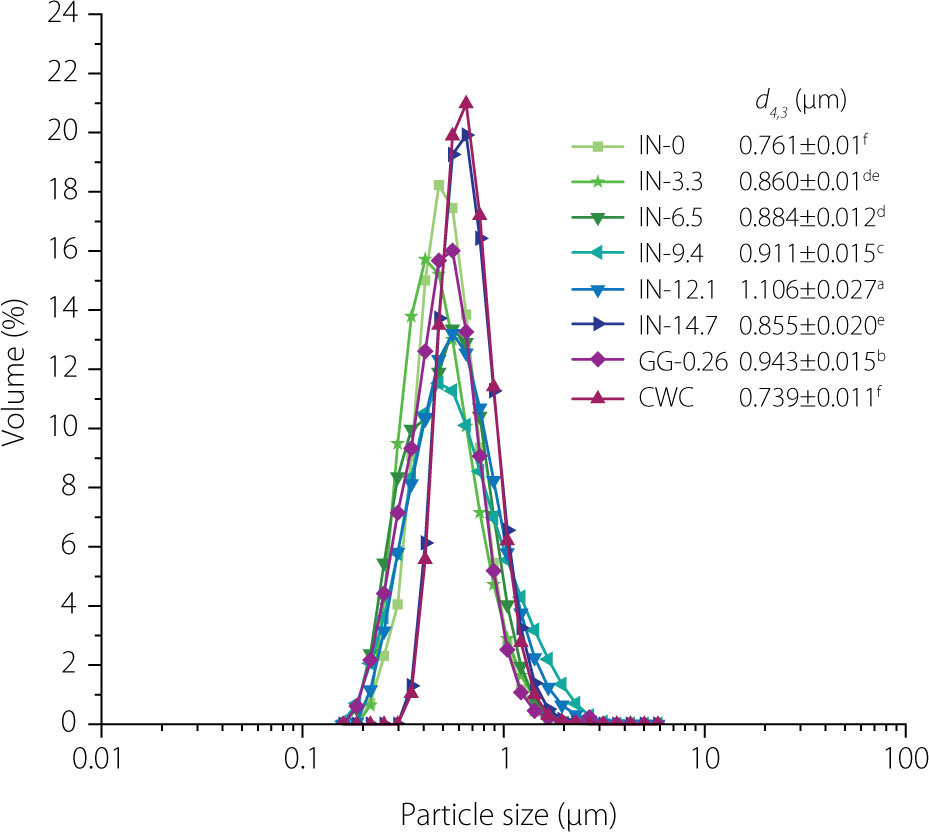
The increase in particle size up to 12.1% (w/w) inulin suggests enhanced droplet-droplet interactions and partial aggregation. This phenomenon may be explained by a bridging flocculation mechanism, where chains in the continuous phase associate with the surfaces of fat droplets, promoting the formation of flocs and increasing the effective droplet size. Bridging phenomena of this type are well-described for protein-stabilized emulsions in the presence of non-adsorbing or partially adsorbing polysaccharides [Dickinson, 2003]. Analogous concentration-dependent effects have been reported in protein-stabilized Pickering emulsions and inulin-containing salad dressings, where moderate polysaccharide levels promote droplet association once the protein surface coverage becomes incomplete [Li et al., 2024; Sinsuwan, 2024].
At the higher inulin content (14.7%, w/w), the decrease in d4,3 indicates a transition from bridging to steric stabilization. The high content of inulin likely promoted the formation of a dense, viscoelastic microgel network in the continuous phase [Kim et al., 2001; Shoaib et al., 2016] as corroborated by the sharp increase in viscosity and moduli. This network impedes droplet movement and coalescence through a combination of steric hindrance and increased continuous phase viscosity leading to a finer and more stable dispersion [Ai, 2023].
The corresponding shift in particle size distribution supports the formation of a structured, immobilized system. The guar gum reference sample exhibited a relatively narrow particle size distribution, reflecting the strong thickening efficiency of guar gum even at a low content. In contrast, the fine and uniform droplets observed in CWC likely reflect optimized industrial homogenization and formulation conditions.
Overall, inulin levels play a part in governing the microstructure of duck fat-based emulsions. Moderate inulin levels promote bridging flocculation, while higher levels (>14.7%, w/w) stabilize the emulsion through bulk network formation.
Microstructure of emulsions determined by confocal laser scanning microscopy
Distribution of fat droplets (red) and proteins (green) in an emulsion under CLSM can be observed in Figure 2. Under consistent magnification, fat droplets were observed to be encapsulated by a protein-rich interface (green), forming a protective barrier essential for preventing coalescence and ensuring emulsion stability. While the fat globules exhibited spherical morphologies of varying sizes across all samples, their spatial distribution remained relatively uniform. The high protein density at the interface may provide robust stabilization against droplet aggregation. Additionally, the presence of some irregularly shaped globules in all emulsions may be attributed to pressure fluctuations during high-pressure homogenization. Inadequate pressure may lead to incomplete fragmentation of fat globules, whereas excessive pressure may result in irregularly shaped globules [Dhungana et al., 2020; Panchal et al., 2017].
Figure 2
Confocal laser scanning microscopy (CLSM) images of duck fat-based cream emulsions formulated without inulin (IN-0), with inulin content ranging from 3.3% to 14.7%, w/w, (IN-3.3–IN-14.7), and with guar gum (GG-0.26), as well as commercial whipping cream (CWC). Fat and protein phases are stained in red and green, respectively, illustrating the microstructural organization of the emulsions. Scale bar is 10 μm.
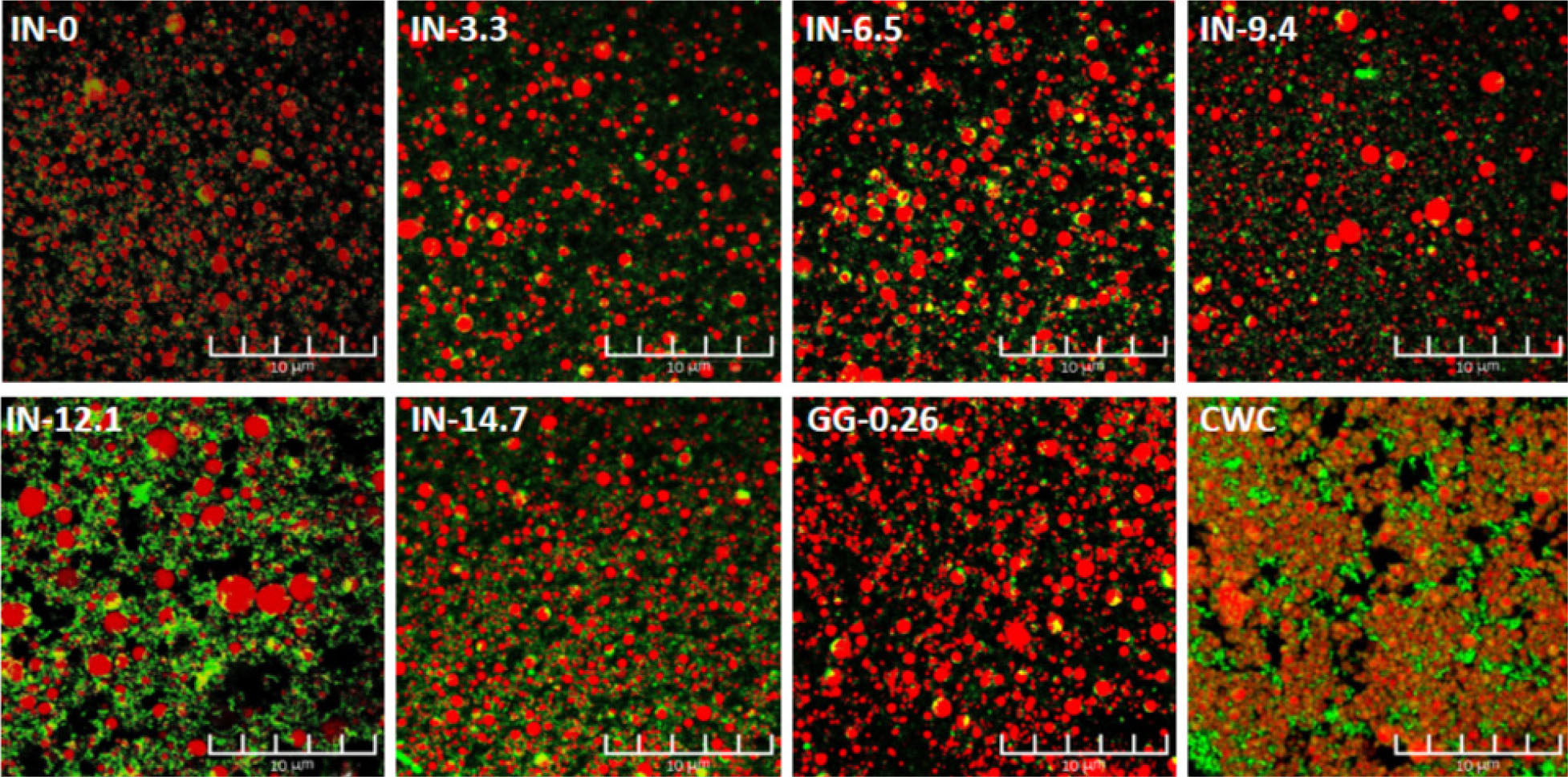
With an increase in inulin content until reaching 12.1% of emulsion (w/w), the fat globule size continued to increase. However, the fat globule size observed in IN-14.7 was smaller than that of IN-12.1. As discussed in the particle size distribution section, steric hindrance may have occurred in sample IN-14.7; therefore, the decrease in fat globule size could be attributed to this effect. Specifically, the reduction in fat globule size in sample IN-14.7 can be attributed to the enhanced steric repulsion provided by the inulin-rich continuous phase. At this concentration, inulin may form a dense network that effectively isolates fat droplets, preventing coalescence [Torres et al., 2010]. As a result, the IN-14.7 sample exhibited a homogeneous dispersion of discrete, spherical droplets with clear boundaries and no visible aggregates. This microstructure is characteristic of systems stabilized by a structured continuous phase [Franck, 2002]. In contrast, sample GG-0.26 exhibited relatively larger globules, which may reflect the strong water-binding and thickening properties of guar gum that modify droplet organization within the matrix.
Zeta potential
The zeta potential reflects the surface charge of the droplets and influences the electrostatic interactions contributing to emulsion stability [Cai et al., 2022]. As shown in Figure 3, all samples demonstrated strongly negative zeta potential ranging from −44 mV to −53 mV, with the absolute values generally increasing with an increasing inulin content in the duck fat-based emulsions. Sample IN-14.7 exhibited the highest absolute zeta potential, suggesting improved colloidal stability, which is consistent with the particle size results. Sample GG-0.26 showed a zeta potential of approximately −49 mV, which was statistically comparable to that of several inulin-containing samples, indicating that both hydrocolloids maintained a stable dispersed system under the tested conditions. However, as a neutral, non-ionic polysaccharide, inulin lacks a surface charge and is generally considered non-surface-active [Kim et al., 2001]. Therefore, the observed increase in the negative charge magnitude is likely an indirect effect rather than a result of inulin adsorption. It is hypothesized that inulin modulates the molecular environment and hydration of the sodium caseinate layer at the oil-water interface. This interaction may induce partial unfolding of the protein chains, exposing more negatively charged amino acid residues and thus increasing the measured surface potential [Nieto-Nieto et al., 2015; Xu et al., 2021]. Similarly, guar gum is also a non-surface-active polysaccharide, and its stabilizing effect is unlikely to arise primarily from direct interfacial charging.
Figure 3
Zeta potential of duck fat-based cream emulsions formulated without inulin (IN-0), with inulin content ranging from 3.3% to 14.7%, w/w, (IN-3.3–IN-14.7), and with guar gum (GG-0.26), as well as a commercial whipped cream (CWC). Different lowercase letters (a–c) indicate significant differences among emulsions (p<0.05).
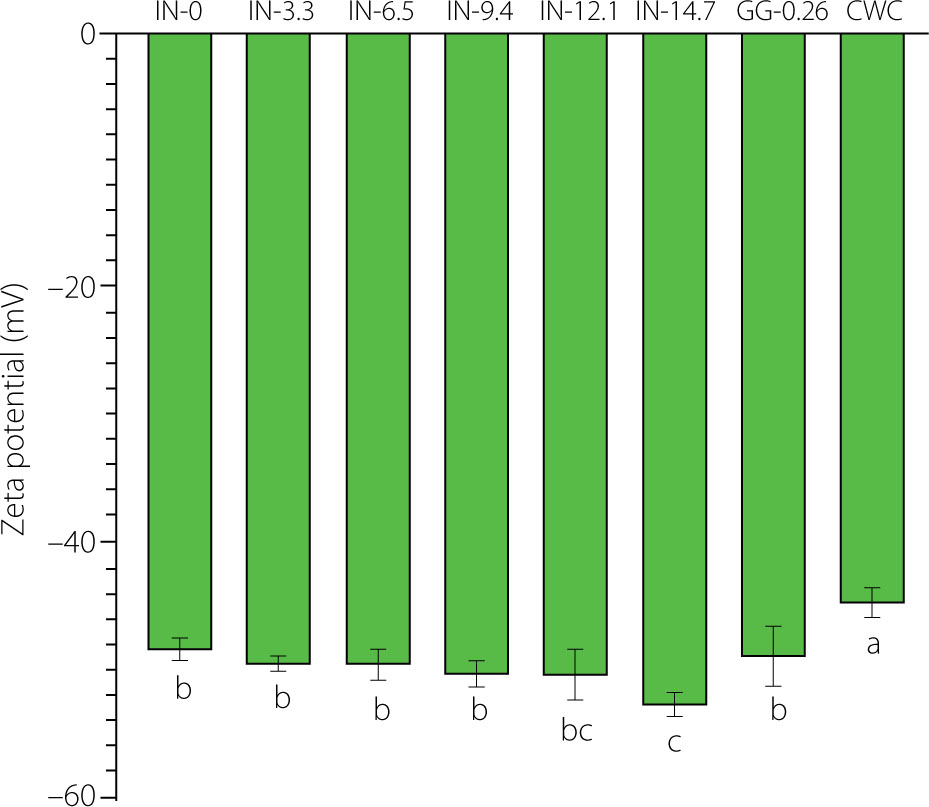
The enhanced stability may be partly due to steric stabilization and aqueous-phase structuring. Inulin may provide stability through steric hindrance, where its hydrated polymer chains form a physical barrier that prevents fat globule proximity and coalescence [Clements, 2005]. This mechanical stabilization, combined with the microcrystalline gel network formed in the continuous phase, effectively preserves the structural integrity of the system irrespective of the direct interfacial charge.
Rheological properties
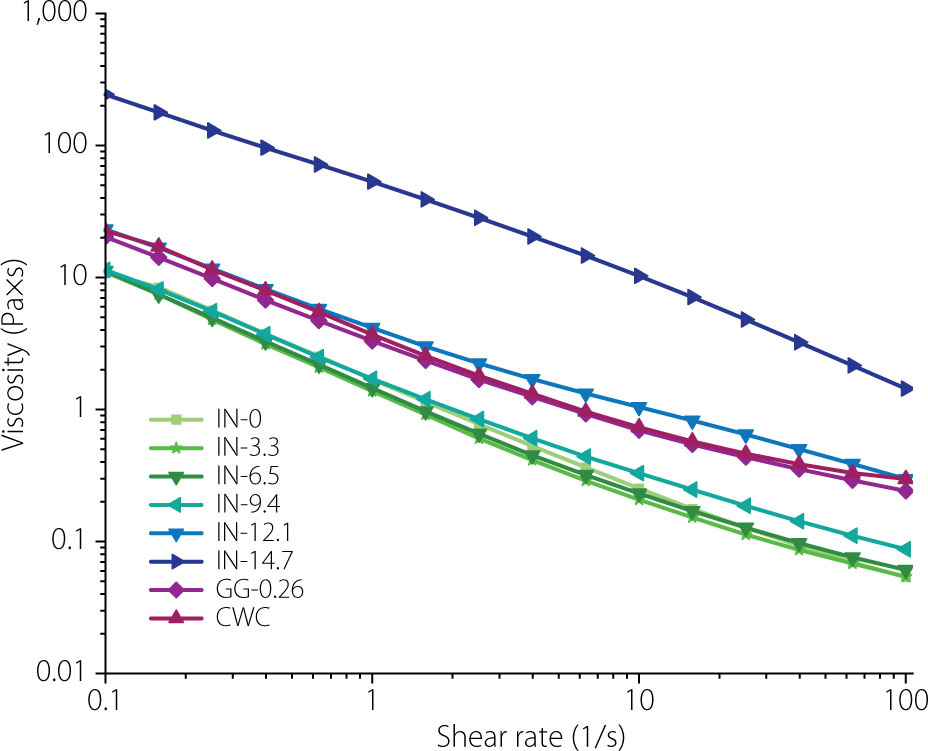
Rheological behavior of an emulsion is an important factor that determines product stability and final texture [Zhang et al., 2024; Zhao et al., 2009]. An optimal viscosity range is critical; excessive viscosity impedes air incorporation and fat globule movement during whipping, while low viscosity promotes bubble coalescence and reduces structural integrity under stress [Rezvani et al., 2020]. As shown in Figure 4, all emulsions exhibited shear-thinning behavior, where viscosity decreased with increasing shear rate. This characteristic is typical of structured fluids, where applied shear disrupts intermolecular interactions and aligns particles, thereby reducing flow resistance [Ningtyas et al., 2021]. The zero-shear viscosity (η₀), indicative of the emulsion’s structure at rest, increased markedly with inulin content (Figure 4). A significant increase was observed from 10.9 Pa×s for IN-0 to 23.1 Pa×s for IN-12.1 at 0.1 s–1, suggesting that inulin reinforced the emulsion network, enhancing its resistance to serum separation under quiescent conditions [Dabo et al., 2024]. This trend aligns with reports of inulin’s concentration-dependent thickening effect in protein-stabilized emulsions [López-Castejón et al., 2019]. At intermediate inulin levels (3.3–9.4%, w/w), the increase in viscosity was less pronounced, suggesting that lower inulin levels had a limited impact on rheological behavior [Franck, 2002]. A substantial change occurred at 14.7% (w/w) inulin content (IN-14.7), where η₀ increased to 243.3 Pa×s. This sharp increase in viscosity may indicate the formation of a continuous gel-like network [Kim et al., 2001]. The guar gum-stabilized sample displayed a viscosity profile between IN-9.4 and IN-12.1, confirming its efficacy as a thickener at low usage levels. Notably, the CWC sample exhibited a viscosity similar to IN-12.1, suggesting that moderate inulin levels may effectively replicate the rheological properties of commercial stabilizer blends.
Figure 4
Viscosity as a function of shear rate for duck fat-based whipping emulsions formulated without inulin (IN-0), with inulin content ranging from 3.3% to 14.7%, w/w, (IN-3.3–IN-14.7), and with guar gum (GG-0.26), as well as a commercial whipping cream emulsion (CWC).
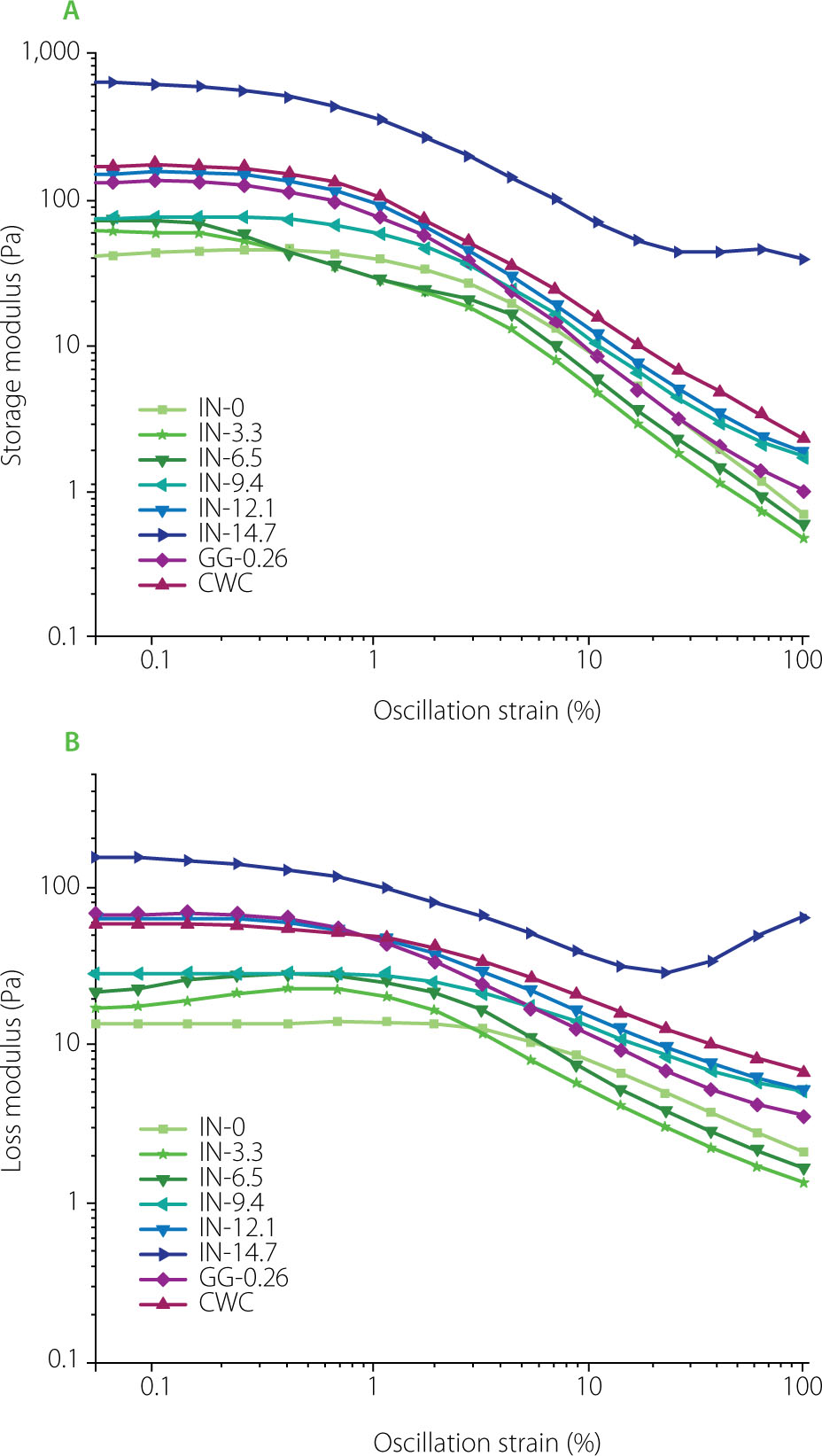
Oscillatory strain sweep tests were performed to determine the linear viscoelastic region (LVR) of the emulsions. As shown in Figures 5A and 5B, the storage modulus (G’) remained higher than the loss modulus (G’’) across the tested strain range for all samples, indicating predominantly elastic (solid-like) behavior. Both G’ and G’’ increased with an increasing inulin content, suggesting enhanced structural integrity and viscoelastic properties of the emulsions. This trend supports the role of inulin in reinforcing the emulsion network and increasing resistance to deformation under oscillatory stress, which is consistent with previous reports describing the thickening effect of inulin on viscoelastic moduli [López-Castejón et al., 2019]. Sample IN-14.7 exhibited the highest G’ value, indicating the formation of a highly rigid network, which is consistent with the gelation behavior of inulin at elevated concentrations [Kim et al., 2001]. In contrast, samples IN-0, IN-3.3, and IN-6.5 exhibited low critical strain values, indicating weak structures that may break down under minimal deformation. On the other hand, samples IN-9.4, IN-12.1, GG-0.26, and CWC showed a significantly wider LVR, withstanding strains above 10–20% before yielding. This indicates the presence of cohesive and deformation-tolerant networks capable of maintaining structural integrity under greater strain. The rheological behavior of GG-0.26 and CWC showed similar trends to that of IN-12.1, suggesting that a moderate level of inulin can provide favorable viscoelastic properties within the range observed for the guar gum reference and the commercial whipped cream sample. However, this comparison is limited to the rheological parameters evaluated in the present study and does not imply full equivalence in overall product performance or composition.
Figure 5
(A) Storage modulus (G’) and (B) loss modulus (G’’) as a function of strain for duck fat-based cream emulsions formulated without inulin (IN-0), with inulin content ranging from 3.3% to 14.7%, w/w, (IN-3.3–IN-14.7), and with guar gum (GG-0.26), as well as commercial whipping cream sample (CWC).
Whipped cream properties
Whipping time and overrun
Whipping time plays a significant role in determining the partial coalescence of whipped cream [Nguyen et al., 2015]. A clear concentration-dependent increase in whipping time was observed, as shown in Table 1. Increasing inulin content from 0% to 14.7% (w/w) lengthened the time required to achieve stiff peaks from 106 s to 316 s. This trend can be attributed to inulin-induced rheological modifications, as discussed in the rheological properties section. The higher viscosities observed in inulin-added samples prevent the partial coalescence of fat globules and thus increase the whipping time [Wang et al., 2023]. Sample GG-0.26 showed similar effects by increasing viscosity and delaying coalescence, but primarily through phase thickening rather than network formation. The continuous increase in viscosity and stronger gel network with increasing inulin content physically resists air incorporation during whipping. In addition, a more viscous and structured continuous phase can slow whisk movement, restrict droplet interactions, and hinder liquid drainage from lamellae surrounding air bubbles, all of which may contribute to longer whipping times [Liu et al., 2024; Rezvani et al., 2020].
Overrun is a key indicator of whipping performance, reflecting the extent of air incorporation and the resulting increase in volume [Liu et al., 2024]. In this study, overrun was significantly influenced by inulin content, showing a clear inverse relationship. As inulin content increased from 0% to 14.7% (w/w), overrun decreased significantly from 330% to 169% (Table 1). At lower contents (0–6.5%, w/w), inulin had a minimal impact on overrun; however, at higher contents (9.4–14.7%, w/w), it significantly reduced the overrun. This can be attributed to the formation of a highly viscous network at a higher inulin content, which restricts air incorporation. In samples IN-12.1 and IN-14.7, the strengthened network limited air entrapment during whipping. Additionally, inulin at higher levels may compete with surface-active components at the fat droplet interface, reducing interfacial stabilization and promoting coalescence, thereby hindering air incorporation [Liu et al., 2024]. Interestingly, sample IN-12.1 exhibited overrun values statistically comparable to GG-0.26 and commercial whipped cream, indicating an optimal balance between structure formation and air incorporation. This suggests that both inulin (at optimal content) and guar gum can enhance structural stability without excessively compromising air incorporation, although their mechanisms differ. Guar gum primarily increases viscosity through hydrocolloid thickening, whereas inulin contributes to network formation and fat structuring. At the 12.1% (w/w) inulin level, the network provided sufficient rigidity to stabilize air cells without excessively limiting their formation, as also supported by rheological and microstructural observations. In contrast, sample IN-14.7 presented an over-stabilized system, characterized by prolonged whipping time and reduced overrun.
Table 1
Optimum whipping time, overrun, and serum loss for duck fat-based whipped cream samples formulated without inulin (IN-0), with inulin content ranging from 3.3% to 14.7%, w/w, (IN-3.3–IN-14.7), and with guar gum (GG-0.26), as well as a commercial whipped cream (CWC).
The whipping properties of duck fat-based cream were negatively impacted by the higher inulin levels, resulting in extended whipping time and decreased overrun. This inverse correlation is consistent with the findings of Camacho et al. [1998], who showed that the addition of hydrocolloids to whipped cream increased the cream’s elastic properties during whipping, which resulted in lesser air incorporation, longer whipping time, and reduced overrun [Camacho et al., 2001]. It should be noted that when no inulin was added or when the added level was low, although the foaming rate during whipping was high and the whipping time was short, the bubbles in the system were large, uneven, and had defects such as easy collapse.
Serum loss
Foam stability depends on the physical and rheological properties of the interface and the continuous phase. Factors such as air bubble size distribution, interface thickness, surface tension, and interface permeability all have an obvious impact on foam stability [Kováčová et al., 2010], which can be additionally determined by the level of serum loss. A lower level of serum loss indicates high foam stability [Liu et al., 2024]. An increase in inulin content significantly reduced the serum loss after 3 h of storage at 22°C, as demonstrated in Table 1. Samples with inulin contents up to 9.4%, w/w, (IN-0 to IN-9.4) showed considerable serum loss, ranging from 6.92% to 5.19%. This could be attributed to the lower viscosities of these samples which allow a large number of air bubbles to be incorporated during whipping, resulting in sample instability [Ma et al., 2025]. At higher inulin contents (IN-12.1 and IN-14.7), excellent stabilization was achieved, as these samples exhibited complete stability with no measurable serum loss (0.00%) under the tested conditions. This improvement may be associated with the formation of a stronger continuous network with enhanced water-immobilization capacity. The higher viscosities observed for samples IN-12.1 and IN-14.7, together with the solid-like behavior (G’>G”), confirm the formation of a gel structure characterized by high water-holding capacity [Kim et al., 2001; Shoaib et al., 2016]. The inulin gel forms a physical barrier that immobilizes the aqueous phase, consequently inhibiting drainage and syneresis under the influence of gravity [Bot et al., 2004; Desu et al., 2025]. When compared with control samples GG-0.26 and CWC, IN-12.1 and IN-14.7 exhibited better foam stability. The serum loss observed in GG-0.26 and CWC was 4.53% and 12.43%, respectively, whereas samples IN-12.1 and IN-14.7 showed no serum loss under the same tested conditions. This highlights the efficiency of inulin as a stabilizer in duck fat-based whipped cream system. These findings enable concluding that inulin, like other polysaccharides, stabilizes the three-phase system, which is consistent with other polysaccharide applications in whipped cream [Farahmandfar et al., 2017; Kováčová et al., 2010]. The use of polysaccharides as stabilizers in whipped creams enhances the viscosity of the continuous phase and forms a network structure. This network ensures foam stability by reducing bubble coalescence and disproportionation, thereby reinforcing the interfacial walls and preventing serum drainage.
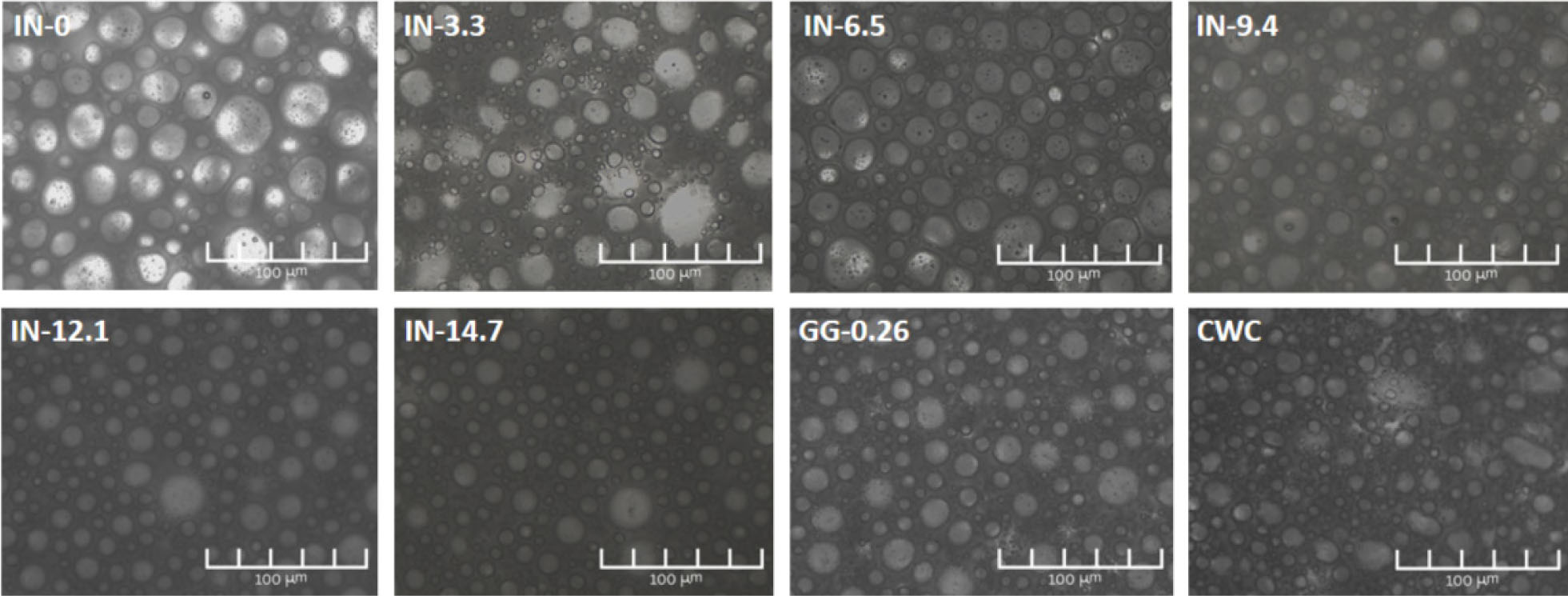
Microstructure of whipped cream by optical microscope
The stability of whipped cream is strongly influenced by the size and distribution of air bubbles [Liu et al., 2022]. Microstructure analysis using an optical microscope revealed that increasing the inulin content resulted in a more uniform distribution of air bubbles (Figure 6). The negative control sample (IN-0) showed the largest foam size and the loosest bubble distribution. Sample GG-0.26 showed a heterogeneous bubble-size distribution, containing both large and small air bubbles. Similarly, the whipped cream samples IN-3.3, IN-6.5, and IN-9.4 exhibited larger and unevenly distributed air bubbles, indicating the formation of a weak interfacial film and insufficient stabilization of the incorporated air. Larger bubbles generate higher internal pressure, making them more prone to coalescence, which may explain the greater serum loss observed in these samples. With an increase in inulin content, a corresponding decrease in bubble size was observed, accompanied by a more uniform distribution of air bubbles. It is worth noting that samples IN-12.1 and IN-14.7 showed the smallest bubble sizes, with a close and even distribution. Small bubble size has been associated with improved longterm foam stability in hydrophilic colloid systems [Zhan et al., 2020]. At higher inulin contents, the formation of a continuous and flexible inulin network within the aqueous phase likely increased viscosity, thereby providing a structural framework that stabilized air bubbles and reduced coalescence and drainage. Overall, the microstructure analysis suggests that an adequate inulin level (>12.1%, w/w) is required to produce a fine and uniform air-cell structure.
Figure 6
Optical microscopy images (40× magnification) of duck fat-based whipped cream samples prepared without inulin (IN-0), with inulin content ranging from 3.3% to 14.7%, w/w, (IN-3.3–IN-14.7), and with guar gum (GG-0.26), as well as a commercial whipped cream (CWC), showing the distribution and size of air bubbles within the foam structure. The scale bar is 100 μm.
Confocal laser scanning microscopy images of whipped cream
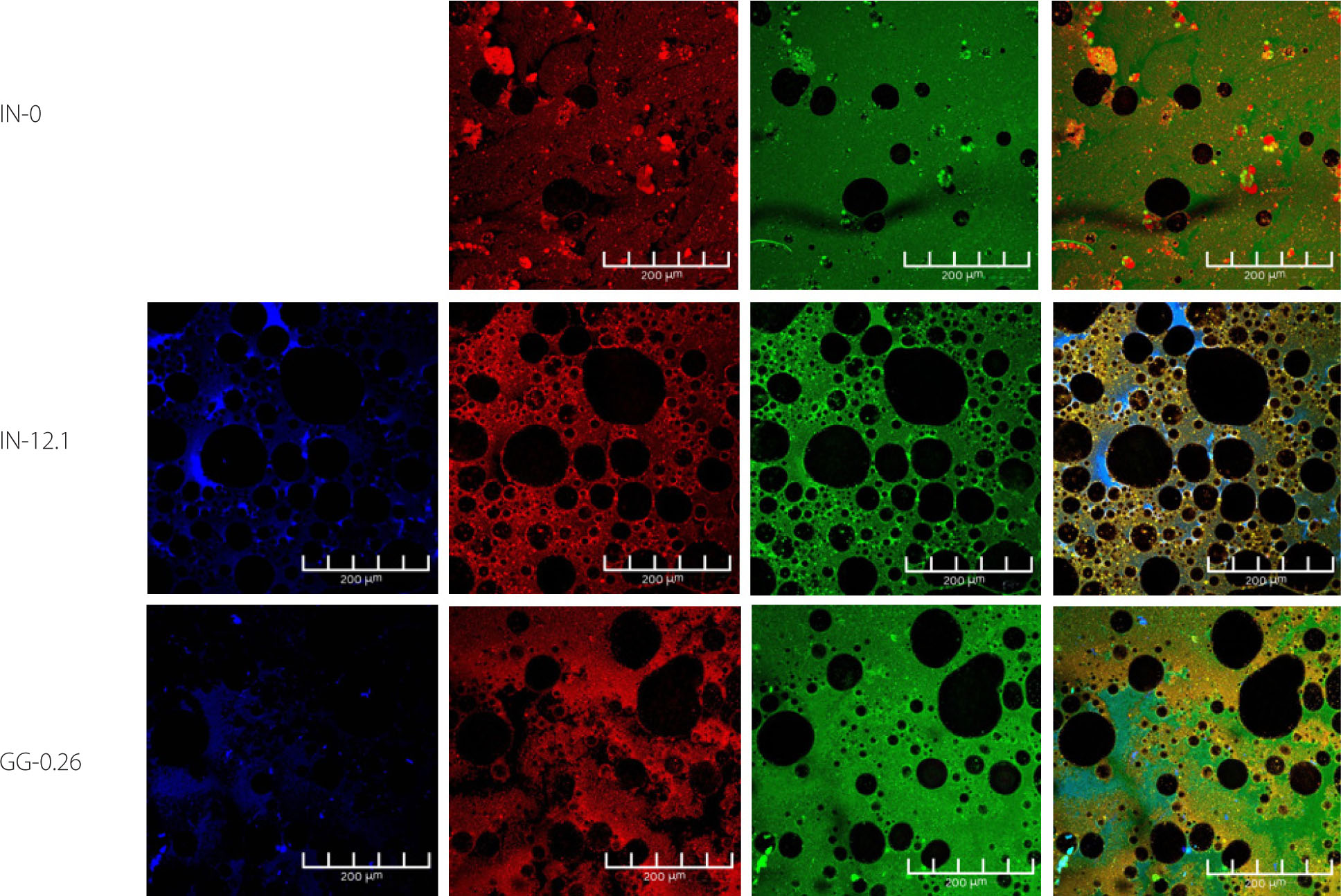
As shown in Figure 7, the negative control sample (IN-0) exhibited irregular air bubbles stabilized by a protein layer at the interface, with several fat globules forming clumps. This underdeveloped structure accounts for its poor stability. While intermediate inulin contents (IN-3.3, IN-6.5, and IN-9.4) exhibited a gradual structural transition (images not shown), the IN-12.1 sample was selected as the representative stabilized model, as it showed the most distinct shift toward uniform, spherical air bubbles. This phenomenon could be attributed to the enhanced structuring effects of inulin within the continuous phase. Notably, sample IN-12.1 exhibited a prominent interfacial film stabilized by sodium caseinate alongside a three-dimensional network of inulin aggregates within the continuous phase. These structural features suggest that IN-12.1 possesses superior mechanical strength and enhanced foam stability, as corroborated by its rheological properties and favorable decoration performance. Furthermore, un-adsorbed proteins observed in the continuous phase may aggregate, further strengthening the network structure [Xu et al., 2021]. In contrast, the guar gum reference sample did not exhibit the same degree of integrated interfacial and continuous-phase structuring under the observed conditions.
Decoration appearance and cross section
The ability of whipped cream to maintain its decorative shape over time is a critical quality attribute for applications in cakes and pastries. As illustrated in Figure 8, sample IN-0 exhibited the poorest shaping ability, indicating that the internal network structure was inadequate to withstand gravitational stress. The shaping performance of samples IN-3.3, IN-6.5, and IN-9.4 improved progressively. Although only slight differences were observed in viscosity among these samples, a clear improvement in shape retention from IN-0 to IN-9.4 was evident, suggesting that inulin contributed to a more cohesive structure even at relatively low levels. The shaping ability was enhanced, and the structural definition improved as the inulin content increased from 0 to 14.7% (w/w). The enhanced shaping feature can be attributed to the ability of inulin to form a three-dimensional gel network, which provides the structural support and textural stability to whipped cream [Kim et al., 2001]. Samples IN-12.1 and IN-14.7 had sharp edges that were well-defined and remained in a rosette-like structure immediately upon piping, and retained their structural integrity without any slumping or serum loss after 3 h at 22°C. These observations are consistent with the results of rheological and microstructural analyses, which indicated increased continuous-phase structuring at higher inulin contents, contributing to a self-supporting matrix. Samples IN-6.5 to IN-14.7 showed no collapse after 3 h at 22°C. A higher inulin content likely increased viscosity and strengthened the network, improving foam stability and resistance to collapse [Farahmandfar et al., 2017]. Although the guar gum reference sample and commercial whipped cream initially formed rosettes with well-defined spikes, both exhibited noticeable structural deterioration after 3 h. The GG-0.26 sample lost much of its spike definition, whereas the CWC sample showed pronounced slumping and a visible reduction in height.
Figure 8
Decorative appearance of duck fat-based whipped cream samples prepared without inulin (IN-0), with inulin content ranging from 3.3% to 14.7%, w/w, (IN-3.3–IN-14.7), and with guar gum (GG-0.26), as well as commercial whipped cream (CWC), evaluated immediately after whipping (fresh) and after 3 h of storage at 22°C. Cross-sectional images illustrate structural integrity and internal texture as influenced by stabilizer type and inulin content.
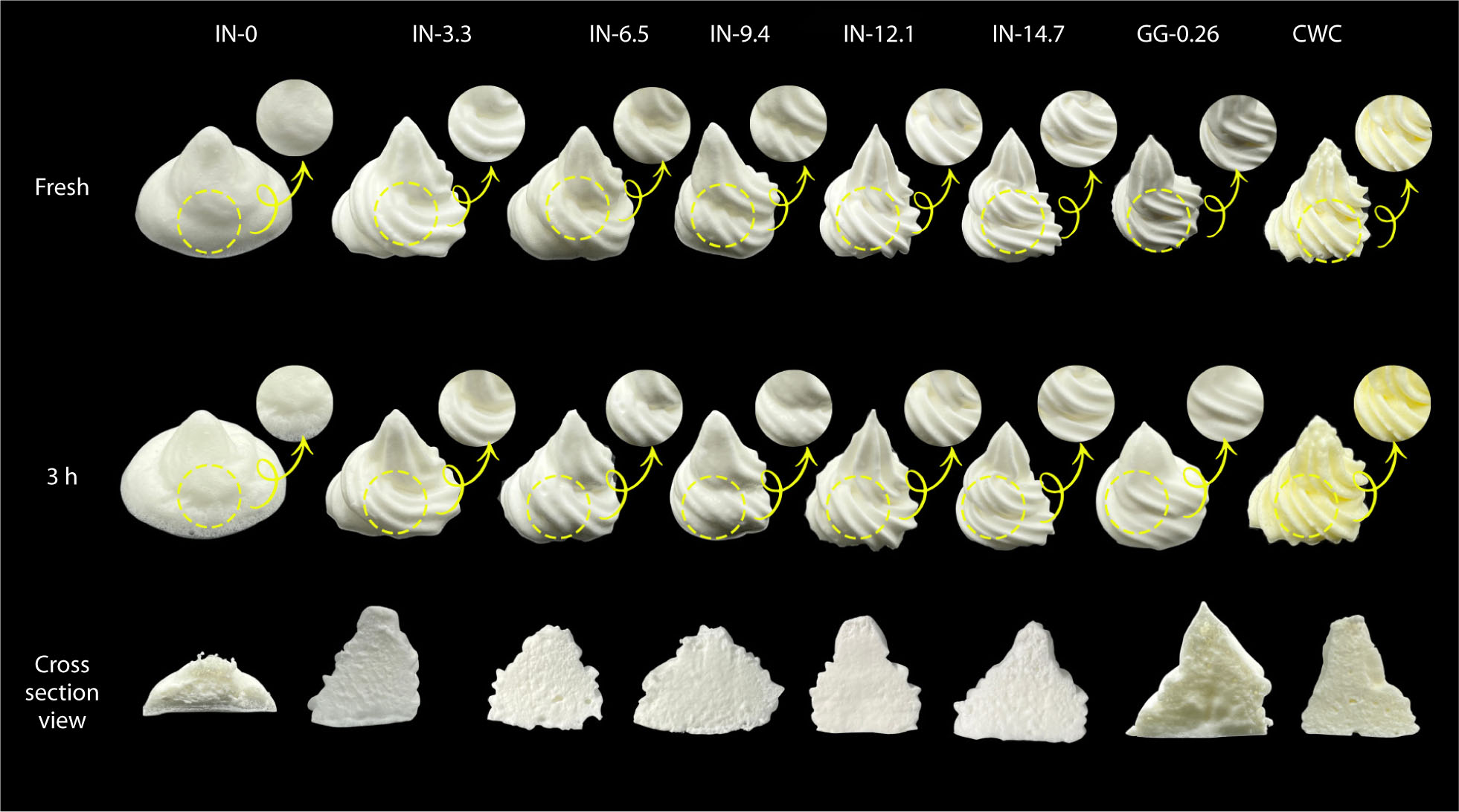
As shown in Figure 8, the cross-sectional analysis of the whipped cream samples further supports the role of inulin as a potential stabilizing and structuring ingredient. Sample IN-0 exhibited a rough, irregular surface, indicating the formation of weak internal networks and large, unstable air cells. In contrast, an increase in inulin content from 0% to 14.7% (w/w) resulted in a uniform, smooth, and delicate cross-sectional view, which was even better than that of the control samples (GG-0.26 and CWC). The appearance of the cross-section can indicate the stability of whipped cream, with smoother and more uniform surfaces often correlating with greater structural integrity [Li et al., 2023; Zeng et al., 2022b].
Sensory evaluation
Sensory scores were significantly (p<0.05) affected by inulin content in the duck fat-based whipped cream (Table 2). All evaluated attributes, including flavor and taste, texture, smoothness, and greasiness, improved progressively as the inulin level increased from 0% to 14.7% (w/w). Sample IN-0 received the lowest scores across all attributes, consistent with its weak rheological structure, poor foam stability, and coarse microstructure. These properties likely resulted in a rough mouthfeel and lower overall acceptability. Samples containing moderate to high inulin levels (IN-9.4 to IN-14.7) showed significantly higher scores, particularly for texture and smoothness. This trend was consistent with increased viscosity, stronger viscoelastic behavior, reduced serum loss, and finer air-bubble distribution, indicating that improved structural stability enhanced sensory perception. Among the experimental samples, IN-12.1 and IN-14.7 achieved the highest sensory ratings, with no significant differences between them (p≥0.05). Their superior performance was likely associated with the formation of a stronger inulin-stabilized network, which provided a creamier texture, smoother mouthfeel, and lower greasy sensation. The guar gum sample (GG-0.26) showed intermediate scores, lower than IN-12.1 and IN-14.7, suggesting that inulin was more effective than guar gum in enhancing sensory quality under the tested conditions. Although the commercial whipped cream (CWC) obtained the highest scores overall, the addition of 12.1–14.7% (w/w) inulin significantly improved the sensory quality of the duck-fat-based whipped cream relative to the lower-inulin formulations. Overall, the sensory assessment results were consistent with the instrumental findings, confirming that improvements in rheological and microstructural properties contributed to enhanced product acceptability. It should be noted that the experimental samples were formulated without added flavoring agents. Future research should investigate appropriate flavor optimization strategies to further enhance sensory acceptability.
Table 2
Sensory evaluation scores of duck fat-based whipped cream samples prepared without inulin (IN-0), with inulin content ranging from 3.3% to 14.7%, w/w, (IN-3.3–IN-14.7), and with guar gum (GG-0.26), as well as commercial whipping cream sample (CWC).
CONCLUSIONS
This study demonstrates that natural inulin can effectively serve as a structuring stabilizer in duck-fat-based whipped cream, enabling the development of a functional product with quality characteristics approaching those of commercial cream. The whipping performance, rheology, decoration appearance, shape retention ability, microstructure, and sensory qualities of whipped cream were systematically evaluated. As the inulin content increased, more non-adsorbed inulin was present in the liquid phase of the whipped foams, which aggregated and cross-linked, resulting in enhanced rigidity of the continuous phase. As a result, the cross-section’s smoothness and the whipped cream’s shaping ability improved. Higher inulin contents (>12.1%, w/w) resulted in a more rigid structure, increased viscosity, longer whipping times, and reduced overrun. These changes contributed to greater foam stability, as shown by samples IN-12.1 and IN-14.7. Samples with high inulin levels (>12.1%, w/w) exhibited more favourable sensory qualities than those with lower levels. Overall, this paper highlights the importance of inulin as a potential stabilizer in duck-fat whipped cream. The addition of inulin to whipped cream not only improved texture and stability but may also provide added functional value through its recognized prebiotic benefits.