
ABBREVIATIONS
ANOVA, analysis of variance; CLSM, confocal laser scanning microscopy; CO, corn oil; DE, dextrose equivalent; EE, encapsulation efficiency; ESI, emulsion stability index; GU, gum Arabic; MD, maltodextrin; PDI, polydispersity index; SEM, scanning electron microscopy; SFO, sunflower oil; Tg, glass transition temperature.
INTRODUCTION
Moringa oleifera Lam. is an indigenous plant of Indian origin, widely recognized for its nutritional richness and medicinal applications in traditional healthcare systems [Sonewane et al., 2022]. Its foliage is particularly abundant in β-carotene and vitamin C, being key contributors to its antioxidant capacity, as well as in B-group vitamins, minerals (calcium, potassium, and iron), and proteins [Islam et al., 2021]. The health-promoting properties of M. oleifera leaves, due to the bioactive compounds they contain, have recently gained attention, and their potential applications include the prevention of chronic diseases such as cancer, hypertension, cardiovascular dysfunctions, vision-related problems, and tissue repair [Jikah & Edo, 2023].
In food systems, β-carotene plays a dual role, acting both as a coloring agent and as an antioxidant. Its intake has been associated with positive health effects, mainly due to its provitamin A activity and its recognized antioxidative properties [Rodriguez-Amaya, 2016]. M. oleifera leaves have been reported to contain significant level of carotenoids, including β-carotene, lutein, zeaxanthin, and luteoxanthin with β-carotene being one of the major compounds [Saini et al., 2014], with contents ranging from approximately 11.86 to 23.15 mg/100 g, depending on plant cultivar.
Plant-derived bioactive compounds are generally extracted using solvents of varying polarities. Common polar solvents include ethanol, methanol, and isopropanol, while non-polar alternatives, such as acetone and hexane, are also employed [Tak et al., 2022]. However, many of these solvents are toxic and must be completely removed from the extract, which increases process complexity and generates additional costs. In contrast, food-grade vegetable oils present a safer and more sustainable extraction option, especially for non-polar compounds like carotenoids [Baria et al., 2019; Chutia & Mahanta, 2021]. These oils are not only safe for consumption but also do not require removal, streamlining the process, offering an alternative to conventional organic solvents while facilitating direct incorporation into food formulations. Vegetable oils, such as sunflower and corn oils, have demonstrated potential for carotenoid extraction Their compositional differences influence their capacity to solubilize lipophilic compounds, such as carotenoids [Plazola-Jacinto et al., 2019]. Corn oil contains a higher percentage of saturated fatty acids (~12% of total fatty acids) than sunflower oil (~10%) [Cherif & Slama, 2022]; and this difference may affect β-carotene extraction efficiency. However, the overall extraction efficiency also depends on processing conditions [Portillo-López et al., 2021]. Nevertheless, carotenoids are highly susceptible to degradation caused by exposure to heat, light, and oxygen, which can significantly reduce their functional efficacy [Rodriguez-Amaya, 2016]. To mitigate these effects, microencapsulation has been widely applied as an effective strategy to improve the stability and bioavailability of carotenoids [Drosou & Krokida, 2024; Lavelli & Sereikaitė, 2022; Menegazzi et al., 2020].
Spray-drying is widely regarded as a reliable technique for microencapsulating heat-sensitive bioactive compounds [Gharsallaoui et al., 2007]. It typically involves the creation of an emulsion by mixing the bioactive extract with wall materials, followed by atomization into fine droplets, drying via hot air exposure, and collection of the resulting powder. The final product is usually characterized by low moisture, high stability, and ease of handling and storage. Spray-drying is widely used to produce powdered β-carotene with enhanced stability [Drosou & Krokida, 2024; Gharsallaoui et al., 2007; Meng et al., 2024]. Compared with other drying methods, such as freeze-drying and hot air drying, spray-drying has been reported to provide improved resistance to photooxidative degradation, highlighting its industrial relevance for functional foods and supplements [Drosou & Krokida, 2024]. Maltodextrin (MD) and gum Arabic (GU) matrices have demonstrated good performance as carrier materials to enhance the stability of oils and their bioactive compounds during storage due to their emulsifying capacity [Comunian & Favaro-Trindade, 2016]. Composite wall materials, such as pullulan and whey protein isolate, are also used, which improve encapsulation efficiency compared to single-component wall materials and enhance the protection of β-carotene against oxidation and degradation during storage [Drosou & Krokida, 2024].
Previous studies have largely addressed oil-based extraction and spray-drying encapsulation as independent processes, with limited attention given to their integration within a single food-grade processing strategy. In particular, the combined influence of extraction conditions, emulsion properties, and wall-material composition on the physicochemical and functional performance of oil-based carotenoid microcapsules remains insufficiently explored. Therefore, this study proposes an integrated extraction–encapsulation approach using sunflower and corn oils as edible extraction media together with tailored MD–GU formulations as wall material. By linking extraction optimization, emulsion stability characterization, and multiscale evaluation of microcapsule structure and functionality, the present work aims to clarify how formulation and processing parameters collectively influence the stability and performance of oil-based β-carotenoid microcapsules.
MATERIALS AND METHODS
Raw materials
M. oleifera leaves were obtained from the research facility CEPROBI-IPN located in Yautepec, Mexico. The dried leaves were ground to a fine powder and passed through a 0.425 mm sieve to ensure uniformity. Although the leaves were dried, the powder was stored under freezing conditions to minimize potential degradation of carotenoids and other heat- and light-sensitive bioactive compounds, ensuring sample stability until experimentation. Commercial sunflower oil (Abreiko brand) and corn oil (Mazola brand) were purchased in the State of Mexico. Maltodextrin (MD) with a dextrose equivalent (DE) of 20 was sourced from Grain Processing Corporation (Muscatine, IA, USA), and gum Arabic (GU) was obtained from Sigma-Aldrich (Darmstadt, Germany).
β-Carotene extraction
β-Carotene was extracted from powdered M. oleifera leaves using corn and sunflower oils as solvents, following previously reported green extraction method [Sachindra & Mahendrakar, 2005] with slight modifications. For each extraction, 15 g of powdered M. oleifera leaves were mixed with 30 mL of the corn oil (CO) and sunflower oil (SFO) blend as a solvent, corresponding to a leaf-to-solvent ratio of 1:2 (w/v). Blends with different oil proportions were used. The mixture was agitated at 100 rpm under different temperature and time conditions according to the experimental design.
β-Carotene was quantified using the spectrophotometric method developed by Nagata & Yamashita [1992] with some modifications. Oil samples (0.1 mL) were dissolved in 10 mL of hexane, and absorbance was measured at 663 nm (A663), 505 nm (A505), and 453 nm (A453) using a spectrophotometer (Thermo Electron BioMate 3, Thermo Electron Corporation, Waltham, MA, USA). The β-carotene content was calculated according to Equation (1), and results were expressed as mg of β-carotene per 100 g of oil:
D-optimal experimental design was employed to evaluate the combined effects of extraction time, temperature, and oil blend formulation on β-carotene content using Design-Expert software (version 11, Stat-Ease Inc., Minneapolis, MN, USA). Time (5, 10, and 30 min) and temperature (30, 60, and 70°C) were treated as numeric process factors, whereas oil proportion (CO to SFO ratios of 1:0, 0:1, 1:1, 1:2, and 2:1 w/w) was considered a formulation (mixture) variable. The levels of the variables, time and temperature, were selected based on previously reported conditions for carotenoid extraction using vegetable oils [Baria et al., 2019; Sachindra & Mahendrakar, 2005]. Experimental runs were selected according to the D-optimality criterion to efficiently explore the experimental space while reducing the total number of experiments. A total of 34 extraction runs were performed (Table 1).
Table 1
Experimental design employed for β-carotene extraction from Moringa oleifera Lam. leaf powder using the blends of corn oil (CO) and sunflower oil (SFO).
Formulation of emulsion systems
Emulsions were formulated according to the procedure described by Plazola-Jacinto et al. [2019]. MD and GU blends (10 g of total solids) were dispersed in 100 mL of distilled water at MD to GU ratios of 2:1, 1:1, and 1:2 (w/w), and the mixtures were stored at 4°C overnight to ensure complete hydration. Subsequently, the oil extract obtained from M. oleifera leaf powder under optimized conditions (sunflower oil as a solvent, 70°C, 10 min) was incorporated at a 1:4 (w/w, oil extract to wall materials) proportion and homogenized at 11,000 rpm for 5 min using a homogenizer (Ultra-Turrax M45, IKA-Werke GmbH & Co. KG, Baden-Württemberg, Germany).
Emulsion stability assessment
Emulsion stability was assessed using a Turbiscan Lab Expert (Microtrac Formulaction SAS, Toulouse, France) within 4 h at 25°C. Emulsion samples (40 mm in height) were scanned using an 850 nm infrared source. Backscattering and transmission profiles were recorded at 45° and 180°, respectively, to monitor spatial and temporal variations in the dispersion [López-Hernández et al., 2022].
Droplet size and zeta potential analysis
Emulsions were diluted at 1:1,000 (v/v) with deionized water and analyzed for droplet size, polydispersity index (PDI), and zeta potential (ζ-potential) using a Zetasizer NANO-S90 analyzer (Malvern Panalytical Instruments Ltd., Malvern, UK). Measurements were performed by dynamic light scattering for particle size and PDI, and by laser Doppler electrophoresis for ζ-potential. The PDI was obtained from the cumulant analysis of the intensity autocorrelation function generated by the instrument software.
Apparent viscosity measurement
Apparent viscosity was measured at room temperature using an RST CC rheometer (Brookfield Engineering Labs Inc., Middleboro, MA, USA) equipped with a coaxial cylinder geometry. A shear rate range from 1 to 1,000 s−1 was used to evaluate the flow behavior of the emulsions.
Spray-drying process
Spray-drying of the emulsions was carried out in a Mobile Minor 2000 pilot-scale unit (GEA Niro, Søborg, Denmark). The emulsions were fed at 7.0 mL/min using a Watson-Marlow 520S pump (Watson-Marlow Fluid Technology Solutions, Falmouth, UK) and dried under co-current airflow with inlet and outlet temperatures of 180°C and 80°C, respectively. The atomization pressure was set at 100 kPa. The powders produced were transferred into sealed plastic bags and stored until further evaluation.
Encapsulation efficiency
Encapsulation efficiency (EE) was calculated with Equation (2), as the proportion of surface oil (So) to total oil (To) present in the microcapsules. Total oil was extracted using the Soxhlet method with n-hexane, whereas surface oil was determined by mixing 2 g of microcapsules with 10 mL of acetone for 5 min, centrifuging at 1,600×g for 15 min, and evaporating the solvent to measure the oil content [Di Giorgio et al., 2019]:
Particle morphology
Approximately 1,500 microcapsules per sample were analyzed using a CILAS 1090 particle size and shape analyzer (CILAS, Orléans, France) equipped with an integrated optical imaging system. For the analysis, a small amount of microcapsule powder was gently dispersed onto a glass slide and spread using a fine brush to ensure adequate separation of individual particles and to minimize aggregation. Images were acquired at 20× magnification and analyzed using Expert Shape software (CILAS). The evaluated morphological parameters included particle size (μm), circularity, aspect ratio, sphericity, and kurtosis, as defined by the software.
Analysis of surface microstructure via scanning electron microscopy
Scanning electron microscopy (SEM) imaging was performed using a Carl Zeiss EVO LS 10 microscope (Carl Zeiss Microscopy GmbH, Jena, Germany) equipped with a backscattered electron detector. Prior to observation, the microcapsule samples were sputter-coated with a thin layer of gold to improve surface conductivity and image resolution. Microcapsules were examined at magnifications of 500× and 1,000× using accelerating voltages of 15 and 25 kV.
Component localization via confocal laser scanning microscopy
The internal distribution of core and wall components was analyzed by means of a Zeiss LSM 800 confocal laser scanning microscope (Carl Zeiss Microscopy GmbH, Jena, Germany). A 375 nm diode laser was used for excitation, and emissions were detected at 488 nm (green) and 640 nm (red). The resulting images were processed and reconstructed in 3D using ZEN software (Carl Zeiss Microscopy GmbH).
Determination of physicochemical and functional characteristics
Gravimetric analysis at 105°C (1-g sample) was used to determine moisture content of microcapsule powders [AOAC, 1995], while water activity (aw) was measured at 25°C with an Aqualab 4TE device (Addium, Inc., Pullman, WA, USA). Hygroscopicity was evaluated by storing 1 g of the powder in a 75% relative humidity (RH) NaCl-saturated chamber at 25°C for one week. The results were expressed as g of adsorbed water per 100 g of dry sample (g H2O/100 g) and calculated from the weight gain of the powder after storage. Bulk and tapped densities were determined using 2 g of the powder before and after 100 tapping cycles, respectively, and were calculated as the ratio between the sample mass and the corresponding bulk or tapped volume (g/mL). The Hausner ratio (tapped/bulk density) was used to assess powder flowability. Solubility and dissolution behavior were evaluated by monitoring absorbance changes over time using a Thermo Electron BioMate 3 spectrophotometer (Thermo Electron Corporation) at 620 nm. Briefly, 30 mg of the powder were dispersed in 3 mL of distilled water, and absorbance was recorded at predetermined time intervals. Dissolution profiles were constructed by plotting absorbance at 620 nm (A620) as a function of time, following the methodology described by Plazola-Jacinto et al. [2019].
Glass transition temperature
A DSC Q-2000 differential scanning calorimeter (TA Instruments-Waters LLC, New Castle, Delaware, USA) was used to measure glass transition temperature (Tg). Approximately 10 mg of the microcapsule sample were sealed in aluminum pans and scanned between −20°C and 150°C at 10°C/min. Data analysis was performed using Orchestrator v.7.2.0.4 software (TA Instruments, New Castle, DE, USA).
Statistical analysis
Experimental data obtained from the extraction design were analyzed using Design-Expert version 11 (Stat-Ease Inc.) via regression modelling and multifactor analysis of variance (ANOVA) to assess the significance of the process variables within the D-optimal experimental design. Model adequacy was assessed using F-values, p-values, coefficients of determination (R2 and adjusted R2), and adequate precision. Experiments were performed in triplicate, and results were expressed as mean and standard deviation (SD). One-way ANOVA followed by Tukey’s test (95% confidence level) was applied only for comparison of physicochemical properties of the selected microcapsule formulations using GraphPad Prism v.5.0 (GraphPad Software Inc., San Diego, CA, USA).
RESULTS AND DISCUSSION
β-Carotene extraction
The β-carotene content in the blends of corn and sunflower oils used as solvents for its extraction from powdered M. oleifera leaves varied depending on the ratios of oils in the blend (Figure 1). A higher content of sunflower oil in the mixture corresponded to greater β-carotene yields. This finding may be attributed to the fatty acid composition, particularly the content of unsaturated fatty acids in the oils. According to the United States Department of Agriculture (USDA) data, the content of polyunsaturated fatty acids in sunflower oil is higher (about 65.78 g/100 g) than in corn oil (60 g/100 g) [USDA, 2019]. In turn, Baria et al. [2019] reported that a higher lipid unsaturation enhances the solubility of carotenoids. Solvent viscosity also plays a key role in the extraction process. Lower viscosity promotes better penetration of the solvent into the plant tissue, improving the release of target compounds [Silva et al., 2021]. In this study, sunflower oil exhibited a lower viscosity (26.3±0.8 mPa×s) than corn oil (33.2±1.2 mPa×s), which likely contributed to its superior extraction performance.
Figure 1
Effect of extraction time and temperature on β-carotene extraction from Moringa oleifera Lam. leaf powder using blends with different proportions of corn oil (CO) to sunflower oil (SFO) (w/w): (A) 0:1, (B) 1:1, (C) 2:1, (D) 1:2, and (E) 1:0. Experimental values are shown as lines, and model-predicted values are shown as bars.
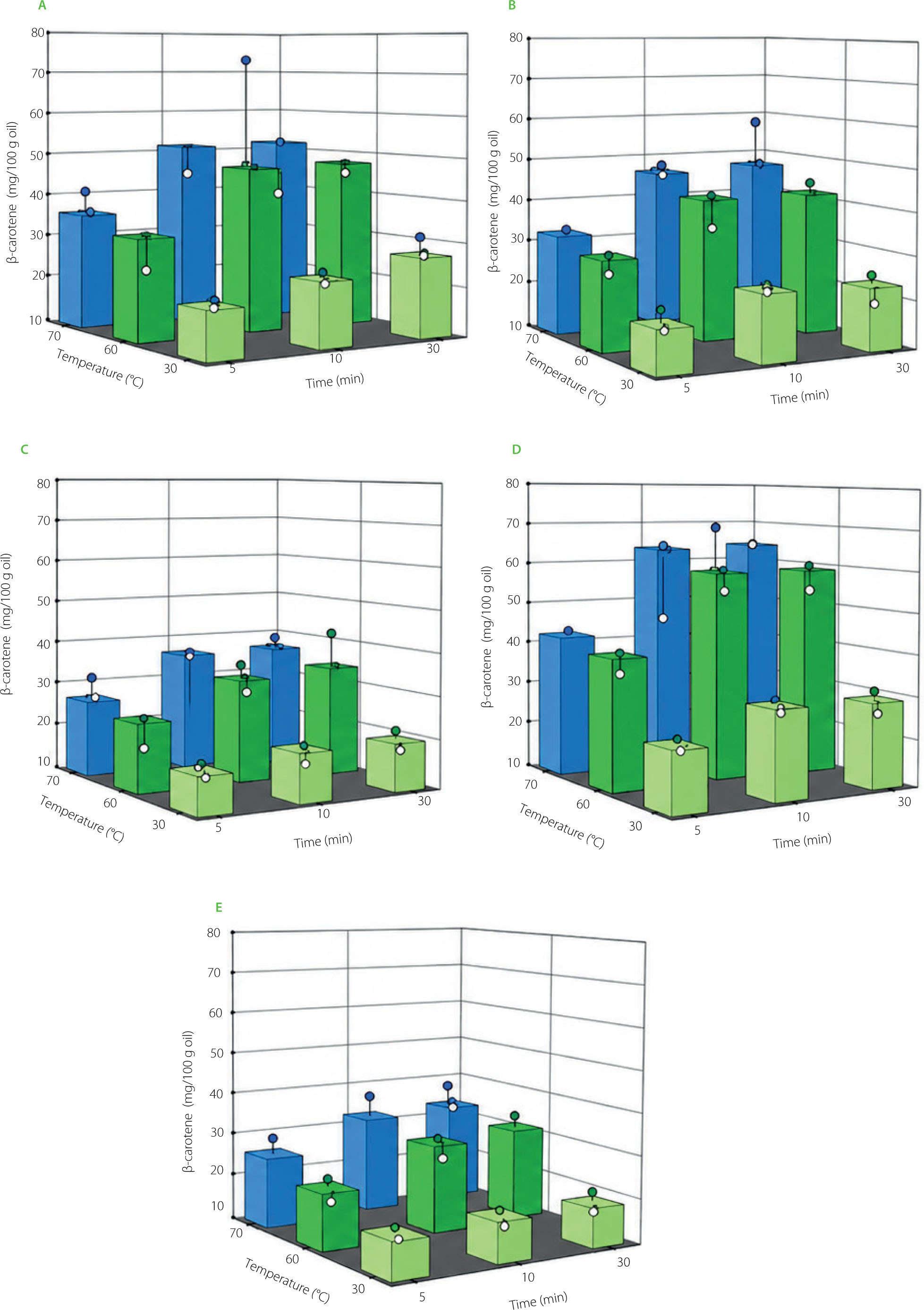
Temperature and time were also critical factors in β-carotene extraction from M. oleifera leaf powder using oil blends (Figure 1). Higher extraction temperatures led to increased β-carotene recovery in all oil combinations. This can be explained by improved solute-solvent interaction due to reduced oil viscosity and enhanced diffusion rates at elevated temperatures [Chutia & Mahanta, 2021]. In turn, increasing the extraction time from 5 to 10 min significantly boosted β-carotene content in the oils, likely due to extended contact time between the solvent and plant matrix. However, extending extraction beyond 10 min did not lead to further improvements, which suggests that a short extraction time is sufficient and potentially advantageous in maintaining compound stability and simplifying the process.
The experimental data were modelled using a two-factor interaction (2FI) model to evaluate the effects of extraction time (A), temperature (B), and oil ratio (C) on carotenoid recovery. The model included the main effects of all factors and their two-way interactions and was fitted using the least squares method. No transformation of the response variable was required. Several mathematical models were evaluated to describe the experimental responses, and the inverse square root model provided the best fit according to ANOVA (Table 2). The selected model was statistically significant (p<0.05) and exhibited a coefficient of determination (R2) of 0.8973, indicating good agreement between predicted and experimental values. The results of the lack-of-fit test were non-significant (p>0.05), confirming the adequacy of the model. The ANOVA results showed that all three factors, including oil ratio (C), had a significant effect on β-carotene extraction (p<0.05). However, a simplified regression equation including only the most influential continuous variables is presented for clarity and visualization purposes (Equation 3):
where: A corresponds to extraction time and B to temperature.Table 2
Results of the analysis of variance for regression modelling of β-carotene extraction from Moringa oleifera Lam. leaf powder using the blends of corn oil and sunflower oil.
The model predicted optimal extraction conditions of 70°C, 10 min, and sunflower oil. Under these conditions, the predicted carotenoid content (52.96 mg/100 g oil) was in close agreement with the experimental value (51.92±1.3 mg/100 g oil), confirming the reliability and predictive capability of the proposed model. These findings demonstrate that the inverse square root model effectively describes the kinetics of carotenoid extraction under the evaluated parameters.
Comparable studies on the optimization of carotenoid extraction using multifactor experimental designs have reported similar time and temperature ranges as critical variables influencing yield [Chutia & Mahanta, 2021; Rodriguez-Amaya, 2016]. For example, optimization studies on carotenoid extraction using edible oils as solvents have identified moderate temperatures and extraction times as key factors influencing extraction efficiency [Sachindra & Mahendrakar, 2005], showing trends comparable to those observed in the present study.
Emulsion characteristics
Maintaining emulsion stability is essential for efficient encapsulation, particularly when using spray-drying. Fine and uniformly distributed droplets help minimize coalescence and aggregation, thus preserving the structural integrity of the emulsion [Guo et al., 2024]. In our study, an increase in GU content in the emulsion led to smaller droplet sizes (Table 3). This reduction in droplet size can be attributed to the good emulsifying properties of GU, which enhanced interfacial adsorption and reduced interfacial tension during homogenization, facilitating the formation of smaller droplets. The smallest average droplet size (1.07 μm) was observed at a 1:1 (w/w) ratio of MD to GU. This behavior suggests a balance between the emulsifying capacity of GU and the viscosity contribution of MD, which together promoted efficient droplet disruption during homogenization. At higher GU proportion, changes in the continuous phase properties, including viscosity and interfacial dynamics, may diminish the efficiency of droplet breakup, resulting in slightly larger droplet sizes.
Table 3
Physicochemical parameters of emulsions of Moringa oleifera Lam. leaf oil extract with β-carotene, containing blends of maltodextrin (MD) and gum Arabic (GU).
The polydispersity index (PDI) and zeta potential (ζ-potential) values are presented in Table 3. A decrease in PDI was observed with an increasing GU content, indicating improved droplet size uniformity. At the same time, the ζ-potential values became more negative, suggesting enhanced electrostatic repulsion between droplets. These results indicate that increasing GU content improved emulsion stability by reducing droplet aggregation through electrostatic stabilization. The PDI reflected improved uniformity with increasing GU content, because the addition of this wall material enhanced the negative surface charge, further preventing droplet aggregation [Jayme et al., 1999]. These observations are consistent with findings by Premi & Sharma [2017], who reported more negative ζ-potential values with an increasing gum Arabic (GU) content in emulsions. Additionally, all samples in the present study exhibited ζ-potential values lower than −30 mV (Table 3), indicating sufficient electrostatic repulsion to ensure physical stability of the emulsions [McClements, 2005].
A significant (p<0.05) increase in apparent viscosity was observed with increasing GU content in the emulsion (Table 3), which can be attributed to its high molecular weight and the resulting enhancement of the continuous phase viscosity. Higher viscosity may reduce droplet mobility and collision frequency, thereby contributing to improved physical stability of the emulsion. This effect has been widely reported in food emulsions, where increased viscosity of the continuous phase limited flocculation and coalescence [McClements, 2005].
The physical stability of the emulsions was evaluated using backscattering profiles (Figure 2). Higher proportions of GU in the emulsions led to minimal temporal changes in backscattering, suggesting a reduced tendency toward creaming (i.e., the upward migration of oil droplets due to density differences) or phase separation. Thus, increasing GU content appeared to enhance emulsion stability, likely due to better steric and electrostatic stabilization. However, a balance between MD and GU was critical for emulsion properties and encapsulation performance. A 1:1 (w/w) ratio produced the smallest droplet size and improved size distribution (Table 3), indicating more efficient droplet disruption during homogenization. This formulation also showed the highest encapsulation efficiency (0.74) (discussed in the subsection below), meaning better retention of β-carotene in final microcapsules. These findings underscore the importance of optimizing wall material composition to achieve favorable emulsion properties and enhance encapsulation efficiency.
Figure 2
Backscattering profiles of emulsions of Moringa oleifera Lam. leaf oil extract with β-carotene, containing blends of maltodextrin (MD) and gum Arabic (GU) during 4 h at 25°C. (A) 2:1 MD to GU ratio (w/w); (B) 1:1 MD to GU ratio (w/w); and (C) 1:2 MD to GU ratio (w/w).
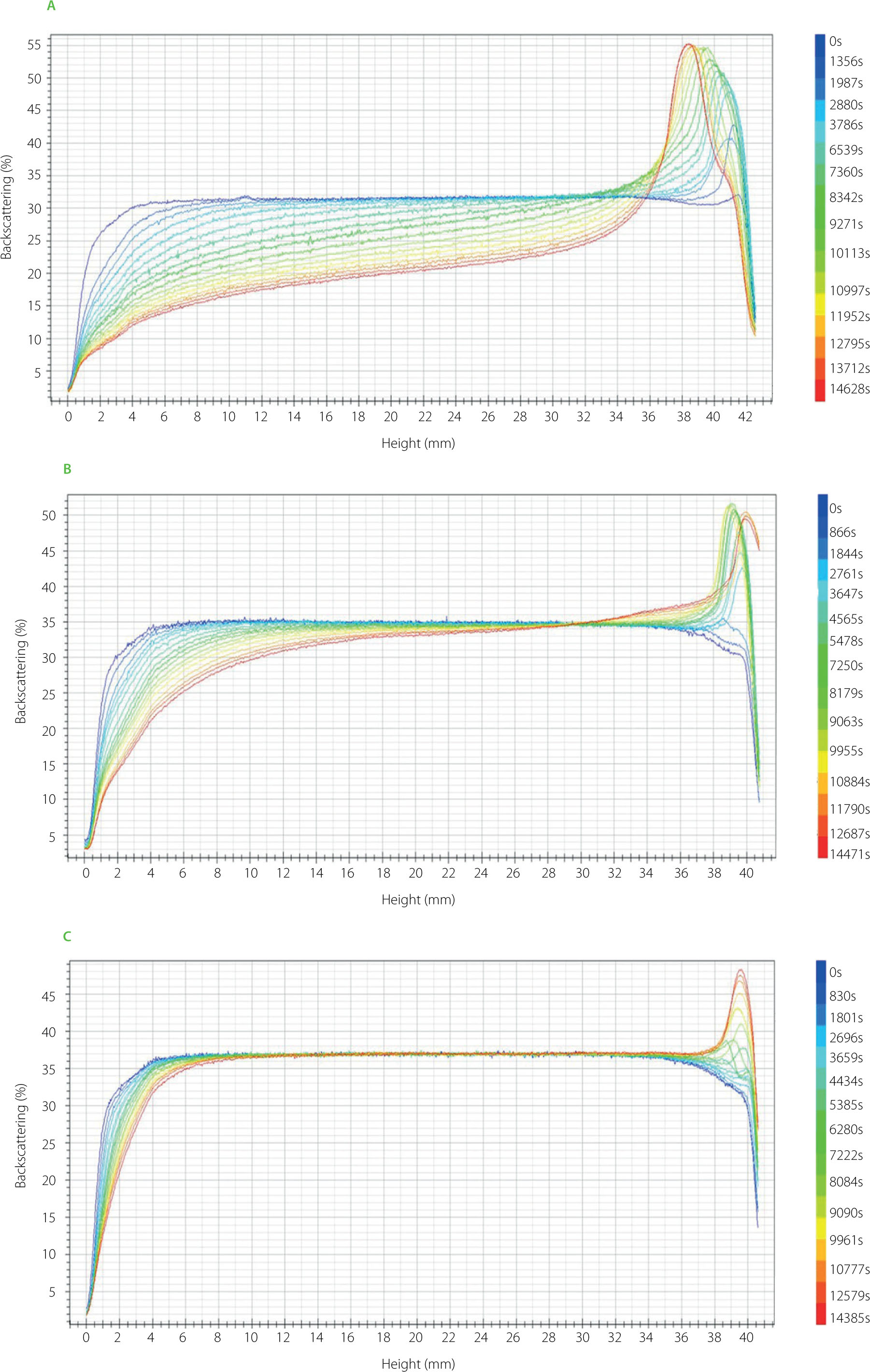
Based on the results, the MD to GU ratio of 1:1 (w/w) yielded the most stable emulsion under the studied conditions. This formulation may be particularly relevant for the encapsulation of sensitive bioactive compounds, such as β-carotene. Previous studies have reported that carbohydrate-based wall materials can improve the protection of bioactive compounds against oxidation and enhance their stability in food systems [Drosou & Krokida, 2024; Lavelli & Sereikaitė, 2022]. Therefore, the optimization of wall material composition plays an important role in improving the functional performance of emulsions.
For comparison, other wall material strategies have been reported to improve emulsion stability and β-carotene protection. For instance, chitosan-stabilized Pickering emulsions have been shown to produce smaller droplet sizes and enhanced stability, which has been attributed to the formation of strong interfacial barriers [Yin et al., 2024]. In their review article, also Lavelli & Sereikaitė [2022] indicate that composite wall materials or coencapsulation strategies significantly reduce β-carotene oxidative degradation compared with single-component systems. These results suggest that while GU effectively stabilizes emulsions, alternative or combined wall materials may provide additional protection and improved performance.
Encapsulation efficiency
Encapsulation performance was strongly influenced by the ratio of wall materials used in the emulsion formulations. The combination of MD and GU at a 1:1 (w/w) ratio produced the highest encapsulation efficiency (0.74±0.02), whereas MD to GU ratios of 2:1 and 1:2 (w/w) resulted in lower efficiencies of 0.43±0.02 and 0.67±0.02, respectively. This behavior can be attributed to the complementary functional properties of both wall materials, since maltodextrin contributes to film formation and reduced viscosity, while gum Arabic provides emulsifying capacity that enhances interfacial stability of emulsion [Gupta et al., 2015].
The superior encapsulation efficiency observed for the formulation with MD to GU of 1:1 (w/w) is likely related to favorable emulsion characteristics, particularly smaller droplet size, lower polydispersity, and appropriate viscosity. These parameters play a key role in improving encapsulation efficiency, as smaller and more uniformly distributed droplets are more easily embedded within the wall matrix, reducing oil migration to the particle surface and minimizing surface oil formation during spray-drying [Salimi et al., 2018].
The 0.74 encapsulation efficiency obtained in this study is similar to that reported by Menegazzi et al. [2020] (~0.70), and De Souza et al. [2024] (~0.88) for carotenoid encapsulation by spray-drying. Higher β-carotene encapsulation efficiencies have been reported when alternative wall materials or optimized emulsification techniques were used; for instance, the use of the polysaccharide fraction obtained from yeast cell walls, consisting mainly of β-glucans and mannans (including mannoproteins) matrices, allowed achieving efficiency close to 0.90 under optimized spray-drying conditions [Do et al., 2019].
Overall, the results confirm that spray-drying remains a robust technique for encapsulating thermolabile compounds such as β-carotene, as it enables the formation of stable microcapsules while protecting sensitive bioactive compounds from oxidation, temperature, and light exposure [Meng et al., 2024].
Morphometry and structural features of microcapsules
The physical properties of the resulting microcapsules, such as size, shape, and surface characteristics, are critical for determining their performance in storage and application. Table 4 shows that the MD to GU ratio of the wall material significantly affected particle morphology. Increasing GU content led to smaller microcapsule sizes, possibly due to GU’s ability to lower surface tension and promote finer droplet formation during spray-drying [Mahdi et al., 2020]. Conversely, higher levels of MD may have reduced emulsion stability, contributing to the formation of larger particles upon drying. In this study, the microcapsules formed with the MD to GU of 1:1 (w/w) ratio had an average diameter of 7.98 μm, being smaller than those reported by Guadarrama-Lezama et al. [2012], i.e., from 11.1 to 12.7 μm, who used similar materials. One of the contributing factors was the atomization pressure, namely 1.0 bar used in the present study and 0.4 bar in the cited work. Higher atomization pressure typically produces smaller particles due to greater droplet break-up energy.
Table 4
Particle size and morphology characteristics of microcapsules of Moringa oleifera Lam. leaf oil extract with β-carotene, encapsulated using blends of maltodextrin (DM) and gum Arabic (GU) as wall material.
Shape descriptors, such as circularity, sphericity, and aspect ratio, indicate how spherical the particles are; with values close to 1 indicating more spherical particles [Rosal, 2021]. Such particles are typically associated with greater mechanical and storage stability of the microcapsules [Gharsallaoui et al., 2007]. The microcapsules obtained with MD to GU ratios of 2:1 (w/w) and 1:1 (w/w) had sphericity values closer to 1 compared to those obtained with a 1:2 (w/w) ratio (Table 4). This may be related to the emulsion’s high viscosity, which leads to irregular droplet formation. Irregular shapes can compromise the capsule wall structure, increasing the risk of rupture and the early release of encapsulated compounds. Kurtosis values were positive for all treatments (Table 4), indicating a leptokurtic (narrow and peaked) distribution of particle sizes [Garcia-Solis et al., 2022]. Kurtosis increased with a higher GU content in the wall material, suggesting that GU supports the formation of more uniform microcapsules.
Distribution of components in the microcapsule determined by confocal laser scanning microscopy
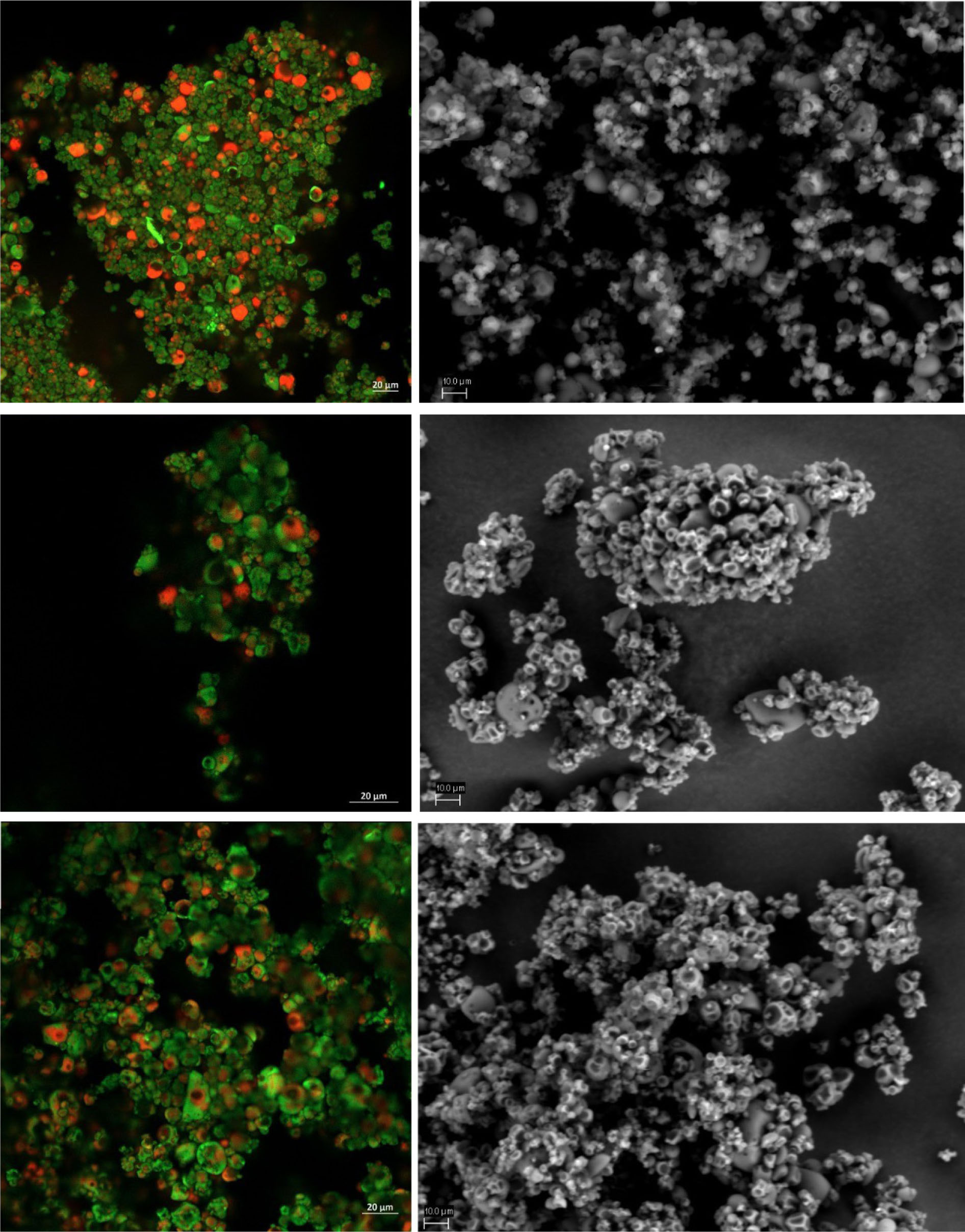
CLSM proved to be an effective tool for visualizing the spatial distribution of core and wall materials within microcapsules. As shown in Figure 3, the encapsulating agents (green) and the β-carotene extract (orange) were clearly distinguishable. The MD to GU ratio influenced the observed internal structure and surface characteristics of the microcapsules. The formulations with a higher GU content (Figures 3B and 3C) appeared to differ in the distribution of the core material compared to those with a higher MD content (Figure 3A), which was qualitatively consistent with the encapsulation efficiency results. Notably, the 1:1 MD to GU (w/w) formulation displayed the most uniform distribution, and clear separation between core and wall materials. Similar microstructural organization has been reported in carotenoid-loaded microencapsulation systems, where confocal microscopy has been used to evaluate the spatial distribution of lipid cores within spray-dried matrices, depending on processing conditions and wall material composition [Zhu et al., 2021]. These findings highlight the importance of optimizing wall material ratios to enhance core retention and maintain the structural integrity of spray-dried microcapsules.
Figure 3
Morphology of microcapsules of Moringa oleifera Lim. leaf oil extract with β-carotene, encapsulated using blends of maltodextrin (DM) and gum Arabic (GU) as wall material observed by confocal laser scanning microscopy (left) and scanning electron microscopy (right). (A) 2:1 MD to GU ratio (w/w); (B) 1:1 MD to GU ratio (w/w); and (C) 1:2 MD to GU ratio (w/w).
Microstructure of microcapsules determined by scanning electronic microscopy
SEM images of microcapsules produced with varying MD to GU ratios are shown in Figure 3. The results confirm that increasing the GU content led to smaller particle sizes, supporting earlier observations made via droplet size analysis. Regardless of the formulation, all microcapsule samples displayed signs of agglomeration, which suggests that the formation of aggregates was not directly related to the MD to GU ratio. A similar behavior has been reported by other authors working with spray-dried systems [Garcia-Solis et al., 2022]. The tendency for agglomerate formation could be influenced by high inlet temperatures used during spray-drying and the inherent hygroscopic nature of wall materials, which may absorb moisture post-process. These factors collectively contribute to particle adhesion and clustering during storage [Wang et al., 2015].
Physicochemical and functional properties of microcapsules
As summarized in Table 5, the microcapsules produced in this study exhibited moisture contents between 3.02 and 4.59 g H2O/100 g of microcapsule powders, and aw values ranging from 0.11 to 0.16. Such low values are favorable for preserving the bioactivity of β-carotene, as excess moisture can trigger enzymatic reactions that promote oxidation and compromise functional stability of this compound. Additionally, low aw suppresses microbial growth, enhancing both shelf-life and safety of the powder. These characteristics were primarily achieved due to the spray-drying conditions employed, namely a high inlet temperature (180°C) and a moderate outlet temperature (80°C), which likely accelerated solvent evaporation and resulted in a reduced powder moisture content [Zhang et al., 2021].
Table 5
Physicochemical and functional properties of microcapsules of Moringa oleifera Lam. leaf oil extract with β-carotene, encapsulated using blends of maltodextrin (DM) and gum Arabic (GU) as wall material.
The bulk and tapped densities of the microcapsules, shown in Table 5, varied significantly with the ratio of wall materials used. A higher GU content yielded powders with greater density, likely due to the smaller and more uniform particle size of those formulations. When particles are smaller and evenly distributed, they pack more efficiently, improving density parameters. High packing density in encapsulated powders has practical advantages. It reduces interstitial air between particles, which in turn minimizes exposure to oxygen and slows down the oxidation of encapsulated oils. The Hausner ratio, which is an indicator of powder flowability and cohesion [Garcia-Solis et al., 2022], was between 1.49 and 1.51 for all samples. Since values below 1.6 suggest an acceptable flow behavior [Guo et al., 2024], all formulations in this study were deemed to have good handling properties.
As shown in Table 5, the GU-rich microcapsules exhibited significantly (p<0.05) higher hygroscopicity (12.95 g H2O/100 g) compared with the MD-rich formulations (11.52 g H2O/100 g). A similar behavior has been reported in spray-dried microencapsulation systems using maltodextrin and gum Arabic, where higher gum Arabic content has been associated with increased hygroscopicity due to its higher affinity for water, while maltodextrin contributed to a lower moisture uptake and improved powder stability [Karaca et al., 2020]. Although beneficial for emulsion stabilization and encapsulation efficiency, excessive hygroscopicity may compromise storage stability of microcapsules by accelerating degradation of structural and bioactive compounds.
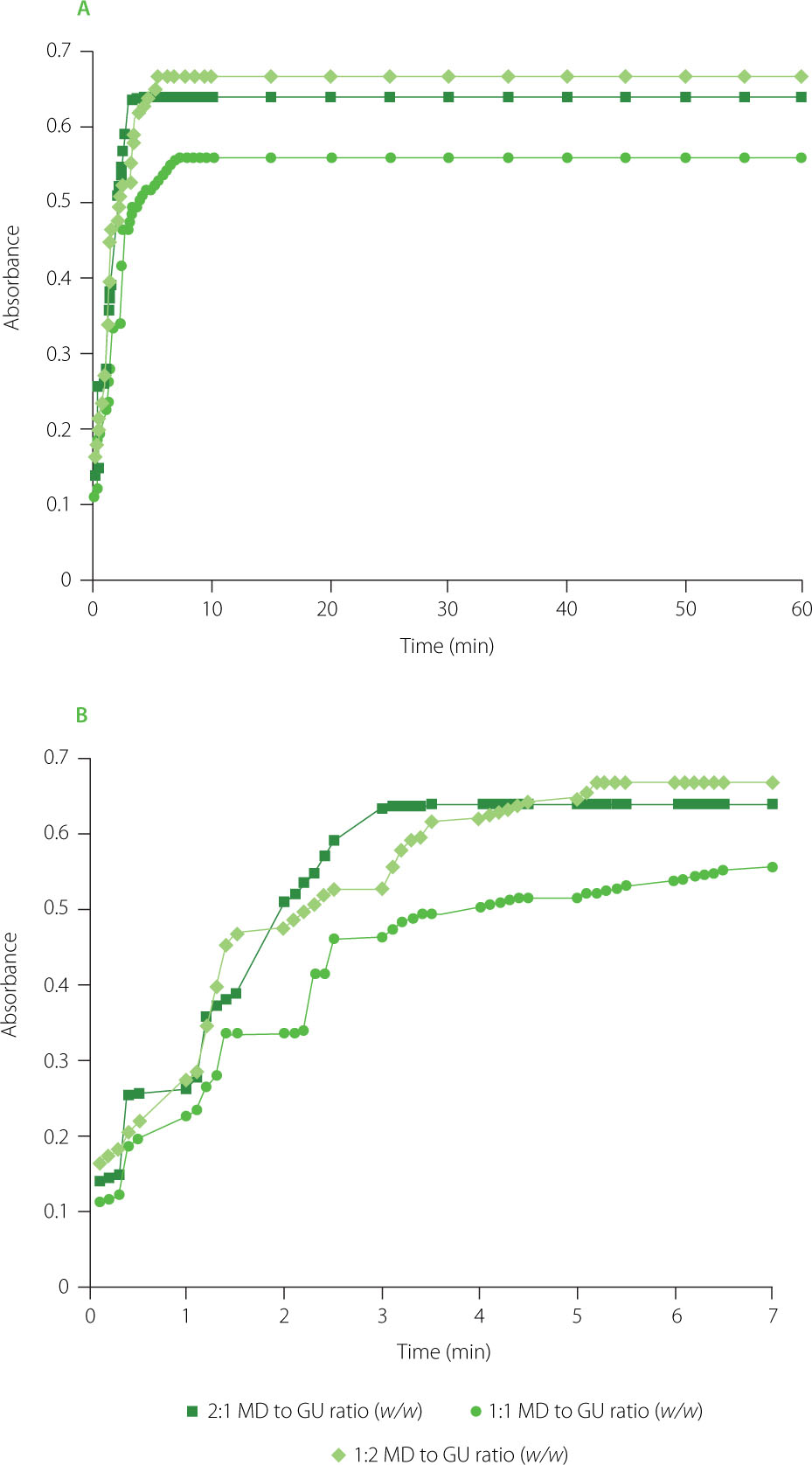
Figure 4 shows the dissolution profiles of microcapsules formulated with different MD to GU ratios, plotted as absorbance vs. time. The sample is considered dissolved when its absorbance remains constant over time. The sample that dissolved most rapidly was the one containing the highest proportion of MD, which dispersed in water within 3 min. The GU-rich formulation dissolved in approximately 5 min, whereas the sample with a 1:1 MD to GU (w/w) ratio needed about 6 min to disperse completely. These differences are attributed primarily to the water solubility of the wall materials. Maltodextrin, known for its high water solubility, serves as an effective carrier in spray-drying encapsulation systems and enables rapid dissolution in aqueous media. In contrast, gum Arabic is a complex polysaccharide–protein hydrocolloid that provides interfacial activity and forms more structured hydrated solutions, potentially affecting the release behavior of encapsulated compounds [Dickinson, 2003].
Figure 4
Dissolution profile of microcapsules of Moringa oleifera Lim. leaf oil extract with β-carotene, encapsulated using blends of maltodextrin (DM) and gum Arabic (GU) as wall material. (A) Absorbance at 620 nm over 60 min; and (B) enlargement of the first 7 min showing the initial stage of the dissolution.
All microcapsule formulations exhibited lower Tg values than the pure wall materials (Table 6), likely due to the plasticizing effect of saturated fatty acids in the β-carotene extract [Guadarrama-Lezama et al., 2012]. The GU-rich formulations showed the lowest glass transition temperature (Tg), while the formulations that included MD exhibited the highest Tg. This behavior suggests that the balance between maltodextrin and gum Arabic influences molecular mobility within the matrix, affecting the thermal properties of the microcapsules.
Table 6
Glass transition temperature of wall materials and microcapsules of Moringa oleifera Lam. leaf oil extract with β-carotene, encapsulated using blends of maltodextrin (DM) and gum Arabic (GU).
| Wall material/microcapsules | Tg (°C) |
|---|---|
| MD | 189.98±0.54a |
| GU | 147.17±0.58b |
| Microcapsules (2:1 MD to GU, w/w) | 56.94±0.75c |
| Microcapsules (1:1 MD to GU, w/w) | 58.87±1.22c |
| Microcapsules (1:2 MD to GU, w/w) | 47.32±1.33d |
The observed Tg values reflect differences in the molecular mobility of the microcapsule matrix. In general, higher Tg values are associated with reduced molecular mobility, which can contribute to improved retention of encapsulated compounds, such as β-carotene, during storage. Based on these properties, spray-dried microcapsules have been widely applied in food systems for the protection and delivery of bioactive compounds in various matrices [Gharsallaoui et al., 2007]. The enhanced structural stability of the microcapsules from the 1:1 MD to GU (w/w) formulation, in particular, indicates its suitability for applications that demand prolonged shelf-life and resistance to processing stresses.
CONCLUSIONS
This study demonstrated that both sunflower and corn oils as well as their blends could effectively serve as carriers for extracting β-carotene from M. oleifera leaves, with sunflower oil used at 70°C for 10 min yielding the highest extraction efficiency. β-Carotene-rich extracts were successfully microencapsulated by spray-drying using MD and GU, with the MD to GU ratio of 1:1 (w/w) yielding the highest encapsulation efficiency, flowability, and glass transition temperature. These findings indicate that optimizing wall material composition can improve the structural stability of microcapsules and retention of the core material under the tested conditions. However, the study was limited to laboratory-scale experiments, and the stability of β-carotene microcapsules during storage or incorporation into real food matrices was not assessed. Future work should, therefore, evaluate long-term bioactive retention, performance in different food systems, and process scalability to better support potential industrial applications.