INTRODUCTION
Dependence on rice remains high across many Asian countries, including Indonesia. The increasing prevalence of metabolic disorders has driven the development of carbohydrate-rich foods that not only serve as a source of energy but also provide additional physiological benefits [Nikrad et al., 2023]. Rice analogs have been introduced as a staple food alternative to lessen reliance on conventional rice. Rice analogs are rice-shaped grains produced from non-rice sources and processed using techniques such as extrusion to achieve cooking and sensory properties similar to those of conventional rice [Chaturvedi & Manickavasagan, 2024].
Extrusion technology modifies starch-based matrices through thermomechanical treatment, promoting starch gelatinization and molecular reorganization, thereby influencing the functional properties of rice analogs. However, most studies on rice analogs have focused on processing feasibility and product characteristics [Bahlawan et al., 2023; Kishore et al., 2024; Shaikh et al., 2025]. In contrast, the influence of formulation on starch digestibility and structural transformations remains insufficiently explored. Structural modification of starch is important from a nutritional perspective because it affects starch digestibility and the proportions of rapidly digestible starch (RDS), slowly digestible starch (SDS), and resistant starch (RS), thereby influencing glycemic control and metabolic regulation [Kim et al., 2024; Zheng et al., 2026]. These starch fractions differ in their digestion rates and physiological effects, making them important determinants of the nutritional quality of starch-based foods [Jiali et al., 2024].
Sorghum fosters considerable potential as the main ingredient for rice analog production because its relatively high amylose content and unique starch characteristics promote the development of a stable matrix during processing [Bahlawan et al., 2023]. Sorghum flour forms a compact gel network after gelatinization and cooling, which contributes to the texture and structural integrity of rice analogs by enhancing matrix cohesiveness and hardness [Chiodetti et al., 2024]. In addition, its non-starch components, including proteins and lipids, influence intermolecular interactions during thermomechanical processing [Chao et al., 2024]. Nevertheless, variations in the physicochemical and functional characteristics of sorghum cultivars, particularly water absorption capacity and structural stability [Adebo & Kesa, 2023], may influence their suitability as raw materials for rice analog production.
Modified cassava flour (mocaf), produced through the fermentation of cassava tubers, has been widely used as an ingredient in composite food formulations due to its favorable processing and quality characteristics [Rahmadani et al., 2025]. Its incorporation into extruded rice analogs may improve structural integrity and overall product quality [Sumardiono et al., 2021]. Despite these advantages, the effects of mocaf on starch structure and digestibility in composite rice analog formulations remain insufficiently documented.
Pumpkin (Cucurbita moschata Duchesne) flour contains substantial amounts of β-carotene and phenolic compounds, which contribute to its antioxidant potential and functional properties [Alija et al., 2025; Ninčević Grassino et al., 2023]. Pumpkin flour may be incorporated into composite flour formulations to enhance the content of bioactive compounds and improve color attributes [Alija et al., 2025]. Its incorporation into food products has also been reported to increase β-carotene content, antioxidant capacity, and sensory quality, as demonstrated in gluten-free egg rolls and instant porridge formulations [Slamet et al., 2025, 2026]. However, information regarding the combined use of sorghum flour, mocaf, and pumpkin flour in extruded rice analog products remains scarce. In particular, the effects of this combination on starch digestibility and structural properties have not been comprehensively studied.
Therefore, there is a clear research gap regarding the coupled effects of sorghum, mocaf, and pumpkin flours on starch digestibility, structural characteristics, and overall quality of extrusion-based rice analogs. Accordingly, this study evaluated the influence of partially substituting sorghum flour with mocaf and pumpkin flour on starch digestibility, physicochemical properties, structural characteristics, and sensory acceptance of extruded instant rice analogs.
MATERIALS AND METHODS
Materials and reagents
Sorghum flour, mocaf, and pumpkin flour were supplied by food producers from Sleman, Yogyakarta, Indonesia. Hydrochloric acid, sulfuric acid, boric acid, sodium hydroxide, and petroleum ether used for proximate and crude fiber determinations were analytical-grade reagents obtained from Merck, Darmstadt, Germany. Folin–Ciocalteu reagent, sodium carbonate, and gallic acid used for total phenolic content analysis were obtained from Sigma-Aldrich (St. Louis, MO, USA). Sigma-Aldrich was also a supplier of solvents (acetone, methanol, ethanol, and n-hexane), anhydrous sodium sulfate, β-carotene standard, α-amylase, amyloglucosidase, pepsin, sodium acetate, potassium phosphate buffer, 3,5-dinitrosalicylic acid, and glucose standard.
Production of rice analogs
Rice analogs were produced from composite flour formulations consisting of sorghum flour, mocaf, and pumpkin flour in different proportions. Flours were blended at ratios of 100:0:0, 80:10:10, 60:20:20, 40:30:30, and 20:40:40 (w/w/w), respectively. The blends underwent hot extrusion using a co-rotating intermeshing twin-screw extruder (Model DS32-II, Jinan Saixin Machinery Co., Ltd., Jinan, China) featuring 32 mm diameter screws with a length-to-diameter (L/D) ratio of 20:1. The screw profile comprised conveying and kneading elements configured to provide sufficient mixing and shear during extrusion. Before extrusion, the flour blends were homogenized and their moisture content was adjusted to 30 g/100 g by manual mixing, followed by equilibration for 30 min. The conditioned feed was then extruded at a barrel temperature profile of 50/65/85/100/95°C, a screw speed of 60 rpm, and a feed rate of approximately 300 g/min. After exiting the 2 mm die, the extrudate was cut into rice-shaped grains and dried at 60°C for 3 h using a hot-air oven (UN55, Memmert GmbH, Schwabach, Germany). Drying proceeded to achieve a final moisture content below 10 g/100 g, which is within the recommended range for dried cereal-based products and contributes to storage stability. After drying, the rice analogs were cooled to room temperature and stored in airtight containers until subsequent analyses.
Proximate composition and crude fiber analysis
Proximate composition and crude fiber content were assessed following AOAC International guidelines [AOAC, 2005], including moisture (method 930.15), ash (method 930.05), fat (method 930.09), protein (method 978.04), and crude fiber (method 978.10). The carbohydrate content of the rice analogs was calculated by difference. Results were expressed as g per 100 g of dried rice analog.
Color coordinate measurement
The color of the rice analogs was determined using a CR-400 colorimeter (Konica Minolta, Osaka, Japan) after calibration against a standard white reference tile. The color of the rice analogs was evaluated according to the CIELab system and reported as L* (lightness), a* (redness/greenness), and b* (yellowness/blueness) values. Measurements were recorded at five different locations on each rice analog sample, and the data were presented as mean values.
Analysis of physical and functional properties
Water absorption capacity (WAC) and oil absorption capacity (OAC) of the rice analogs were determined gravimetrically following the procedure described by Beuchat [1977], with slight modifications. An aliquot of 10 mL of distilled water or vegetable oil was mixed with 1.0 g of the instant rice analog in a centrifuge tube. The suspension was mixed using a Genie 2 vortex (Scientific Industries Inc., Bohemia, NY, USA) for 1 min, incubated at room temperature (25±2°C) for 30 min, and subsequently centrifuged at 3,000×g for 15 min using a 5804R centrifuge (Eppendorf, Hamburg, Germany). After removal of the supernatant by careful decantation, the residue was weighed. Water and oil absorption capacities were expressed as grams of water or oil retained per gram of dry rice analog (g/g).
The bulk density of rice analogs was determined using a standard gravimetric method following the AOAC International method [AOAC, 2016]. The sample was gently introduced into a 100-mL graduated cylinder, and its surface was leveled carefully without applying pressure. The mass was measured using an analytical balance (AUY220, Shimadzu, Kyoto, Japan). Bulk density (g/mL) was determined from the quotient of rice analog mass and the corresponding sample volume.
Water activity (aw) of rice analogs was determined at 25±1°C using an AquaLab 4TE instrument (METER Group Inc., Pullman, WA, USA), which operates based on the dew-point principle. Prior to analysis, the instrument was calibrated with certified salt solution standards according to the manufacturer’s recommendations. Rice analogs were placed in the sample cup, and the measurement was performed until a stable reading was obtained.
The swelling power of rice analogs was determined using a modified procedure based on the method of Leach et al. [1959]. A 0.5-g sample (dry basis) was suspended in 10 mL of distilled water and heated at 90°C for 30 min in a water bath (WNB14, Memmert GmbH), with manual stirring every 5 min. Following heat treatment, the suspension was cooled to room temperature before centrifugation at 3,000×g for 15 min using a 5804R centrifuge (Eppendorf). After decanting the supernatant, the sediment (gel) was weighed. Swelling power (g/g) was calculated using Equation (1):
Cooking loss was determined using a modified procedure based on the method of Sutrisno et al. [2024]. A 5-g portion of rice analog (dry basis) was immersed in 100 mL of boiling distilled water and cooked for 15 min to achieve complete gelatinization. The cooking water was collected and dried in a hot-air oven (UN55, Memmert GmbH) at 105°C until reaching a constant weight. The weight of the residue was used to calculate the cooking loss (%) using Equation (2):
Determination of starch fractions with different digestibility
In vitro starch digestibility of rice analogs was assessed using a sequential enzymatic hydrolysis procedure based on the method of Englyst et al. [1992] with slight modifications. This procedure mimics gastrointestinal digestion through stepwise enzymatic treatments. To simulate gastric digestion, 1 g of the rice analog was incubated with pepsin at pH 2.0 and 37°C for 30 min. Subsequently, the pH was adjusted to 6.9 for enzymatic hydrolysis performed using pancreatic α-amylase (10 U/mg starch) and amyloglucosidase (3 U/mg starch) at 37°C under continuous agitation. Aliquots were collected at 20 min and 120 min to determine glucose release. Glucose concentration in the hydrolysates was quantified spectrophotometrically by the 3,5-dinitrosalicylic acid (DNS) method [Li & McKee, 2023]. Glucose released after 20 and 120 min of enzymatic hydrolysis was used to calculate the contents of rapidly digestible starch (RDS), slowly digestible starch (SDS), and resistant starch (RS). RDS represented the starch fraction hydrolyzed during the first 20 min of digestion, whereas SDS corresponded to the fraction hydrolyzed between 20 and 120 min. The starch remaining unhydrolyzed after 120 min was classified as RS. Total starch digestibility was expressed as the percentage of hydrolyzed starch relative to the total starch content of the rice analog. The amount of hydrolyzed starch was estimated from the glucose released during enzymatic digestion and converted to starch equivalents using a conversion factor of 0.9. In this study, the total starch digestibility represents the sum of RDS and SDS, corresponding to the starch fraction hydrolyzed within 120 min of digestion.
Determination of β-carotene content and total phenolic content
The β-carotene content of rice analogs was quantified spectrophotometrically after extraction with an acetone and n-hexane (4:6, v/v) mixture using a modified procedure derived from the method previously used by Bieżanowska-Kopeć et al. [2022]. For extraction, 1.0 g of the rice analog (dry basis) was combined with 10 mL of the extraction solvent, homogenized, and then centrifuged at 3,000×g for 10 min. The upper phase was collected as the extract. The absorbance of the extract was measured at 450 nm using a UV–Vis spectrophotometer (UV-1800, Shimadzu). The β-carotene content was calculated from a β-carotene calibration curve and expressed as mg/100 g dry rice analog.
The total phenolic content (TPC) of rice analogs was quantified using the Folin–Ciocalteu reagent according to the method described by Martins et al. [2021]. For extraction, the dry sample was mixed with 80% (v/v) aqueous ethanol at a sample-to-solvent ratio of 1:10 (w/v). The mixture was incubated under agitation at 150 rpm for 30 min at room temperature before centrifugation at 3,000×g for 15 min. The resulting supernatant was used as the extract. For TPC analysis, 0.5 mL of the extract was combined with 2.5 mL of a 10% (v/v) Folin–Ciocalteu reagent and 2.0 mL of a 7.5% (w/v) Na2CO3 solution. After standing in the dark at room temperature for 30 min, the absorbance of the reaction mixture was measured at 765 nm with a UV–Vis spectrophotometer (UV-1800, Shimadzu). The total phenolic content was calculated from a gallic acid calibration curve, and the results were reported as mg gallic acid equivalent (GAE)/g dry rice analog.
Texture profile analysis
For texture profile analysis, instant rice analogs were first cooked using a rice-to-water ratio of 1:2 (w/v) according to the preparation procedure applied in the sensory evaluation. Following cooking, the rice analogs were cooled to room temperature, and then subjected to measurements of texture properties using a TA.XTplus texture analyzer (Stable Micro Systems Ltd., Surrey, UK) fitted with a cylindrical probe (P/36R). The analysis was conducted using a two-cycle compression test. The pre-test, test, and post-test speeds were 1.0 mm/s. Rice analog samples were compressed to 50% of their original height using a trigger force of 0.05 N. Their texture profile parameters included hardness, cohesiveness, springiness, and chewiness. Hardness (N) was defined as the highest force recorded in the initial compression cycle. Cohesiveness was calculated by dividing the area under the second compression curve by that obtained during the first compression. Springiness described the ability of the rice analog to recover its original height after the compressive force was released. Chewiness (N) was calculated as the product of hardness, cohesiveness, and springiness.
Analysis of structural and microstructural characteristics
Fourier transform infrared (FTIR) spectra of the rice analogs were recorded using an IRTracer-100 spectrometer (Shimadzu) operated in attenuated total reflectance (ATR) mode. Spectral data were acquired over the wavenumber range of 4,000–400 cm−1 at a resolution of 4 cm−1 using 32 scans for each rice analog sample. The analysis was performed to examine differences in the position and intensity of absorption bands corresponding to O–H, C–H, and C–O functional groups among the rice analog formulations.
Rice analog microstructure was characterized by scanning electron microscopy (SEM) using a JSM-6510LV instrument (JEOL Ltd., Tokyo, Japan). Prior to imaging, rice analog samples were mounted on aluminum stubs and coated with a gold–palladium layer for 60 s using a JEC-3000FC sputter coater (JEOL Ltd.). Micrographs were captured at an accelerating voltage of 10 kV with magnifications of ×500 and ×1,000. The evaluation focused on differences in surface morphology, pore structure, and matrix continuity among the samples.
Sensory preference test
The rice analog preference test was conducted with 30 untrained panelists, namely students of the Agricultural Product Technology Study Program at Universitas Mercu Buana Yogyakarta, Yogyakarta, Indonesia (17 women and 13 men; aged 18–21 years) who did not have allergies to pumpkin, mocaf, or sorghum. All panelists participated voluntarily and provided written informed consent after receiving an explanation of the sensory evaluation procedure. The number of panelists (n=30) was considered sufficient for preliminary assessment of consumer acceptability. The attributes evaluated included color, aroma, taste, texture, and overall acceptance, which were scored using a five-point hedonic scale ranging from 1 (strongly dislike) to 5 (strongly like). Prior to evaluation, rice analog samples were prepared in a rice cooker at a rice-to-water ratio of 1:2 (w/v), allowed to equilibrate at room temperature (29±1°C) for 10 min, and served warm in 10-g portions. All samples were coded using randomly generated three-digit numbers before sensory assessment.
Statistical analysis
Data are presented as mean and standard deviation. Three independent production batches were prepared, and each analytical measurement was performed in triplicate for every batch. The reported values represent the means of all measurements obtained from these independent experiments. The experiment was arranged in a completely randomized design (CRD) with a single factor, namely the proportion of sorghum flour, mocaf, and pumpkin flour in the formulations. Statistical differences among treatments were evaluated using one-way analysis of variance (ANOVA), followed by Duncan’s multiple range test (DMRT) when significant effects were detected. Differences were considered statistically significant at p<0.05. All analyses were carried out using IBM SPSS Statistics for Windows, version 25.0 (IBM Corp., Armonk, NY, USA).
RESULTS AND DISCUSSION
Proximate composition of raw materials
The compositional profiles of the flours used in the rice analog formulations are summarized in Table 1. Sorghum flour exhibited the highest protein (8.29 g/100 g) and fat (2.60 g/100 g) contents among the raw materials, indicating its potential contribution to the nutritional value of the rice analog formulations. Sorghum has been recognized as a cereal with moderate protein and lipid contents and has been widely utilized in rice analog production due to its favorable nutritional properties [Kishore et al., 2024]. In contrast, mocaf had the highest carbohydrate content (88.61 g/100 g) and relatively low contents of protein, ash, and fat (Table 1). Its high carbohydrate content can be attributed to the starch-rich composition of cassava flour [Alamu et al., 2017]. Pumpkin flour was characterized by the highest ash content (5.78 g/100 g) (Table 1), indicating a higher mineral content than in the other raw materials. These compositional differences among sorghum flour, mocaf, and pumpkin flour were expected to influence the nutritional composition, starch digestibility, physicochemical properties, and sensory characteristics of the resulting rice analogs.
Table 1
Proximate composition of raw materials.
Proximate composition and crude fiber content of rice analogs
The moisture content of instant rice analogs based on sorghum flour, mocaf, and pumpkin flour ranged from 6.65 to 6.74 g/100 g with significant differences found only between the rice analog obtained at a flour ratio of 20:40:40 (w/w/w) and other products (p<0.05) (Table 2). The relatively narrow range of moisture contents in the rice analogs indicates that variations in formulation had only a limited effect on this parameter. In the case of extrusion-based rice analogs, processing conditions, including extrusion and post-extrusion drying parameters, mainly influence the residual moisture content [Shaikh et al., 2025; Sumardiono et al., 2021]. The moisture content of the rice analogs produced in this study was less than 12 g/100 g, a level generally regarded as adequate for maintaining the storage stability of dry cereal-based products [Bahlawan et al., 2023].
Table 2
Proximate composition and crude fiber content of instant rice analogs produced from sorghum flour, mocaf, and pumpkin flour blended in various proportions.
The protein content of the rice analogs produced from blends of sorghum flour, mocaf, and pumpkin flour ranged from 7.13 g/100 g (flour ratio of 20:40:40, w/w/w, respectively) to 10.63 g/100 g (100:0:0 formulation) (Table 2). Significant differences between the samples indicate that changes in the proportion of raw materials directly affect the protein content in the composite system. This trend is consistent with reports indicating that the protein content of rice analogs is highly determined by the type and ratio of their ingredients [Bahlawan et al., 2023; Sumardiono et al., 2021]. The decrease in protein content observed in the rice analogs produced from blends with higher proportions of mocaf and pumpkin flour (Table 2) was primarily due to the lower protein contents of these ingredients (1.45 and 1.38 g/100 g, respectively) compared to sorghum flour (8.29 g/100 g) (Table 1). Protein content gradually declined as the proportion of mocaf and pumpkin flour increased because replacing sorghum flour produced a dilution effect. In addition, the extrusion process might have promoted protein denaturation and modify starch–protein interactions, thereby affecting the protein fraction of the final product [Sumardiono et al., 2021; Sun et al., 2023; Webb et al., 2023]. Nevertheless, protein content of the rice analogs produced in this study was substantially higher than that reported for starch-based rice analogs (0.46–1.25 g/100 g) [Zulfa et al., 2023]. These results indicate that the inclusion of sorghum flour contributed to the higher protein content and overall nutritional quality of the rice analog formulations.
Ash content is widely used as an indicator of the mineral content of food products. As presented in Table 2, the ash content of the rice analogs increased from 1.68 g/100 g for the sorghum-only formulation (100:0:0) to 3.47 g/100 g for the formulation containing sorghum flour, mocaf, and pumpkin flour at a ratio of 20:40:40 (w/w/w). A successive increase in ash content was observed with increasing proportions of mocaf and pumpkin flour in the formulations. The higher ash content was likely associated with the higher mineral content of pumpkin flour, which is known to be a good source of potassium, magnesium, and phosphorus [Aktaş & Gerçekaslan, 2024]. These findings indicate that the incorporation of pumpkin flour may improve the mineral content of rice analogs and contribute to their nutritional value.
The fiber content of rice analogs increased significantly from 2.59 to 5.71 g/100 g as the proportion of pumpkin flour and mocaf increased in the formulation (Table 2). Pumpkin flour is a rich source of dietary fiber, with insoluble dietary fiber constituting its major fraction [Aktaş & Gerçekaslan, 2024]. In formulations, dietary fiber of pumpkin flour may compete with starch for available water, thereby limiting starch granule swelling and gelatinization and reducing the availability of enzymes to starch, which may contribute to lower starch digestibility and to a reduced glycemic response [Zhang et al., 2025; Zhang et al., 2022].
The carbohydrate content of rice analog increased as the proportion of pumpkin flour and mocaf in the flour blend increased and reached 80.88 g/100 g for the formulation with sorghum flour, mocaf, and pumpkin flour at 20:40:40 (w/w/w) (Table 2). The relatively high carbohydrate content of the rice analog formulations may be attributed to the carbohydrate-rich nature of mocaf, which contained 88.61 g/100 g carbohydrate (Table 1). The gelatinization properties of cassava starch are influenced by the amylose-to-amylopectin ratio, which affects the development of structure and texture during cooking [Li et al., 2022]. In addition, higher proportions of mocaf may contribute to increased water absorption and rehydration capacity. Similar functional characteristics have been reported for cassavabased rice analogs [Putri et al., 2022]. Although mocaf has a high carbohydrate content, its resistant starch fraction may reduce starch digestibility by limiting enzymatic hydrolysis, thereby contributing to a lower glycemic response [Rahmadani et al., 2025].
Color characteristics of rice analogs
The color of rice analogs exhibited a significant (p<0.05) decrease in L* from 76.91 to 64.90 and increases in a* from 3.27 to 9.52 and b* from 8.72 to 21.02 with increasing pumpkin flour and mocaf proportion in the flour blend (Table 3). These values indicate a color shift from white-cream to a more intense yellow-orange. The simultaneous increase in a* and b* and a decrease in L* values were probably caused by carotenoid pigments, especially β-carotene from pumpkin flour, which, as was previously reported, imparts a yellow-orange color to starch-based products [Alefew et al., 2024]. The reduction in L* value may also be due to thermal browning reactions occurring during extrusion processing, particularly Maillard reactions, which can generate colored compounds and reduce product lightness [Chaturvedi & Manickavasagan, 2024; Sun et al., 2023].
Table 3
Color coordinates of instant rice analogs produced from sorghum flour, mocaf, and pumpkin flour blended in various proportions.
Physical and functional properties of rice analogs
Increasing the proportion of mocaf and pumpkin flour in the formulation led to an increase in hydration capacity and oil retention, a decrease in density, and stabilization of the aw value of rice analogs (Table 4). The water absorption capacity (WAC) increased significantly from 2.13 g/g in the rice analog produced from sorghum flour (100:0:0 formulation) to 3.24 g/g in the product made from the 20:40:40 (w/w/w) blend of sorghum flour, mocaf, and pumpkin flour. WAC is the ability of insoluble compounds to absorb and retain water during rehydration and serves as an important quality parameter of instant products [Ren et al., 2024]. The increase observed in our study was likely associated with the higher starch and fiber contents in the composite formulation. The contribution of dietary fiber from pumpkin flour may support water retention through its structural properties and water-holding capacity. The more porous structure may facilitate water diffusion and retention, which could contribute to the rehydration capacity of the rice analogs [Shaikh et al., 2025]. The combination of starch and fiber in the composite formulations might have also influenced water absorption capacity of the rice analogs.
Table 4
Physical and functional properties of instant rice analogs produced from sorghum flour, mocaf, and pumpkin flour blended in various proportions.
The oil absorption capacity (OAC) of the rice analogs increased from 1.35 g/g in the 100:0:0 formulation to 2.05 g/g in the formulation containing sorghum flour, mocaf, and pumpkin flour at 20:40:40 (w/w/w) (Table 4). This increase indicates an enhanced ability of the matrix to absorb and retain oil as the proportions of mocaf and pumpkin flour increased. OAC reflects material ability to bind oil via capillary forces and hydrophobic interactions and is strongly influenced by the composition of proteins and non-starch compounds [Kaushik et al., 2021]. The higher OAC observed in the formulations with greater proportions of mocaf and pumpkin flour may be due to their higher dietary fiber content and the formation of a more porous matrix, which can facilitate oil retention. Higher OAC can increase flavor retention and palatability because oil acts as a carrier of volatile compounds in the food matrix [Zhang et al., 2021].
The bulk density of the rice analogs decreased significantly from 0.83 g/mL at 100:0:0 to 0.46 g/mL at 20:40:40 (w/w/w) ratio of sorghum flour, mocaf, and pumpkin flour (Table 4), indicating increased porosity and changes in the composite matrix structure. This parameter is influenced by particle geometry, material composition, and the extrusion and drying processes. The increase in pumpkin fiber content and the modification of mocaf starch during heating resulted in a more porous structure, thereby reducing the bulk density. Functionally, lower bulk density correlates with higher hydration capacity and lighter texture after cooking [Webb et al., 2023].
The water activity (aw) of the composite rice analogs ranged from 0.32 to 0.42 (Table 4). All aw values were below 0.60, a threshold below which microbial growth is generally not observed, indicating good microbiological stability during dry storage [Beuchat, 1981]. Microbial growth is limited at low water activity because the availability of free water required for metabolic activity is reduced [Tarlak, 2023]. In addition, at low aw, the chemical reaction rates are reduced, which improves product stability during storage.
Increasing the proportion of mocaf and pumpkin flour increased the swelling power of the rice analogs from 5.82 to 8.63 g/g (Table 4). This behavior may be related to differences in starch composition and the resulting hydration characteristics. The increase in swelling power indicates that starch has a greater ability to absorb water and expand during cooking [Zhang et al., 2025]. The inclusion of easily hydrated mocaf might have enhanced the water absorption capacity of products, facilitating starch swelling. In addition, extrusion could modify starch structure and affect its hydration properties, thereby influencing swelling behavior [Shaikh et al., 2025].
Cooking loss increased significantly (p<0.05), from 5.74% to 10.67%, as the levels of mocaf and pumpkin flour increased in the rice analog formulations (Table 4), suggesting reduced starch matrix integrity during cooking. This increase was consistent with the increase in swelling power, reflecting more intense granule swelling and greater amylose release due to the disruption of the starch gel structure [Shaikh et al., 2025]. Moreover, this effect could also be due to the presence of fibers and non-starch components which are known to disrupt the continuity of the starch network and weaken structural cohesion [Zhao et al., 2026].
Starch digestibility of rice analogs
With the increase in the proportions of mocaf and pumpkin flour in the formulation of the rice analogs, a decrease was observed in their total starch digestibility, i.e., from 87.42% to 76.05% (Table 5). This decrease may be associated with differences in starch composition of flours and the presence of dietary fiber. The accessibility of amylases to starch granules is reduced in the rice analogs with dietary fiber-rich material [Miao & Hamaker, 2021]. Dietary fiber forms a physical barrier that impairs enzyme diffusion. Moreover, it enhances matrix complexity through interactions with starch, proteins, and non-starch components. Additionally, phenolic compounds may inhibit α-amylase activity, thereby reducing enzymatic starch hydrolysis and starch digestibility [Sun et al., 2020].
Table 5
Starch fractions with different digestibility of instant rice analogs produced from sorghum flour, mocaf, and pumpkin flour blended in various proportions.
The rapidly digestible starch (RDS) fraction decreased significantly from 62.74% in the rice analog produced from sorghum flour (100:0:0 formula) to 48.58% in the product based on the 20:40:40 (w/w/w) formulation (Table 5). This result indicates that increasing the proportion of mocaf and pumpkin flour reduced the susceptibility of starch to enzymatic hydrolysis during the early stages of digestion. A lower RDS fraction suggests reduced rapid glucose release during digestion, which has been associated with glycemic response [Kim et al., 2024].
The slowly digestible starch (SDS) fraction increased from 26.03% in the rice analog from sorghum flour to 29.55% in the product made from the 40:30:30 (w/w/w) formulation and stabilized at 29.26% in the product from the 20:40:40 (w/w/w) formulation (Table 5). This increase may be related to compositional and structural changes in the matrix that influence the rate of starch hydrolysis. The increase in SDS content may be associated with interactions among starch, dietary fiber, and proteins, which can reduce enzyme accessibility to starch and thereby promote slower starch digestion, although these interactions were not directly measured. An increase in SDS is generally associated with a more gradual release of glucose during digestion [Kim et al., 2024].
Resistant starch (RS) fraction increased significantly from 3.32% to 6.84% (Table 5), indicating an enhanced proportion of starch that resists digestion in the small intestine and functions as a form of dietary fiber [Miao & Hamaker, 2021]. This increase may be due to starch retrogradation during extrusion and subsequent drying, coupled with interactions between starch and non-starch components. These thermal processes may facilitate the formation of resistant starch fractions in starchbased products [Rahmadani et al., 2025; Shaikh et al., 2025].
Bioactive compound content of rice analogs
A significant increase in β-carotene content of the rice analogs was observed from 4.60 μg/g for the 100:0:0 formulation to 32.66 μg/g for the 20:40:40 (w/w/w) formulation containing sorghum flour, mocaf, and pumpkin flour (Table 6). Higher inclusion levels of pumpkin flour and mocaf contributed to an increased β-carotene content, with pumpkin flour serving as the primary source of carotenoids [Ninčević Grassino et al., 2023]. The retention of carotenoids in the rice analog formulations may be influenced by the composition and structure of the food matrix during processing. Zhang et al. [2017] reported that changes in the pumpkin food matrix during drying altered carotenoid release and bioaccessibility, indicating that matrix characteristics play an important role in carotenoid stability.
Table 6
β-Carotene content and total phenolic content of instant rice analogs produced from sorghum flour, mocaf, and pumpkin flour blended in various proportions.
The total phenolic content (TPC) increased significantly from 2.54 to 9.15 mg GAE/g with increasing levels of mocaf and pumpkin flour (Table 6), indicating the accumulation of phenolic compounds derived from these composite materials. The concurrent increase in β-carotene content and TPC among the formulations highlights the contribution of pumpkin flour as a source of bioactive compounds. This trend suggests that increasing the proportion of pumpkin flour increases contents of both lipophilic (β-carotene) and hydrophilic (phenolic compounds) bioactive fractions within the composite systems.
Texture profile analysis of cooked rice analogs
The hardness of rice analogs ranged from 36.9 to 18.4 N and decreased with increasing proportion of mocaf and pumpkin flour in the formulation (Table 7). Lower hardness values may reflect weakening of the continuous starch gel matrix, which reduced product resistance to compressive forces [Barbosa et al., 2023]. Increasing the proportion of mocaf and pumpkin flour increased the fiber content of the rice analogs. The high fiber content and changes in the starch ratio in the composite formulation likely interfere with the formation of the starch gel network. The incorporation of insoluble fiber creates discontinuities within the gel matrix, reducing its resistance to deformation and thereby lowering hardness values [Gu et al., 2026].
Table 7
Texture profile parameters of cooked instant rice analogs produced from sorghum flour, mocaf, and pumpkin flour blended in various proportions.
A decrease was found in the cohesiveness of rice analogs from 0.61 to 0.42 as sorghum flour substitution with mocaf and pumpkin flour increased (Table 7). This decrease reflects a reduced ability of the internal structure to withstand successive deformation cycles in TPA. This was due to two main reasons: first, the reduced content of sorghum starch, which forms a gel matrix, thereby reducing cohesiveness [Bahlawan et al., 2023], and second, the higher fiber content which may create structural discontinuities within the gel matrix, thereby weakening internal bonding [Shaikh et al., 2025].
The decrease in the springiness of the rice analogs from 0.82 to 0.54 with increasing substitution of sorghum flour with mocaf and pumpkin flour (Table 7) indicates a reduced ability of the sample to return to its original shape after deformation, reflecting diminished elastic recovery of the gel structure. The reduction in the dominance of the main starch and changes in the amylose-amylopectin ratio, particularly the relatively high amylopectin content characteristic of mocaf starch, resulted in a less-organized, less-elastic gel network. Furthermore, the incorporation of higher levels of non-starch compounds, especially dietary fiber from pumpkin flour, induces structural irregularities within the starch matrix. These irregularities disrupt molecular interactions within the gel network, thereby reducing elasticity [Vandana et al., 2026]. Changes in composition may also affect the degree of gelatinization during extrusion, leading to a looser gel structure [Shaikh et al., 2025].
Chewiness of the rice analogs decreased from 14.95 N to 5.43 N with increasing proportions of mocaf and pumpkin flour in the formulation (Table 7). This decrease reflects the combined effect of reductions in hardness, cohesiveness, and springiness, as chewiness is a composite TPA parameter derived from these three attributes. Structurally, these changes are associated with modifications in the amylose-amylopectin ratio and with the disruption of the starch gel matrix by non-starch components, such as fiber and protein, during extrusion.
Structural characteristics of rice analogs
FTIR spectra of the rice analogs produced from sorghum flour, mocaf, and pumpkin flour blends at 100:0:0, 80:10:10, 60:20:20, 40:30:30, and 20:40:40 (w/w/w) ratios are shown in Figure 1. They exhibited the characteristic absorption pattern of starch without the formation of new functional groups, indicating that formulation variations primarily affected intermolecular interactions.
Figure 1
Fourier transform infrared (FTIR) spectra of instant rice analogs produced from sorghum flour, mocaf, and pumpkin flour blended in various proportions.
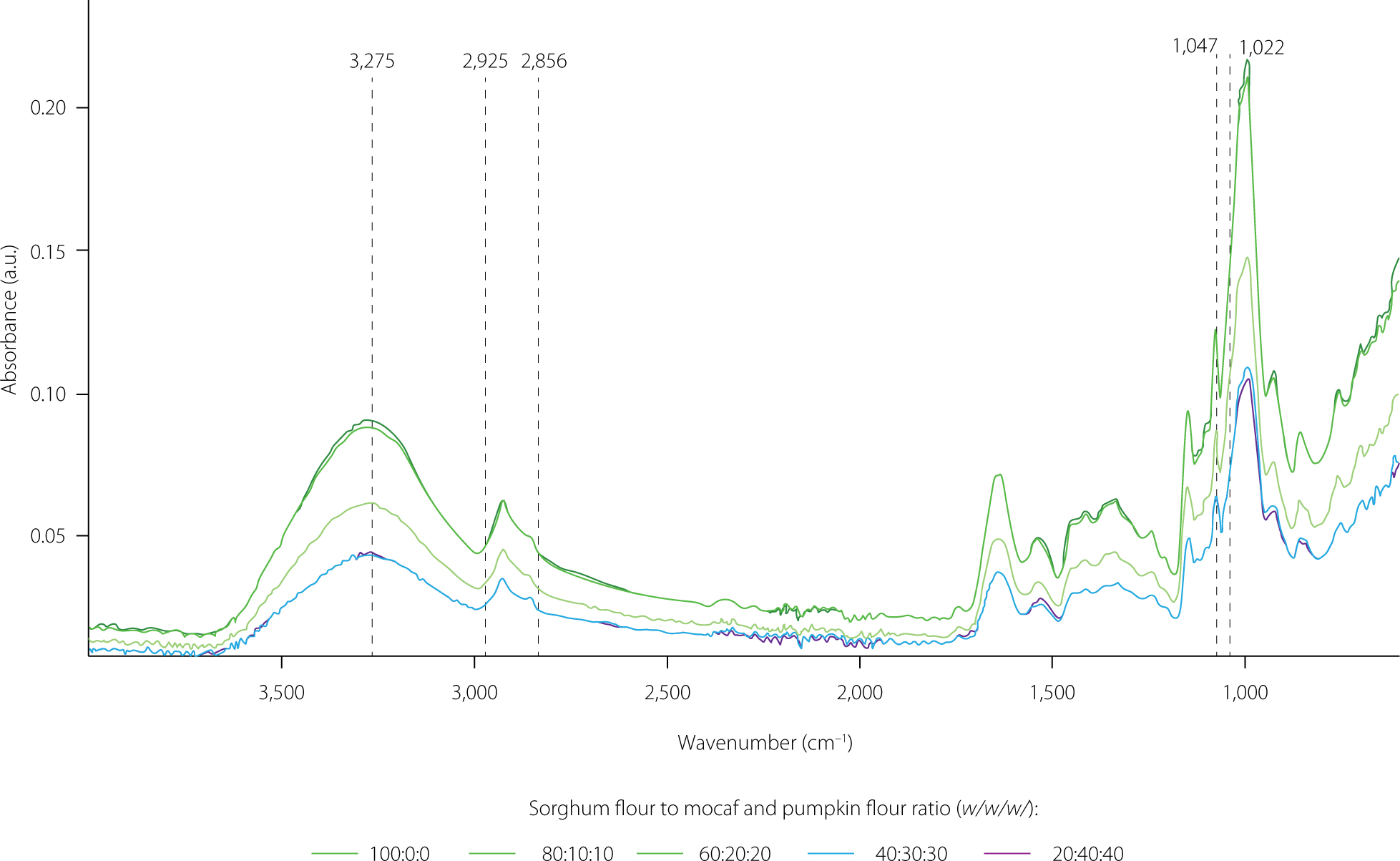
All rice analogs showed a broad band at approximately 3,275 cm−1 (Figure 1), corresponding to O–H stretching from starch hydroxyl groups and bound water. The intensity of this band was the highest for products from 100:0:0 and 80:10:10 (w/w/w) formulations, intermediate for the rice analog from the 40:30:30 (w/w/w) formulation, and lowest when the flour blends at the 60:20:20 and 20:40:40 (w/w/w) ratios were used, indicating differences in hydrogen-bonding interactions within the matrix. The bands at 2,925 and 2,856 cm−1 correspond to the asymmetric and symmetric C–H stretching vibrations of aliphatic groups [Kıymaz et al., 2025]. In the 1,200–900 cm−1 fingerprint region, all formulations exhibited bands at 1,047 and 1,022 cm−1, which are commonly associated with the crystalline and amorphous regions of starch, respectively [van Soest et al., 1995].
Microstructure of rice analogs
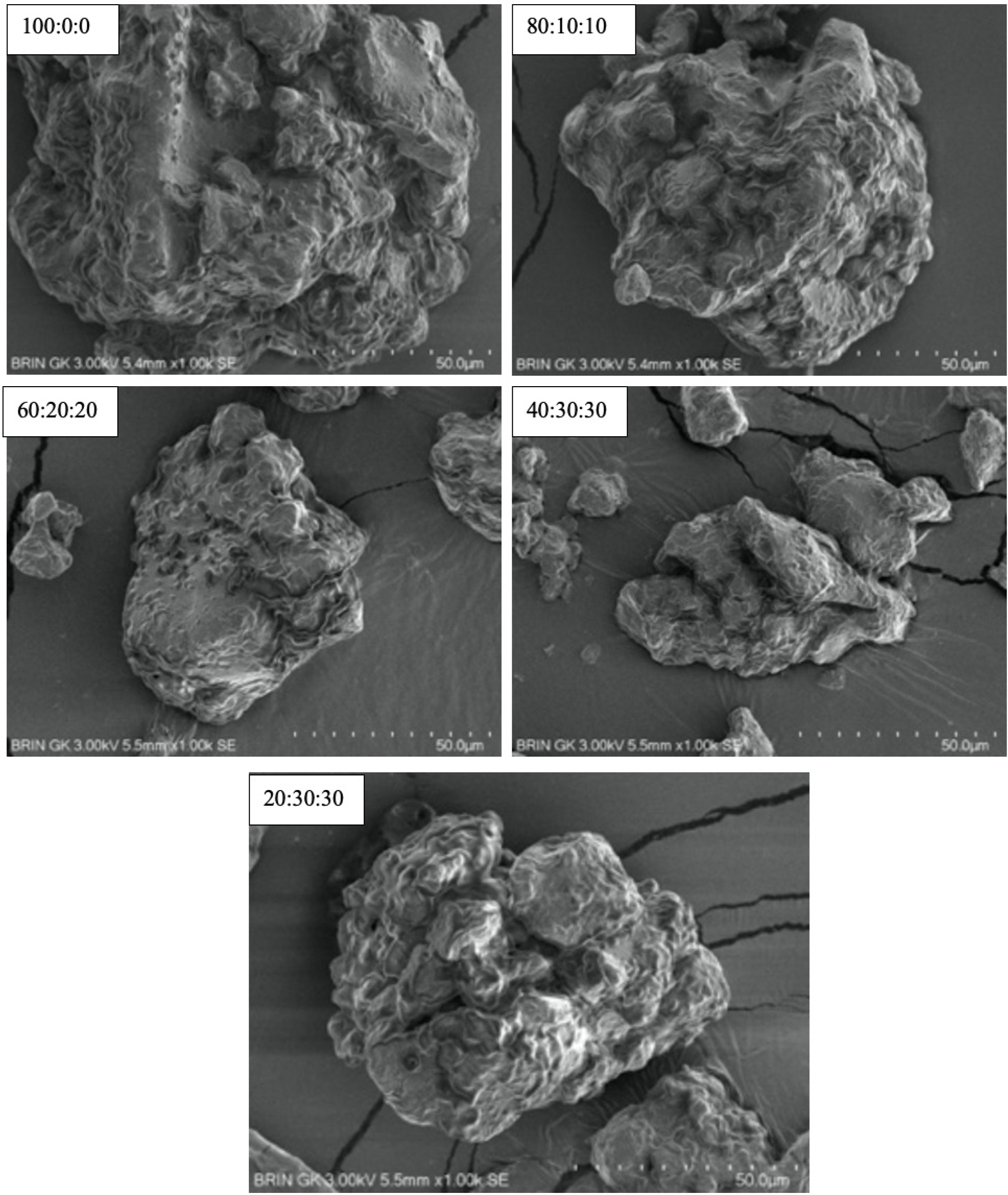
SEM images show that increasing the substitution of sorghum flour with mocaf and pumpkin flour in the formulations from 100:0:0 to 20:40:40 (w/w/w) progressively modified the morphology of the rice analogs (Figure 2). The 100:0:0 formulation formed a compact and homogeneous matrix with minimal pores, indicating a continuous starch network and uniform gelatinization. In turn, the rice analogs produced from sorghum flour, mocaf and pumpkin flour at 80:10:10 and 60:20:20 (w/w/w) ratios exhibited microcracks and small cavities, resulting from the disruption of matrix continuity by non-starch components. The rice analogs obtained from flour blends in the 40:30:30 and 20:40:40 (w/w/w) ratios showed more pronounced porosity and cracks, indicating weakening of the starch network and structural heterogeneity after processing. These structural changes are consistent with the observed increase in water absorption capacity and a decrease in bulk density, suggesting that greater porosity facilitates water penetration and reduces matrix compactness. The more open and discontinuous matrix structure explains the observed reduction in hardness and cohesiveness in the texture profile analysis. This indicates weaker internal bonding within the gel network. Such morphological changes may also be related to starch reorganization during processing and cooling, which can influence the development of heterogeneous regions within the matrix [Chang et al., 2021]. In this study, the presence of pores and discontinuities in high-substitution formulations suggests that structural rearrangement occurs alongside increased incorporation of non-starch components. This structural modification contributes to the observed variations in the physicochemical and textural properties of the rice analogs.
Sensory acceptance of cooked rice analogs
Based on the 5-point hedonic scale, all rice analogs received mean scores above 3.0 for color, aroma, taste, texture, and overall acceptance, indicating acceptable consumer responses (Figure 3). The rice analog produced from the sorghum flour, mocaf, and pumpkin flour blend at the ratio of 40:30:30 (w/w/w) received the highest mean scores for taste and aroma. Furthermore, its overall acceptance score was high, although did not differ significantly (p≥0.05) from that of the product based on sorghum flour, mocaf, and pumpkin flour at the 60:20:20 (w/w/w) ratio. Rice analogs made from formulations containing higher proportions of pumpkin flour (60:20:20, 40:30:30, and 20:40:40, w/w/w) received the highest color scores (4.00), which may be attributed to the presence of β-carotene pigment in pumpkin flour [Ninčević Grassino et al., 2023]. Aroma and taste scores improved with increasing proportions of mocaf and pumpkin flour in the formulation up to the 40:30:30 (w/w/w) formulation, whereas the 20:40:40 (w/w/w) formulation did not show further improvement. This trend may be related to differences in the composition of the flour blends and flavor development during processing.
Figure 3
Sensory acceptance of cooked rice analogs produced from sorghum flour, mocaf, and pumpkin flour blended in various proportions. Results are shown as mean and standard deviation. Different letters (a–d) above the bars within the same sensory attribute indicate significant differences (p<0.05).
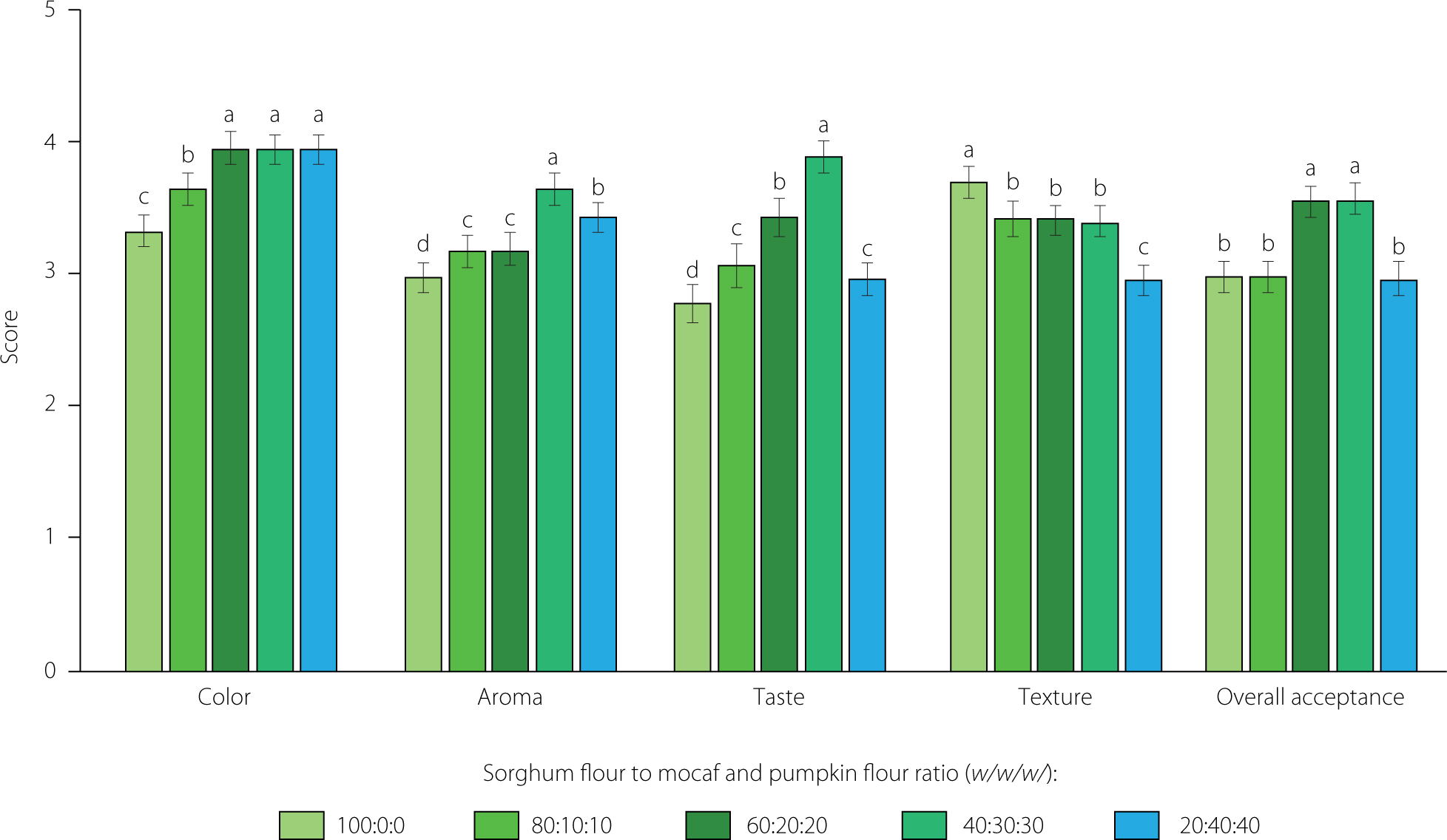
No significant differences (p≥0.05) were observed in texture acceptance among the rice analogs from 80:10:10, 60:20:20, and 40:30:30 (w/w/w) formulations. The texture of the sorghum flour product was rated the highest, while the texture of rice analog made from a flour blend at the 20:40:40 (w/w/w) ratio received the lowest score. Comparison of these results with the instrumental texture measurements suggests that texture acceptance was not solely determined by hardness and chewiness values among the formulations.
CONCLUSIONS
Increasing the proportion of mocaf and pumpkin flour in sorghum-based instant rice analogs significantly affected their chemical composition, functional properties, structural characteristics, and starch digestibility. Substitution of sorghum flour with mocaf and pumpkin flour increased contents of crude fiber, β-carotene, and total phenolics, and the proportions of slowly digestible starch and resistant starch, while decreased rapidly digestible starch, total starch digestibility, bulk density, and texture hardness. FTIR analysis indicated no formation of new functional groups but suggested changes in starch organization associated with an increased amorphous fraction, whereas SEM observations revealed greater matrix porosity and structural heterogeneity. These structural modifications were consistent with the higher hydration capacity and softer texture observed after cooking. Among the formulations evaluated, the sorghum flour, mocaf, and pumpkin flour blend at 40:30:30 (w/w/w) ratio provided the most favorable balance between functional properties and sensory acceptance of rice analogs. Overall, the developed rice analogs demonstrate potential as a locally sourced functional food with increased contents of bioactive compounds and a modified starch digestibility profile.