INTRODUCTION
Bergamot (Citrus bergamia Risso) is a tree belonging to the Rutaceae family, native to Western India, with fruits resembling yellow oranges in size and shape. Distinguished by health-promoting compounds that are uncommon in other citrus fruits, bergamot is valued for its rich flavonoid profile and volatile organic compound composition, which have led to numerous industrial and functional applications [Baron et al., 2021; Dosoky & Setzer, 2018; Forlot & Pevet, 2012; Nogata et al., 2006]. However, due to its acidic and bitter taste, bergamot is not widely consumed as a fruit juice, thereby increasing interest has aroused in the alternative utilization of pectin and bioactive compounds derived from its juice and albedo fractions [Ballistreri et al., 2021; Capomolla et al., 2019; Navarra et al., 2020]. Bergamot juice, peel, and albedo contain considerable amounts of health-promoting compounds and pectin with potential prebiotic properties. Nevertheless, the fruit is primarily processed for essential oil extraction from the peel, leaving a substantial portion of the remaining biomass underutilized and discarded as waste [Di Donna et al., 2020; Gattuso et al., 2023].
Among these bioactive compounds, phenolic compounds, particularly flavonoids, have attracted considerable attention due to their significant pharmacological properties. Approximately 61 phenolic compounds have been identified in various parts of the bergamot fruit, including the pulp, peel, flavedo, and albedo [Baron et al., 2021]. Most of these compounds are glycosides and acetyl derivatives of flavones and flavanones [Baron et al., 2021; Nogata et al., 2006; Pernice et al., 2009]. Neoeriocitrin, naringin, neohesperidin, naringin dioxalate, and neohesperidin dioxalate constitute nearly 90% of flavanone O-glycosides [Delle Monache et al., 2013]. The flavonoids present in bergamot exhibit numerous bioactivities, including anticancer, antioxidant, anti-inflammatory, antidiabetic, antibacterial, and antifungal properties as well as protection against the metabolic syndrome [Ortiz et al., 2022; Shilpa et al., 2023]. Research suggests that the antiproliferative and pro-apoptotic effects observed in cancer cells are associated with the suppression of cyclooxygenase-2 (COX-2) expression, decreased reactive oxygen species (ROS) levels, modulation of oncogenic signaling pathways, and down-regulation of nuclear transcription factor kappa B (NF-kB) [Delle Monache et al., 2013].
As studies have elucidated the impact of colon health on overall well-being, prebiotics and probiotics used in fermentation technology are gaining increasing importance and are becoming highly researched. Fermentation plays a key role in the food industry by contributing to the production of functional foods and beverages with an enhanced nutritional value and contents of health-promoting compounds, such as bioactive compounds with increased bioavailability and beneficial end products like short-chain fatty acids (SCFAs) [Cecchi et al., 2024]. Ongoing studies are aimed at identifying bacterial strains during fermentation that do not reduce the concentrations of key components [Di Donna et al., 2020]. Lactobacillus species, particularly Lactobacillus plantarum, play a significant role among the bacteria commonly used in lactic acid fermentation. L. plantarum is widely used in the fermentation of various food products such as dairy, pickles, fermented beverages, and fermented vegetables. L. plantarum is recognized as safe by the Food and Drug Administration (FDA) because of its probiotic features, ability to adapt to environmental conditions, and ability to withstand different pH levels, temperatures, and salt concentrations [Behera et al., 2018].
Processing and consumption of the fruit generate considerable amounts of by-products, accounting for nearly half of the total fruit weight and consisting mainly of peels, seeds, pulp, and segment residues. This waste contains substantial quantities of bioactive compounds and exhibits a high biological oxygen demand, thereby contributing to environmental pollution [Di Donna et al., 2020]. Limited research has investigated the valorization potential of bergamot fruit, including its albedo, through microbial fermentation, particularly regarding its effects on bioactive compound composition, antioxidant activity, and prebiotic potential. Therefore, this study aimed to evaluate the potential of L. plantarum fermentation to enhance the functional properties of bergamot fruit, including the non-consumable albedo fraction, by analyzing total phenolic content, antioxidant capacity, flavonoid composition, and prebiotic characteristics.
MATERIALS AND METHODS
Preparation of a bergamot homogenate
Approximately 10 kg of bergamot fruit commercially sourced from a local grower in the Antalya region in Turkey was used in this study. The fruits were washed with an iodine solution, rinsed, and peeled. The albedo portions were retained. The peeled fruits were homogenized using a Waring 8011 blender (Waring Laboratory Science, Torrington, CT, USA) and stored at −80°C until the completion of the study.
Fermentation process
A commercially obtained probiotic strain of L. plantarum (Swanson Health Products, Fargo, ND, USA) was reactivated by inoculating it into De Man, Rogosa, and Sharpe (MRS) broth (Biokar Diagnostics, Beauvais, France) and grown at 36°C for 24 h. A bergamot homogenate (75 mL corresponded to 75 g of fruits) was diluted with sterile distilled water at a 1:4 (v/v) ratio (total volume of 300 mL) and adjusted to pH 7.0 using 3 M KOH. Two different experimental setups were implemented: a control group without bacteria addition and a fermentation group inoculated with L. plantarum, 106 CFU/mL (LP group). The experimental design was adapted from Hashemi & Jafarpour [2020]. To determine the optimal growth conditions, parameters such as temperature and incubation time were optimized, and 30°C for 6 days were identified as optimal for growth.
Samples (300 mL) collected on days 0, 2, 3, 4, and 6 were centrifuged at 2,650×g for 30 min using a 5804 R centrifuge (Eppendorf, Hamburg, Germany), and the supernatant was used for future analysis of pH, total phenolic content, antioxidant capacity, and individual phenolic compound content. The fermentation experiments were carried out in three independent batches prepared at different times under identical conditions. Samples collected at each time point were analyzed in triplicate.
Determination of total live bacteria count
For each sampling day, 100 μL of bergamot homogenates from both the control and fermentation groups were taken, serially diluted, and plated on MRS agar for the determination of viable L. plantarum counts. The control group was used to verify the absence of contamination by indigenous lactic acid bacteria (LAB). The plates were incubated at 36°C for 48 h [Multari et al., 2020]. The visible colonies were enumerated, and the results were presented as log CFU/mL of product.
Determination of antioxidant capacity
2,2-Diphenyl-1-picrylhydrazyl radical scavenging activity determination
A solution of 3.54 mg of 2,2-diphenyl-1-picrylhydrazyl (DPPH) radicals (TCI, Tokyo, Japan) in 150 mL of methanol was prepared by placing in an ultrasonic bath (VCX 130 PB, Sonics and Materials, Inc., Newtown, CT, USA) for 30 min. After passing through a 0.45 μm filter, supernatants of both control and LP groups were diluted at 1/20, and this dilution was used to calculate the results from the Trolox calibration curve. Sample solutions (0.1 mL) were mixed with 3.9 mL of a DPPH• solution. The absorbances were read at 515 nm after 30 min of incubation in the dark [Brand-Williams et al., 1995]. For the calibration curve, Trolox (Sigma-Aldrich, Saint Louis, MO, USA) solutions at concentrations of 100, 50, 25, 12.5, 6.25, and 3.125 μmol/L were prepared and analyzed under the same conditions. The results were expressed as mmol Trolox/L of supernatant.
2,2’-Azinobis(3-ethylbenzothiazoline-6-sulfonic acid) assay
A mixture of 360.2 mg of 2,2’-azino-bis(3-ethylbenzothiazoline-6-sulfonic acid) (ABTS; Sigma-Aldrich) and 67.5 mg of potassium persulfate (Sigma-Aldrich) was prepared, completed to 100 mL with a methanol and water mixture (80:20, v/v), and left for 16 h [Re et al., 1999]. Prior to analysis, 30 mL of this solution with generated ABTS•+ was adjusted to an absorbance of 0.7 at 734 nm by adding 300 mL of a methanol and water solution (80:20, v/v). The calibration curve was prepared using Trolox solutions with a concentration range from 3.125 to 100 μmol /L. For the reaction, 100 μL of the sample or the standard solution was mixed with 3.9 mL of the ABTS•+ solution and left for 15 min in the dark at room temperature, absorbance was then measured at 734 nm. ABTS•+ scavenging activity was expressed as mmol Trolox/L of supernatant based on the standard curve.
Determination of total phenolic content
The total phenolic content of the bergamot supernatant was analyzed using the Folin-Ciocalteu reagent [Singleton et al., 1999]. In this method, 300 μL of supernatants were mixed with 1.5 mL of the Folin-Ciocalteu reagent (Merck, Darmstadt, Germany) diluted 10 times and 1.2 mL of a 7.5% (w/v) solution of sodium carbonate (Merck). After vortex mixing, the tubes were incubated in the dark at 25°C for 90 min, and absorbances were measured at 760 nm using a spectrophotometer (T80+ UV/VIS spectrometer, PG Instruments, Lutterworth, UK). The total phenolic content was calculated using gallic acid standard curve and expressed as mg gallic acid equivalent (GAE)/mL of supernatant.
Analysis of phenolic compound composition
The phenolic compounds were identified and quantified in the collected samples using liquid chromatography-diode array detection–electrospray ionization-mass spectrometry (LC-DAD-ESI-MS/MS) according to the procedure adapted from Kelebek et al. [2020]. An Agilent 1100 HPLC system (Agilent Technologies, Santa Clara, CA, USA) with a diode array detector equipped with Windows NT-based ChemStation software was used for phenolic compound analysis. A reverse-phase Luna C18 column (4.6×250 mm, 5 μm diameter; Phenomenex, Torrance, CA, USA) was employed. Two different solvents were used in the mobile phase: solvent A consisting of water and formic acid (99:1, v/v) and solvent B consisting of solvent A and acetonitrile (60:40, v/v). Phenolic compounds were eluted under the following conditions: 0–5 min, 0% B; 5–25 min, 0–5% B; 25–43 min, 5–15% B; 43–57 min, 15–25% B; 57–88 min, 25–50% B; and 88–91 min, 50–100% B. The flow rate was set at 0.5 mL/min, and the temperature was maintained at 25°C. Ultraviolet-visible (UV-Vis) spectra (from 200 to 800 nm) were recorded for all the peaks. Samples were also analyzed using an Agilent 6430 LC-MS/MS system (Agilent Technologies) equipped with an electrospray ionization source. Detection was performed in a negative ion mode under optimized conditions: capillary temperature 400°C, capillary voltage −3 V, nebulizer gas flow 1.75 L/min, desolvation gas flow 1 L/min, and spray voltage 5 kV. The identification of neoeriocitrin, naringin, and neohesperidin was performed by comparing their retention times and UV spectra with those of authentic standards, and the identities were further confirmed by LC-ESI-MS/MS analysis in a multiple reaction monitoring (MRM) mode. Neoeriocitrin, naringin, and neohesperidin standards were purchased from Sigma-Aldrich. Neoeriocitrin dioxalate, melitidin, and neohesperidin dioxalate were tentatively identified based on their UV spectra, MS/MS fragmentation patterns, and literature data. These tentatively identified compounds were semi-quantified as equivalents of the structurally closest available standards. Quantification was carried out using calibration curves prepared from the available authentic standards, with regression coefficients consistently exceeding 0.995. The calculated amounts of phenolic compounds were expressed as mg/L of supernatant.
Statistical analysis
The data obtained in this study were analyzed using SPSS Statistics for Windows 25.0 (IBM, Armonk, NY, USA). For quantitative data comparisons in normally distributed datasets, an independent t-test was applied for differences between two independent groups, whereas a one-way analysis of variance (ANOVA) was used for comparisons involving more than two independent groups. In cases where a significant difference was found, Duncan’s post-hoc test was used to identify the specific group(s) causing the difference. Differences were considered significant at p<0.05. Correlation analysis was conducted to examine the relationships between the two variables.
RESULTS AND DISCUSSION
Total live bacteria count and pH
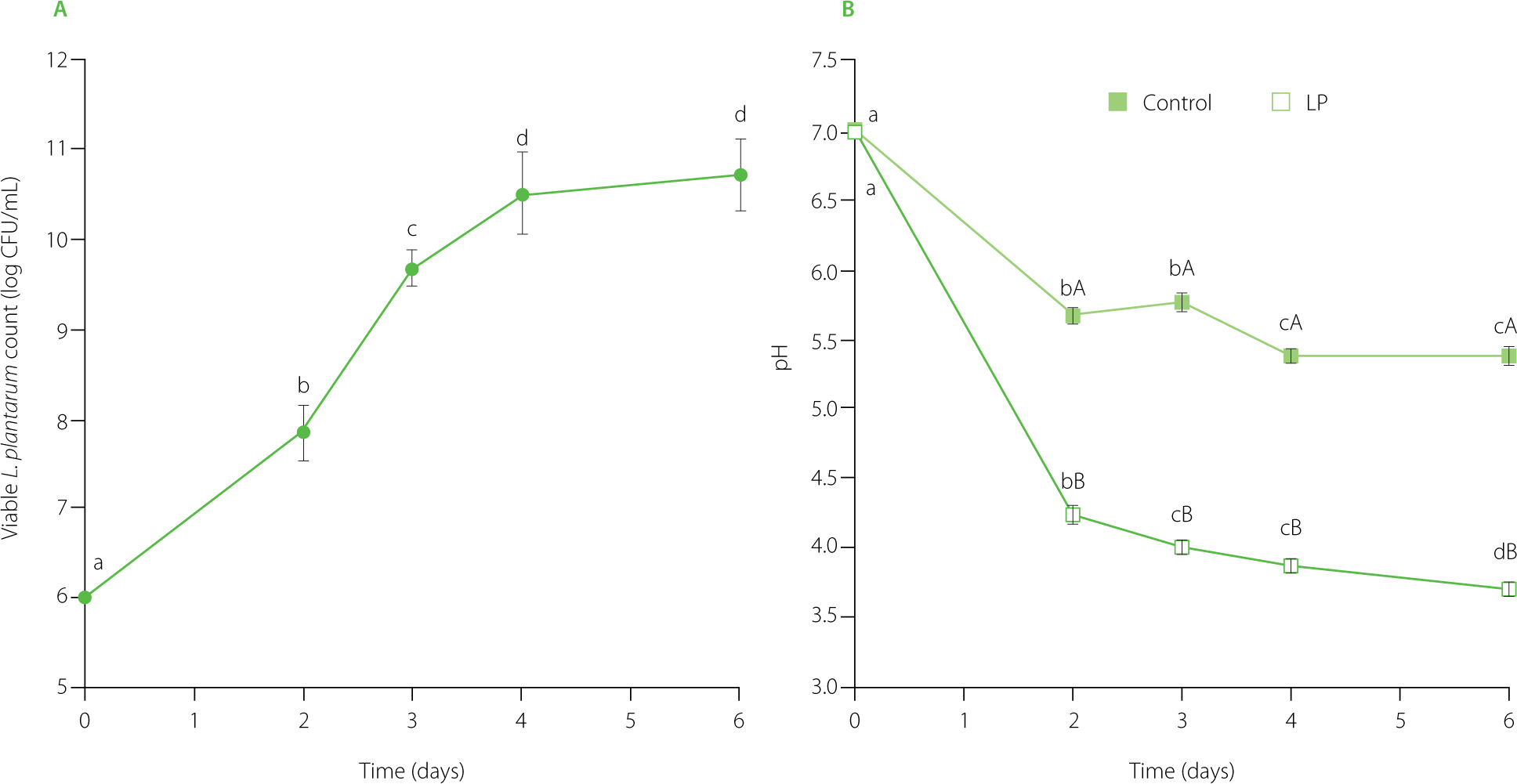
The growth rate of probiotic strains can vary based on the composition and physicochemical properties of the food as well as the metabolic capacity and nutritional requirements of the microorganisms. L. plantarum requires a limited number of amino acids compared to other lactic acid bacteria, which may require more than fifteen amino acids for optimal growth [Gokavi et al., 2005]. The growth kinetics of L. plantarum and the corresponding pH changes during fermentation of bergamot fruit homogenate are presented in Figure 1. L. plantarum exhibited a prolonged adaptation phase in the homogenate, characterized by relatively slow growth during the first 48 h, followed by a marked increase in viable cell counts. Growth stabilized on the 4th day and reached 10.7 log CFU/mL (5.3×10¹⁰ CFU/mL) by the 6th day, at which point fermentation was terminated. Throughout the fermentation period, pH values in the LP group decreased. In the control group, pH also decreased, but reached the equilibrium on day 4. Significant differences were observed between the control and LP groups on each day of fermentation (p<0.05). Final pH values were 5.4 for the control group and 3.7 for the LP group, indicating active acid fermentation. In a study by Hashemi & Jafarpour [2020], fermenting bergamot juice with L. plantarum subsp. plantarum PTCC 1896, L. plantarum AF1, and L. plantarum LP3 for 72 h resulted in an increase in the live cell count of L. plantarum AF1 from 6 log CFU/mL to 8.9 log CFU/mL. Although the overall growth patterns observed in the present study are consistent with previous findings, the relatively slower growth rate may be attributed to the use of a single bacterial strain and the absence of cross-feeding interactions that typically occur in mixed microbial consortia [Hashemi & Jafarpour, 2020]. Owing to the delayed adaptation of L. plantarum to the bergamot homogenate medium, fermentation was extended to six days, at which point maximum viable counts were achieved. These findings support the potential of bergamot homogenate as a substrate with prebiotic characteristics capable of sustaining probiotic growth.
Figure 1
(A) Changes in viable L. plantarum counts in bergamot homogenate during 6 days of fermentation. No growth was detected in the control group, and therefore it was not illustrated in the figure. (B) Changes in pH during fermentation of bergamot homogenate inoculated with L. plantarum (LP) and the control group. Different lowercase letters indicate significant differences between fermentation days within the same group, whereas different uppercase letters indicate significant differences between the LP and control group on the same fermentation day (p<0.05).
Antioxidant capacity
Fermentation may influence the antioxidant properties of plant-based substrates by modifying the composition, availability, and activity of phenolic compounds. Microbial enzymatic activities can promote the release of bound phenolics and facilitate their transformation into compounds with different antioxidant characteristics. Consequently, fermentation has the potential to alter the antioxidant capacity of food matrices, making the assessment of antioxidant activity an important parameter in evaluating the functional properties of fermented products [Hur et al., 2014].
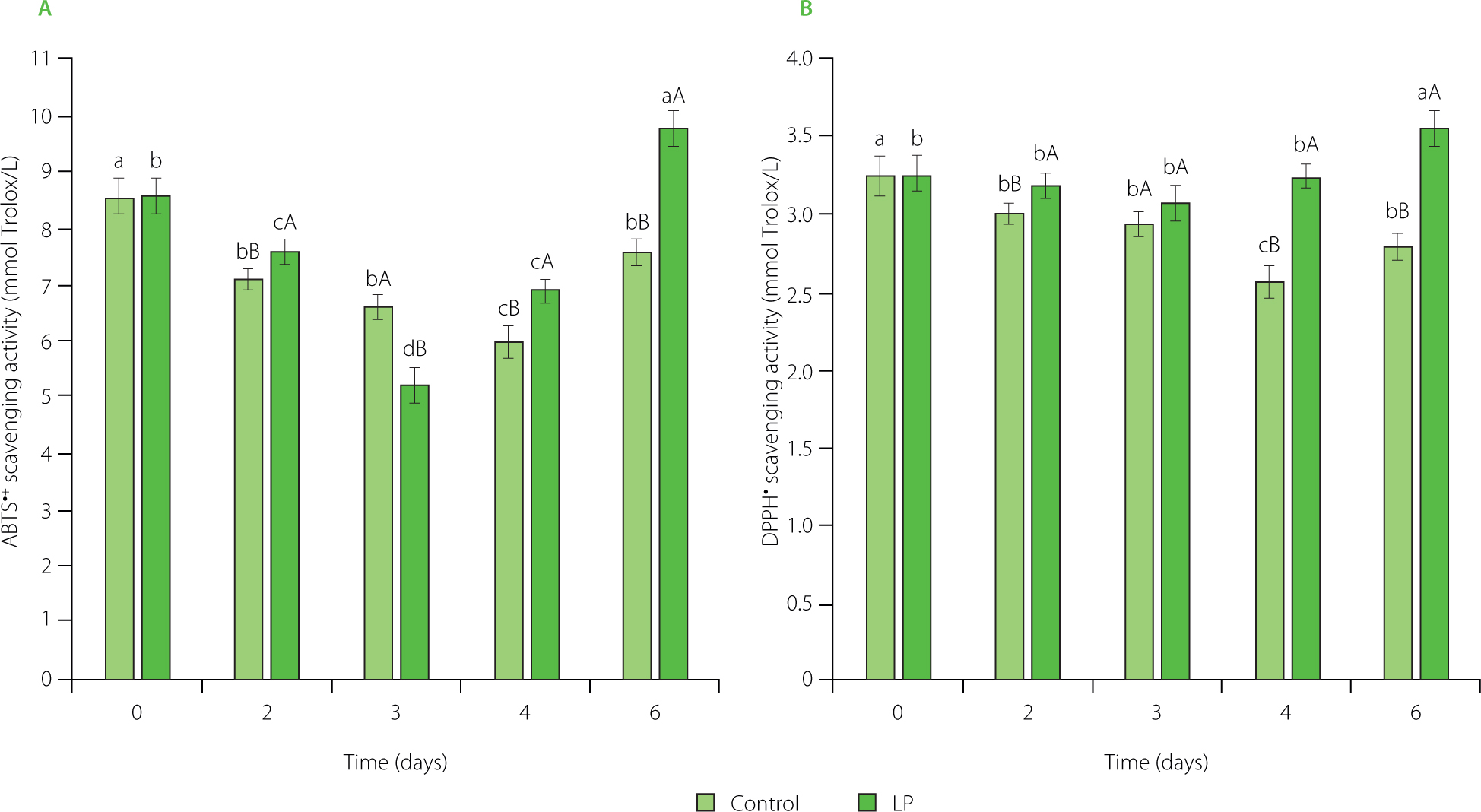
To ensure a reliable determination of the antioxidant capacity, two assays (DPPH and ABTS assays) were used. As depicted in Figure 2, the antioxidant capacity of the supernatant from the untreated bergamot homogenate (day 0) was determined as 8.56 mmol Trolox/L using the ABTS assay and 3.25 mmol Trolox/L using the DPPH assay. During the fermentation period, some fluctuations in antioxidant activity were observed in the ABTS assay; it decreased at the beginning of the process and then increased in both groups. Such fluctuations in DPPH radical scavenging activity were negligible. Nevertheless, following six days of fermentation, antioxidant capacity in the LP group increased to 9.72 and 3.55 mmol Trolox/L, respectively, while in the control group, it decreased significantly (p<0.05) to 7.63 and 2.80 mmol Trolox/L, respectively.
Figure 2
Antioxidant capacity of bergamot homogenate fermented by L. plantarum (LP) and control without bacteria over a period of six days determined using (A) ABTS assay and (B) DPPH assay. Different lowercase letters indicate significant differences between fermentation days within the same group, whereas different uppercase letters indicate significant differences between the LP and control group on the same fermentation day (p<0.05).
Mousavi et al. [2013] observed a similar increase in the antioxidant activity in the DPPH assay after the 72-h fermentation of pomegranate juice with L. plantarum and L. acidophilus. In another study in which sweet lemon juice was fermented with L. plantarum LS5, a significant increase in DPPH radical scavenging activity and ferric-reducing antioxidant power (FRAP) was reported as a result of lactic acid fermentation [Hashemi et al., 2017]. The increase in antioxidant activity is positively associated with changes in phenolic composition during fermentation [Adebo et al., 2018]. It may be attributed to the enzymatic hydrolysis of glycosidic bonds in phenolic compounds and release of aglycones, which are generally more active than their glycosidic forms, or the generation of other metabolites with higher antioxidant potential [Adebo et al., 2018]. In addition, fermentation-induced structural disruption of plant cell walls may facilitate the release of bound phenolic compounds, thereby contributing to the observed antioxidant effects [Katina et al., 2007; Zhang et al., 2025].
Hashemi & Jafarpour [2020] examined bergamot juice fermented for 72 h using L. plantarum subsp. plantarum PTCC 1896, L. plantarum AF1, and L. plantarum LP3. The authors revealed that the juice fermented with L. plantarum strains exhibited greater antioxidant potential than the control juice fermented with natural flora. This observation is confirmed by the results of our research; in both antioxidant assays, indicating that antioxidant capacity of LP group homogenates was higher than of the control group homogenates after 6 days of fermentation (Figure 2).
Phenolic compound content
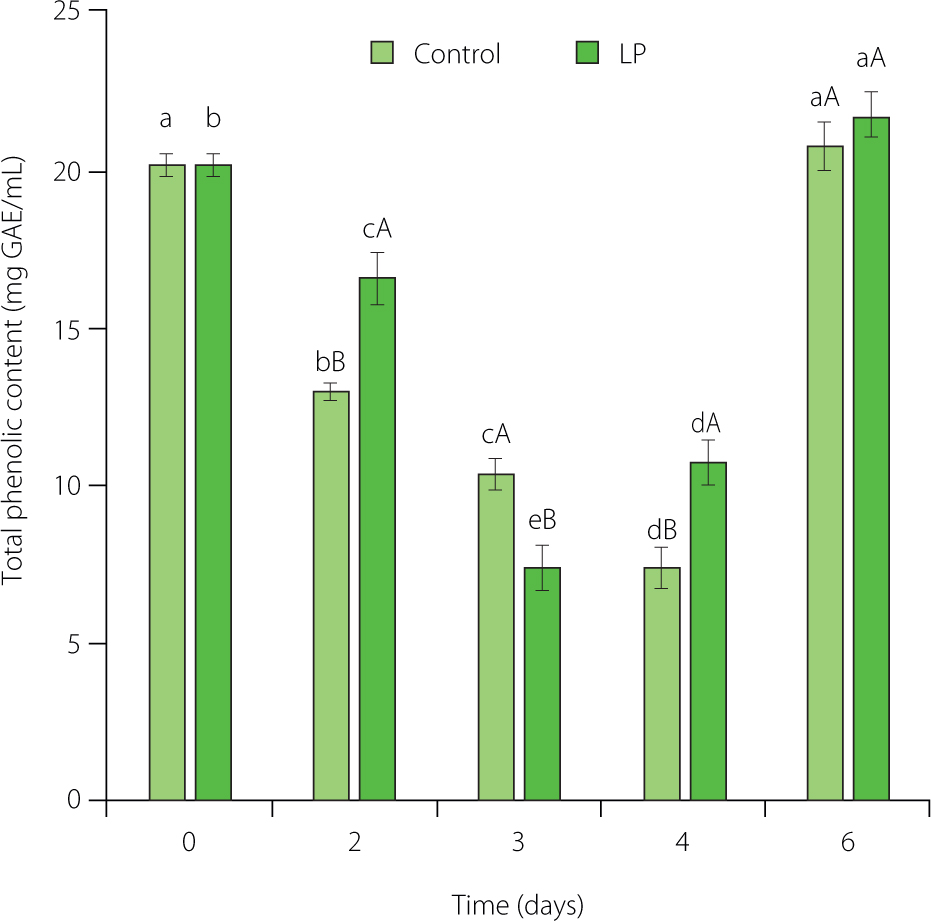
Changes in the total phenolic content during the six days of bergamot homogenate fermentation are presented in Figure 3. The initial total phenolic content of the bergamot supernatant was determined to be 20.17 mg GAE/mL. At the end of fermentation, the total phenolic content did not change significantly (p≥0.05) in the control group (20.78 mg GAE/mL), however in the LP group it was 21.74 mg GAE/mL and represented a statistically significant increase (p=0.048) compared to the initial total phenolic content. During the first days of incubation, the total phenolic content decreased to 7.32 mg GAE/mL (day 4) and 7.40 mg GAE/mL (day 3) in the control and LP groups, respectively, followed by a recovery by day 6 of fermentation. However, no statistically significant (p≥0.05) differences in total phenolic content were observed between the groups on day 6.
Figure 3
Total phenolic content of bergamot homogenate fermented by L. plantarum (LP) and control without bacteria over a period of six days. Different lowercase letters indicate significant differences between fermentation days within the same group, whereas different uppercase letters indicate significant differences between the LP and control group on the same fermentation day (p<0.05). GAE, gallic acid equivalent.
Hashemi et al. [2017] reported a significant decrease in the total phenolic content during the fermentation of sweet lemon juice with L. plantarum LS5, while Guo et al. [2019] reported no significant changes in the total phenolic content of ougan juice fermented with L. plantarum or L. paracasei. In a similar study, Multari et al. [2020] reported that the effect of lactic acid bacteria on the total phenolic content was specific to orange varieties. They reported that L. rhamnosus increased the phenolic content of ‘Washington navel’ juice but decreased phenolics in juice from the ‘Tarocco’ variety.
The fluctuation in the total phenolic content over fermentation time, which decreased and then increased, may be explained by the majority of compounds in the fruit being in a bound form initially, becoming soluble over time, or their microbial hydrolysis during fermentation [Yu et al., 2015].
Among phenolic compounds, neoeriocitrin, naringin, neoeriocitrin dioxalate, neohesperidin, melitidin, and neohesperidin dioxalate were identified in the bergamot homogenates by LC-MS/MS method. The LC-MS/MS chromotograms used for identification are presented in Figure S1 in Supplementary Materials. All these compounds have been previously detected in bergamot fruits and their products [Baron et al., 2021; Delle Monache et al., 2013; Gattuso et al., 2023]. Most of them are typical of the phenolic profiles of citrus fruits, although neoeriocitrin and neohesperidin distinguish bergamot from others [Nogata et al., 2006]. The contents of identified phenolics in the supernatants from the bergamot homogenates at different fermentation times are shown in Table 1. The sum of individual phenolic compounds in the supernatant from the untreated bergamot homogenate on day 0 was 608.18 mg/L and in the case of the bergamot fermented with L. plantarum, it ranged from 653.70 to 687.92 mg/L, with the highest value (p<0.05) obtained on the 4th day, suggesting that a four-day fermentation period may be sufficient to maximize phenolic availability. Neoeriocitrin was the most abundant in all samples, which can be considered important due to its potential cardioprotective properties [Capomolla et al., 2019]. On the 4th day of fermentation, contents of neoeriocitrin and neoeriocitrin dioxalate in the LP group were 297.23 and 55.86 mg/L, respectively, showing a statistically significant increase compared to the supernatant of the untreated homogenate on day 0 and the control group on day 4. In the control group, neoeriocitrin content did not show statistically significant differences between 0, 4, and 6 days of fermentation (p≥0.05), and neoeriocitrin dioxalate showed a numerical increase on day 4, followed by a decrease by day 6; however, these changes were not statistically significant (p≥0.05). The content of naringin, which has been associated with antioxidant and anti-inflammatory activities [Shilpa et al., 2023], was 158.01 mg/L in the control group on the 4th day and 160.37 mg/L in the LP group on the same day. These values were significantly (p<0.05) higher than that in the supernatant from raw homogenate (138.26 mg/mL). On the 6th day of fermentation, a statistically significant reduction was noted in naringin content compared to day 4 in LP group (p<0.05). The content of melitidin, which showed statin-like activity and cardioprotective effects [Shen et al., 2023; Wang et al., 2026], was observed to significantly (p<0.05) decrease in both groups to 44.82 mg/mL (control) and 39.00 mg/mL (LP group) compared to that determined on day zero (49.68 mg/mL). The content of neohesperidin dioxalate in the control group did not differ significantly (p≥0.05) on day 0 and day 6, while in the LP group, it decreased gradually with fermentation time to 72.04 mg/L on the 6th day (p<0.05). Overall, a fermentation period of four days was sufficient to enhance the content of main phenolic compounds of bergamot homogenate, including neoeriocitrin and naringin. The 4-day fermentation also promoted increases in neoeriocitrin dioxalate content. However, melitidin content decreased significantly during fermentation with LP.
Table 1
Content of phenolic compounds in the supernatant from the bergamot homogenate fermented by L. plantarum (LP) and control without bacteria over a period of six days analyzed by LC-DAD-ESI-MS/MS (mg/L).
[i] Results are presented as mean ± standard deviation. In rows, different lowercase letters followed by values indicated significant differences between fermentation days within the same group, whereas different uppercase letters indicate significant differences between the LP and control group on the same fermentation day (p<0.05). Rt, retention time.
Fermentation with bacteria exhibiting β-glucosidase activity may lead to a decrease in flavonoid glycosides due to hydrolysis, whereas bacteria possessing esterase activity can promote the release and accumulation of flavonoid compounds [Guo et al., 2019]. Multari et al. [2020] reported decreased hesperidin and narirutin contents when orange juice was fermented with Lactobacillus strains. In a study on vinegar produced from bergamot wine with Acetobacter strains, the levels of neoeriocitrin, neohesperidin, melitidin, and brutieridin decreased, whereas the naringin level increased compared with the levels determined in bergamot wine [Di Donna et al., 2020]. In another study by Tang et al. [2022], fermented citrus fruits (grapefruit, kumquat, blood orange) with 10 strains of lactic acid bacteria grapefruit showed an increase in naringin content, while the content of hesperidin and neohesperidin decreased in blood oranges.
Correlation analysis revealed significant associations between specific phenolic compounds within the LP group. Positive correlations were observed between neoeriocitrin and naringin contents (correlation coefficient, r=0.807, p<0.01), as well as between contents of neoeriocitrin and its dioxalate derivative (r=0.673, p<0.05), while negative correlations were detected between contents of neoeriocitrin and melitidin (r=–0.830, p<0.01). A statistically significant positive correlation was detected between levels of naringin and neoeriocitrin dioxalate (r=0.976, p<0.01), but a negative correlation was observed between naringin and melitidin contents (r=−0.847, p<0.01). The content of melitidin and neohesperidin dioxalate correlated positively (r=0.739, p<0.01), and the content of neoeriocitrin dioxalate and melitidin correlated negatively (r=−0.770, p<0.01).
A significant positive correlation was also detected between neoeriocitrin content and L. plantarum viable counts (r=0.704, p<0.05), whereas negative correlations were observed between live bacterial counts and melitidin (r=−0.736, p<0.01) and neohesperidin dioxalate (r=−0.726, p<0.01) contents. These findings suggest an association between microbial growth dynamics and phenolic transformations during fermentation, although causal relationships cannot be inferred.
Phenolic compounds found in bergamot have been observed to exert beneficial effects on health, providing protection against cancer, diabetes, and neurodegenerative diseases [Ferlazzo et al., 2020; Fogacci et al., 2023; Navarra et al., 2020]. In an experimental model, the oral administration of bergamot juice to Wistar rats improved blood cholesterol levels [Miceli et al., 2007]. The authors reported that the administration of bergamot juice containing neoeriocitrin, naringin, and neohesperidin decreased cholesterol, triglyceride, and low-density lipoprotein (LDL) cholesterol levels. Moreover, there was an increase in high-density lipoprotein (HDL) cholesterol levels compared to those in hypercholesterolemic controls. In another study conducted by Toth et al. [2016], 80 hypercholesterolemic patients received bergamot flavonoids at 150 mg/day for 6 months. The results showed a reduction in the total cholesterol, LDL cholesterol, and triglyceride levels and an increase in HDL cholesterol levels, suggesting a cardioprotective effect.
CONCLUSIONS
The results of this study demonstrate that fermentation of bergamot homogenate with L. plantarum led to the stabilization or enhancement of contents of key phenolic compounds, particularly neoeriocitrin and naringin, when compared with the non-fermented control. Fermentation was associated with an increase in ABTS radical scavenging activity, which reached its highest value on day 6 of fermentation. Notably, neoeriocitrin was quantified as the main phenolic compound in bergamot homogenates using LC-DAD-ESI-MS/MS analysis, and its content was positively associated with L. plantarum growth during fermentation. Despite its high flavonoid content, bergamot is not widely consumed due to its bitter taste, which points to the need for seeking alternative methods to make its beneficial compounds more accessible. Our study findings suggest that L. plantarum-mediated fermentation is a promising approach to enhance the functional value of bergamot, by improving its phenolic composition and antioxidant potential, thereby supporting its potential application in functional food development.