INTRODUCTION
The rising prevalence of nutrition-related diseases, such as obesity, heart disease, and certain cancers, has driven a surge in consumer demand for healthy and nutritious food options. The World Health Organization (WHO) advocates food fortification to address malnutrition, adding functional ingredients and nutrients without compromising safety, shelf-life, or consumer appeal [Dary & Hurrell, 2006]. The term “food fortification”, as a public strategy, is the process of the intentional addition of nutrients or non-nutrient bioactive compounds to food products to balance the nutritional value or prevent nutrient intake shortfalls and associated deficiencies. Up to now, it functions mostly to increase low dietary intake and prevent malnutrition rather than prevent diagnosable conditions [Olson et al., 2021]. Incorporating fruits and vegetables, rich in nutrients and antioxidants, can be considered as a key strategy for enhancing product quality and reducing the risk of chronic diseases [Hossain et al., 2025].
With a 10.07% annual growth and widespread appeal, bakery goods are well-suited for fortification due to their convenience and palatability [Tasnim et al., 2020]. Muffins are one of the most commonly consumed bakery products worldwide, often enjoyed as a breakfast item, snack, or dessert on various occasions [Kaur & Kaur, 2018; Mildner-Szkudlarz et al., 2016]. However, standard muffin recipes, including wheat flour, vegetable oil, eggs, and milk, generally present a nutritional profile of low dietary fiber, limited key amino acids and minerals, while being high in sugars and lipids [Choi, 2015; Croitoru et al., 2018]. With their low nutrient content and short shelf-life, fortification of muffins fosters potential to increase nutrient and bioactive compound intakes. Driven by a growing interest in nutrition and disease prevention, consumers increasingly demand value-added or functional foods rich in antioxidants and dietary fiber.
A wide range of natural-based nutritional ingredients, such as dietary fiber, protein, antioxidants, and phytochemicals, have been successfully incorporated to enhance muffin’s nutritional value and extend their shelf-life, as evidenced by studies on red capsicum pomace powder [Nath et al., 2018], dried lotus flour [Ashoka et al., 2025], tomato pomace [Marak et al., 2022], pomegranate peel [Giri et al., 2024; Topkaya & Isik, 2019], brewer’s spent grain flour [Bazsefidpar et al., 2024; Shih et al., 2020], and seaweed composite flour [Mamat et al., 2018]. Nath et al. [2018] found that fortifying muffins with red capsicum pomace powder improved their overall quality and enhanced appearance, flavor, texture, fiber content, and antioxidant properties. Furthermore, the fortified muffins exhibited significantly lower hardness and staling rates than the control sample after 15 days of storage. According to Mehta et al. [2018], incorporating tomato pomace into muffins significantly improved their nutritional profile, resulting in higher levels of dietary fiber, vitamin C, antioxidants, and minerals. Despite these benefits, the literature also highlights significant technological trade-offs when incorporating such by-products. For instance, high fiber substitution may lead to texture hardening, loss of loaf volume due to gluten dilution, and color darkening, which may negatively affect consumer acceptance [Ashoka et al., 2025; Gadallah et al., 2022]. These limitations necessitate a careful balance between nutritional enrichment and the maintenance of standard sensory and structural profiles.
Banana (Musa spp.), a member of the family Musaceae, is one of the most significant agricultural commodities worldwide. Global banana trade has recorded high levels of around 20 million tonnes annually [FAO, 2025]. Vietnam contributes significantly to this landscape; as the country’s largest fruit crop covers 163,000 hectares, and the sector produces 2.8 million tons per year [Diep, 2025]. In most areas of the world, the pulp of the banana is used and consumed because of its nutrient content and health advantages, while banana blossoms are mostly underexploited and discarded as agricultural waste. Banana flowers are an excellent source of high-quality protein, dietary fiber, vitamins, and trace minerals, including copper, iron, and magnesium [Lau et al., 2020; Mostafa, 2021]. Additionally, they contain considerable levels of flavonoids, which are known for their bioactive properties [Chiang et al., 2021]. This leads to their high antioxidant capability, which contributes to the mitigation of oxidative stress, a key factor in the development of various cardiovascular diseases. Following Bhaskar et al. [2012], banana flowers have also been proven to possess antihyperglycemic, antimicrobial, hypolipidemic, and anti-hypertensive activities. Therefore, they have been traditionally used in ethnomedicine to treat conditions such as diarrhea, ulcers, and bronchitis. Considering their favorable nutritional composition, banana flowers are used quite widely in Asian cuisines, especially in curries, soups, salads, and cutlets. To enhance both the nutritional value and economic utility of banana flowers, their integration into food products presents a promising avenue for value addition. For instance, Amornlerdpison et al. [2021] reported that an extract with bioactive compounds and antioxidant properties from banana inflorescence was a healthy food supplement in beverages for breastfeeding mothers. Tasnim et al. [2020] used banana blossom powder with various pretreatment methods to supplement plain cake to investigate the nutritional quality, structure, and sensory properties of the product. They demonstrated that banana blossom powder had moderate water (>4 g/g) and oil (>7 g/g) absorption capacities, low solubility and foaming capacity, and hence an appropriate substitution should be controlled to maintain consumer acceptability.
Although several studies have highlighted the nutritional richness of banana flower bracts and their application in various food systems [Gayathry & John, 2024; Senevirathna & Karim, 2024; Silva et al., 2025], research specifically focusing on their integration into muffin formulations remains limited. Therefore, this study aimed to evaluate the effects of incorporating different levels of banana flower powder on muffins’ quality characteristics, bioactive compound contents, and sensory properties, providing further insights into its potential as a functional ingredient in bakery products.
MATERIALS AND METHODS
Materials and chemicals
The inflorescence of fresh banana (Musa × paradisiaca L.), which was grown in Ho Chi Minh City, Vietnam, was collected 12 months post-planting between September and October. Commercial all-purpose wheat flour (Meizan, Calofic, Quang Ninh, Vietnam), sugar (Bien Hoa Co., Dong Nai, Vietnam), oil (Simply, Calofic, Quang Ninh, Vietnam), milk (Vinamilk, Ho Chi Minh City, Vietnam), baking powder (Arm & Hammer, Ewing, NJ, USA), eggs (Ba Huan, Long An, Vietnam), and salt were purchased from a local market in Ho Chi Minh City, Vietnam. All the chemicals were of analytical grade and purchased from Sigma-Aldrich, Inc. (St. Louis, MO, USA), including sulfuric acid, acetone, hexane, sodium hydroxide, boric acid, potassium sulfate, n-octanol, potassium hydroxide, copper(II) sulfate, ethanol, Folin-Ciocalteu reagent, gallic acid, sodium carbonate, sodium nitrite, aluminum chloride, rutin, potassium chloride, sodium acetate, acetic acid, and hydrochloric acid.
Preparation of banana flower powder
Banana flowers were washed under running tap water, and any damaged or wilted portions were removed. The cleaned flowers were manually sliced into 3-mm thick pieces and immersed in a 0.5% (w/v) citric acid solution for 1 h. Subsequently, the sliced flowers were blanched at 90°C for 3 min, drained and dried overnight at 55°C in a drying oven (Memmert GmbH & Co. KG, Schwabach, Germany) until the moisture content of ≤10% was achieved. The dried flowers were then pulverized into powder using a grinder and passed through a 60-mesh sieve. The resulting banana flower powder (BFP) was stored at −20°C for further analyses.
Muffin preparation
Six muffin formulations were prepared with varying BFP levels (Table 1) according to the method of Heo et al. [2019] with minor modifications. Wheat flour (WF) was substituted with BFP (w/w) at 0% (control, designated BFP0), 5% (BFP5), 10% (BFP10), 15% (BFP15), 20% (BFP20), and 25% (BFP25). Eggs, milk, and vegetable oil were combined and stirred manually for 2 min. The well-mixed dry ingredients (wheat flour, baking powder, BFP, and salt) were then added, and the mixture was hand-mixed for approximately 15 s. Equal portions of batter (30 g) were poured into muffin molds and baked at 170°C for 20 min in a pre-heated oven. The baked muffins were removed from the oven and allowed to cool at room temperature for 2 h. Muffins were placed in polypropylene zip-lock bags and stored in a dry and cool place for further analyses. Each batch of baking contained 10 muffins. The samples were prepared in triplicates.
Table 1
Formulas for muffins with wheat flour (WF) substituted with different ratios of banana flower powder (BFP).
Determination of chemical composition of wheat flour and banana flower powder
Chemical composition of WF and BFP was determined following the AOAC International methods, including moisture (AOAC method 934.01), protein (AOAC method 990.03), ash (AOAC method 942.05), crude fiber (AOAC method 978.10), and lipid content (AOAC method 920.39) [AOAC, 2005]. The total carbohydrate content was calculated based on the difference by subtracting the sum of protein, lipid, ash and crude fiber in 100 g from 100 (on dry weight basis).
Determination of pasting properties of blends of wheat flour and banana flower powder
The pasting properties of composite flours were determined using a micro visco-amylograph (Brabender GmbH & Co. KG, Duisburg, Germany). A 15% (w/v) flour suspension in water was subjected to the controlled heating and cooling cycle, including heating from 30°C to 93°C at 7.5°C/min, holding at 93°C for 15 min, cooling from 93°C to 30°C at 7.5°C/min, and holding at 30°C for 15 min [Krishnaiya et al., 2016; Marti et al., 2015]. Key pasting parameters were recorded, including gelatinization temperature (T, °C), peak viscosity (PV), which is the maximum viscosity reached during the heating cycle and reflects the water-binding capacity of starch and the degree of granule swelling, trough viscosity (TV), which is the minimum viscosity reached during the constant temperature (holding) phase and measures the ability of starch to withstand breakdown under shear and heat, and final viscosity (FV), which is the viscosity at the end of the cooling cycle and indicates the ability of starch to form a viscous paste or gel after cooling. Breakdown viscosity (BV) was calculated as the difference between peak viscosity and trough viscosity. A high breakdown value indicates that the starch is less stable under heat and mechanical shear. Setback viscosity (SV) was calculated as the difference between final viscosity and trough viscosity. A higher setback value typically indicates a greater tendency for the gel to firm up or leak water (syneresis). All the viscosities were expressed in Brabender unit (BU), which is an empirical measure of torque resistance.
Determination of antioxidant contents of wheat flour, banana flower powder, and muffins
Total phenolic, flavonoid, and anthocyanin contents of WF, BPF, and muffins were determined. The crumb was used in these tests to minimize the interference from Maillard reaction products typically concentrated in the crust. Following the research of Nath et al. [2018], with slight modifications, the sample (1.5 g) was extracted with 15 mL of 80% (v/v) ethanol at 25°C for 1 h in a shaking incubator. The mixture was then centrifuged at 2,378×g and 4°C for 15 min. The supernatant was collected for measurements.
The total phenolic content (TPC) was determined using the Folin-Ciocalteu colorimetric method based on Singleton et al. [1999] with a minor modification. A 1 mL aliquot of the extract was mixed with 6 mL of distilled water and 1-mL of a 10% (v/v) Folin-Ciocalteu reagent and left in the dark at room temperature for 5 min. Subsequently, 1 mL of a 7.5% (w/v) Na2CO3 solution was added, and the mixture was vortexed for 10 s. After a 1-h incubation in the dark at room temperature, the absorbance was measured at 765 nm using a UV-Vis spectrophotometer (UVD-2960, Labomed Inc., Los Angeles, CA, USA). Gallic acid was used to establish the standard curve (y=0.5998x, R2=0.9989). The results were expressed as mg of gallic acid equivalents (GAE) per 100 g of dry weight (DW).
The total flavonoid content (TFC) was determined using a method adapted from Saeed et al. [2012]. A 1-mL aliquot of the extract was combined with 4 mL of distilled water and 0.3 mL of a 5% (w/v) NaNO2 solution, and allowed to stand for 5 min. Subsequently, 1 mL of a 10% (w/v) AlCl3 solution, 2 mL of a 4% (w/v) NaOH solution, and 2.4 mL of distilled water were added, and the mixture was vortexed for 10 s. Absorbance was measured at 506 nm. Rutin was used to establish the standard curve (y=0.0104x, R2=0.9981). Results were expressed as mg of rutin equivalents (RE) per 100 g DW.
The total anthocyanin content (TAC) was measured according to the method previously used by Saldaña et al. [2021] with modifications. A 1-mL extracted aliquot was mixed with 9 mL of a potassium chloride buffer (pH 1.0) or sodium acetate buffer (pH 4.5) with HCl. Absorbance of both mixtures was then measured at 510 nm and 700 nm. The TAC, expressed as cyanidin 3-glucoside equivalent (CGE), was calculated as follows (1):
where: A was calculated as (absorbance at 520 nm – absorbance at 700 nm)pH1.0 – (absorbance at 520 nm – absorbance at 700 nm)pH4.5, MW is the molecular weight of cyanidin 3-glucoside (449.2 g/mol), DF is a dilution factor, V1 is the volume of the mixture (mL), V0 is the total volume of the extract (mL), V2 is the volume of the extract used for measurement (mL), L is the pathlength (cm), ε is the molar extinction coefficient for cyanidin 3-glucoside (26,900 L/(mol×cm)), m is the weight of the sample subjected to extraction (g), and MC is the moisture content.
Determination of physical properties of muffins
The muffins’ specific volume was determined by the seed replacement method [Çabuk, 2021]. The bulk density of the seeds was determined by filling a container of known volume with seeds and recording their weight. A muffin was then placed in the container, and the volume of displaced seeds was measured. The volume of a muffin was calculated from the weight of displaced seeds and the established bulk density. The specific volume was determined by dividing the muffin volume by its weight.
The muffins’ crumb and crust colors were measured using a color device (RGB-1002, Lutron, Taipei, Taiwan), matching the CIE Lab color scales, determining L* (brightness), a* (green to red), and b* (blue to yellow). The total color difference (∆E) in comparison with the control muffin was then calculated following Equation (2) [Nath et al., 2018]:
where: L*, a*, and b* are color parameters of the tested muffins; L*0, a*0, and b*0 are color parameters of the control muffin.
The muffins’ porosity was assessed through their halved scanned pictures. Using the ImageJ software (National Institutes of Health, Bethesda, MD, USA), color images were converted to grayscale, leveraging the resulting contrast between the dark void cells of muffin pores and the light crumb for porosity determination [Petrusha et al., 2018].
Texture profile analysis
The texture profile of muffins, including hardness, cohesiveness, chewiness, and springiness, was obtained by Brookfield CT3 texture analyzer (Brookfield Engineering Labs, Middleboro, MA, USA) according to the method described by Topkaya & Isik [2019], with a minor modification. Muffins were cut into 2-cm cubes. The texture analysis was performed by pressing the probe down 30% of the muffin original height with an initial force of 0.05 N, with a pre-test speed of 2 mm/s, a test speed of 1 mm/s, and a post-test speed of 1 mm/s.
Sensory evaluation of muffins
The sensory evaluation was conducted in a standard sensory laboratory with individual booths, involving 30 untrained panelists (22 women and 8 men) aged 19 to 35 years. Participants were recruited based on their regular consumption of bakery products (at least once a week) and were screened via a questionnaire to exclude smokers or individuals with known food allergies (specifically to wheat, eggs, dairy, or banana flower powder) after providing verbal informed consent. Before the session, panelists were briefed on the specific olfactory, taste, and textural attributes associated with banana flower powder to ensure high sensitivity to the modifications in the muffin samples. Each sample was coded with a three-digit random number and served in a randomized order. To prevent sensory fatigue and ensure accuracy, the panelists were required to rinse their mouths with water and rest for at least 30 s between samples to maintain a clean palate. The sensory evaluation was conducted using a 9-point hedonic scale (1 – dislike extremely; 9 – like extremely), and the panelists rated the muffins for appearance, color, texture, taste, and overall acceptability.
Statistical analysis
All samples were triplicated, and data were expressed as mean and standard deviation. Statistical analysis was performed using Minitab software at a 95% confidence level. Independent t-tests were used for two-sample comparisons, and one-way analysis of variance (ANOVA) with Fisher and Tukey post-hoc tests was used for multiple-sample comparisons. In cases where variance homogeneity was not satisfied, Welch’s ANOVA and Games-Howell tests were employed.
RESULTS AND DISCUSSION
Chemical composition and antioxidant properties of wheat flour and banana flower powder
The chemical composition of WF and BFP is shown in Table 2. BFP had significantly higher levels of ash, protein, lipid, and crude fiber but lower contents of moisture and carbohydrates when compared to WF. The protein, lipid, and ash contents of BFP were 20.54, 7.76, and 7.83 g/100 g DW, which were comparable to those reported by Wickramarachchi & Ranamukhaarachchi [2005]. With its high protein and lipid contents (>50% higher than those of WF), the banana flower powder could deliver enough levels of necessary nutrients. Ash content quantifies the overall quantity of minerals or inorganic components in food. The report by Basumatary & Nath [2018] had already demonstrated that banana flower contained various minerals necessary for the human body’s physiological and biological activities. It contained both macro-elements, including potassium, sodium, calcium, and magnesium (Mg), as well as micro-elements, such as iron, zinc, copper, and manganese [Kang et al., 2014]. Notably, the crude fiber content of BFP was 28.57 g/100 g DW, i.e., approximately six-fold higher than that of WF (Table 2). These values demonstrated higher nutrient contents of BFP compared to WF.
Table 2
Proximate composition and antioxidant contents of wheat flour (WF) and banana flower powder (BFP).
[i] Results are shown as mean ± standard deviation. Means with different lowercase letters indicate significant differences between WF and BFP (p<0.05). TPC, total phenolic content; TFC, total flavonoid content; TAC, total anthocyanin content; DW, dry weight; GAE, gallic acid equivalent; RE, rutin equivalent; CGE, cyanidin 3-glucoside equivalent.
Regarding antioxidants, Table 2 lists the TPC, TFC, and TAC of BFP and WF. These values for BFP were 2,564 mg GAE/100 g DW; 164.6 mg RE/100 g DW; and 2,729 µg CGE/100 g DW, respectively, which were approximately 20-, 2- and 40-fold higher than those of WF. These findings imply BFP can be a rich source of antioxidants, which is consistent with previous reports. For example, Lau et al. [2020] concluded from numerous studies that banana flowers were found a rich source of simple phenolics, such as gallic, p-hydroxybenzoic, protocatechuic, gentisic, vanillic, caffeic, syringic, ferulic, p-coumaric, chlorogenic, and sinapic acids, vanillin, and catechol, as well as flavonoids, including catechin, epicatechin, quercetin, and rutin. These bioactive compounds with free radical scavenging, anti-allergic, antibacterial, anticoagulant, and antimutagenic properties, could potentially contribute to cancer chemoprevention [Lau et al., 2020].
Pasting properties of composite flours
The pasting characteristics of WF and its blends with BFP are presented in Table 3. Pasting properties are important in determining the flour quality for cooking and baking purposes. The BFP fortification significantly influenced the pasting properties of starch in the composite flours. The pasting temperature, also referred as gelatinization temperature (T), is the point at which starch granules begin to swell [Malomo et al., 2011]. In this study, the gelatinization temperature of flour blends varied significantly (p<0.05), exhibiting a gradual increase from 57.3°C in WF to 58.1°C with the incorporation of 25% (w/w) BFP. The progressive increase in BFP content interfered with the gelatinization and swelling processes, which required a higher temperature to initiate gelatinization. Furthermore, the highest recorded values for peak viscosity (PV), trough viscosity (TV), and final viscosity (FV) were recorded for WF without BFP fortification, which were 1,021 BU; 676 BU; and 1,188 BU, respectively. However, with increasing BFP incorporation, the viscosities of the flour blends decreased, reaching the lowest values of 875 BU for PV, 354 BU for TV, and 956 BU for FV at the highest BFP content. The observed trends were consistent with the findings from previous studies examining the effects of replacing wheat flour with water chestnut and perennial wheatgrass [Krishnaiya et al., 2016; Marti et al., 2015]. They could be explained by the presence of fiber, protein, and lipid components in the BFP, as shown in Table 2, which could compete with starch for water absorption, hindering starch gelatinization, weakening the gluten network, and ultimately reducing viscosity [Feng et al., 2025]. Moreover, the lipid content in the composite flour could partially affect the viscosity, as it hinders starch molecule interactions and reduces their swelling ability. Additionally, the lower starch content in the BFP-incorporated blends, indicated by the carbohydrate levels in Table 2, also acted as a significant factor in these observed structural modifications.
Table 3
Pasting properties of wheat flour (WF) and its blends with banana flower powder (BFP).
[i] Results are shown as mean ± standard deviation. Means with different lowercase letters indicate significant differences among flour and blends (p<0.05). BFP5, 5% substitution of WF by BFP (w/w); BFP10, 10% substitution of WF by BFP (w/w); BFP15, 15% substitution of WF by BFP (w/w); BFP20, 20% substitution of WF by BFP (w/w); BFP25, 25% substitution of WF by BFP (w/w).
Among pasting characteristics, breakdown viscosity (BV) serves as an indicator of the degree of disintegration of starch granules, and, in contrast, setback viscosity (SV) refers to the viscosity produced by a decrease in temperature, which causes starch molecules to retrograde or reassociate. BV exhibited mostly no significant differences (p≥0.05) among the samples, except for BFP15, in which it was significantly lower than in the WF (Table 3). This reduction is likely attributed to the presence of fiber, protein, and lipids in BFP, which compete with starch for water absorption and restrict starch granule swelling, thereby reducing granule breakdown during heating [Feng et al., 2025]. Similar non-linear trends in BV have been reported in starch systems supplemented with fiber-rich powders [Lou et al., 2022]. Meanwhile, SV showed no significant differences (p≥0.05) among the flour blends with and without BFP. Overall, with the appropriate addition of BFP, the moderate peak viscosity in this study indicated its sutiability for making bakery products with desirable starch swelling and batter viscosity during baking, which allows greater cake expansion. However, an over-incorporation may lead to an excessive decrease in batter viscosity, which may hinder the stabilization of the cake structure during baking, potentially leading to the collapse or formation of a dense, underbaked interior.
Moisture and antioxidant contents of muffins
Table 4 presents the moisture and antioxidant contents of muffins prepared from WF and different flour blends with BFP, while Figure 1 illustrates their appearance. The moisture of the control muffin was 32.95%. The substitution of WF by BFP up to 15% (w/w) did not significantly influence the moisture content (p≥0.05), but its further amounts at 20% and 25% (w/w) slightly increased it to 34.74%. This may be because BFP had more fiber than WF (as shown in Table 2). Fiber-rich ingredients have been demonstrated to retain water and raise the moisture content of muffins after baking [Mehta et al., 2018; Nath et al., 2018]. Similar findings were reported for muffins with kale powder added [Choi, 2015].
Table 4
The moisture and antioxidant contents of muffins produced using wheat flour (WF) and its blends with banana flower powder (BFP).
[i] Results are shown as mean ± standard deviation. Means with different lowercase letters indicate significant differences among muffins (p<0.05). TPC, total phenolic content; TFC, total flavonoid content; TAC, total anthocyanin content; DW, dry weight; GAE, gallic acid equivalent; RE, rutin equivalent; CGE, cyanidin 3-glucoside equivalent; BFP0, control sample (without BFP); BFP5, 5% substitution of WF by BFP (w/w); BFP10, 10% substitution of WF by BFP (w/w); BFP15, 15% substitution of WF by BFP (w/w); BFP20, 20% substitution of WF by BFP (w/w); BFP25, 25% substitution of WF by BFP (w/w).
On the other hand, there were statistically significant increases (p<0.05) in TPC, TFC, and TAC in the muffins with increasing BFP content (Table 4). The control sample had the lowest TPC (757 mg GAE/100 g DW), which increased progressively with higher percentages of BFP, reaching the highest value of 1,055 mg GAE/100 g DW at 25% (w/w) BFP. Additionally, a significant increase in TFC was observed in the fortified muffins, rising from 89.9 mg RE/100 g DW in the control sample to 124.8 mg RE/100 g DW in the muffins produced from the blend with 25% (w/w) substitution of WF by BFP. Similarly, TAC improved from 86.7 µg CGE/100 g DW to 297.4 µg/100 g DW. These enhancements were due to the abundant presence of these antioxidants in BFP (as discussed from Table 2) and their notable retention in the baked product. The increasing trend of total phenolic, total flavonoid, and total anthocyanin contents was also demonstrated in the report by Croitoru et al. [2018], upon increasing the amount of black rice flour in muffins. Therefore, the muffins fortified with BFP were expected to potentially offer numerous health benefits to consumers.
Physical properties, textural profile, and color attributes of muffins
Parameters of the physical properties and textural profile of muffins are shown in Table 5. The specific volume, a parameter indicative of dough swelling, showed a significant decrease from 2.09 mL/g to 1.71 mL/g as the BFP content increased from 0 to 25% (w/w) in the flour blend. The finding aligned with those previously reported by Lee & Chung [2013] and Choi [2015] who pointed out that the muffins’ specific volume decrease occurred as a result of partial substitution of WF with freeze-dried apricot powder and kale powder, respectively. Another parameter reflecting the capacity of muffin to retain trapped carbon dioxide and air bubbles introduced during mixing is porosity. Figure 2 depicts the cross-sectional images of muffin, indicating that the crumb structure became denser with the increase in BFP amount. Subsequently, the porosity exhibited a decreasing trend from 43.72% to 32.93% when muffin fortification with BFP increasing to 25% (Table 5). Similar observations were reported by Konuk Takma et al. [2021], where the incorporation of fig seed pomace flour produced less porous cupcakes. The decreases in specific volume and porosity were consistent with the reduction in viscosity of the flour blends as shown in Table 3, which was attributed to the elevated content of fiber and the lessened amount of starch. These changes could disrupt and weaken the starch-gluten matrix, limiting its capacity to retain air bubbles during baking [Sandrine et al., 2022].
Table 5
The physical properties and textural profile of muffins produced using wheat flour (WF) and its blends with banana flower powder (BFP).
[i] Results are shown as mean ± standard deviation. Means with different lowercase letters indicate significant differences among muffins (p<0.05). BFP0, control sample (without BFP); BFP5, 5% substitution of WF by BFP (w/w); BFP10, 10% substitution of WF by BFP (w/w); BFP15, 15% substitution of WF by BFP (w/w); BFP20, 20% substitution of WF by BFP (w/w); BFP25, 25% substitution of WF by BFP (w/w).
Figure 1
The appearance of muffins produced using wheat flour (WF) and its blends with banana flower powder (BFP). BFP0, control sample (only WF); BFP5, 5% substitution of WF by BFP (w/w), BFP10; 10% substitution of WF by BFP (w/w); BFP15, 15% substitution of WF by BFP (w/w); BFP20, 20% substitution of WF by BFP (w/w); BFP25, 25% substitution of WF by BFP (w/w).
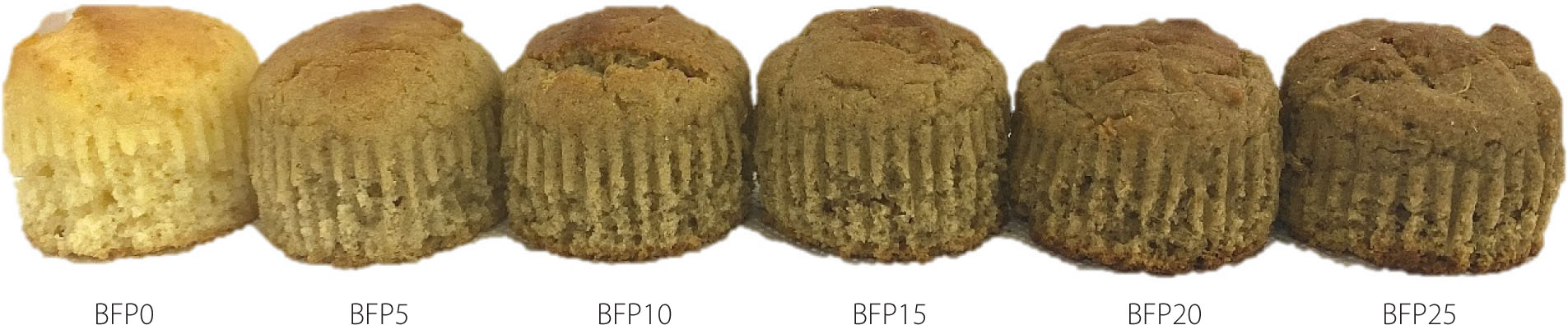
Figure 2
Cellular structure of muffin crumb with different levels of banana flower powder (BFP). Left: scanned images of the cross section of muffin crumb, right: modified binary images. BFP0, control sample (only wheat flour, WF); BFP5, 5% substitution of WF by BFP (w/w); BFP10, 10% substitution of WF by BFP (w/w); BFP15, 15% substitution of WF by BFP (w/w); BFP20, 20% substitution of WF by BFP (w/w); BFP25, 25% substitution of WF by BFP (w/w).
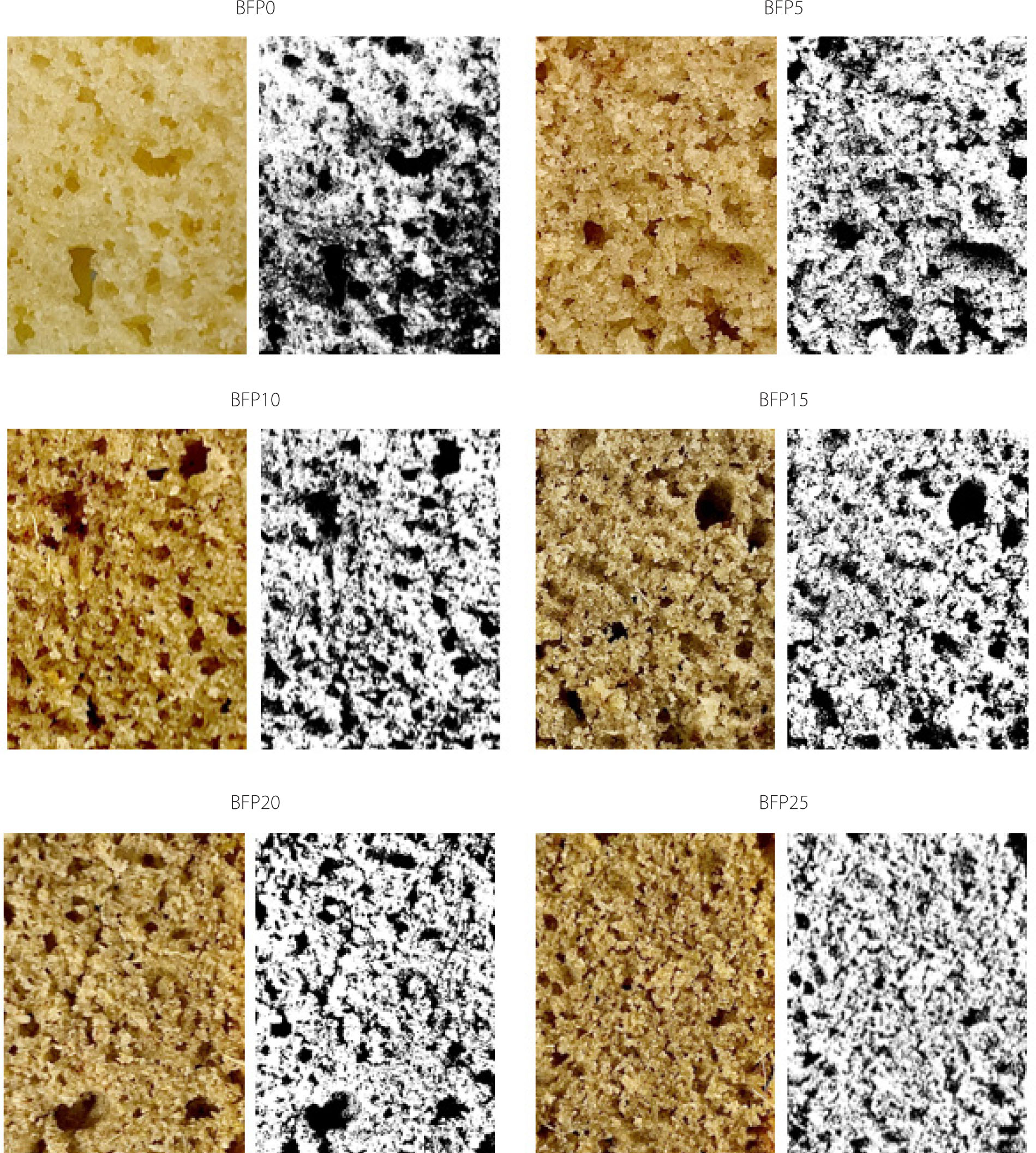
There was also a correlation between structure density with the textural profile of muffins. As presented in Table 5, the control muffin with the highest specific volume and porosity presented the lowest hardness (3.31 N) and chewiness (2.85 N). With an increasing content of BFP in the flour blend, the fortified muffins exhibited significantly higher values (p<0.05) of these two attributes up to 6.69 N and 4.50 N, respectively, with a dense and tightly packed crumb structure. The compact microstructure due to the lack of large air pockets increased crumb density, making it more resistant to deformation and more difficult to chew. These results matched those of earlier research conducted by Topkaya & Isik [2019] and Lee et al. [2020], in which muffins incorporated with pomegranate peel and Kamut exhibited an increase in hardness and chewiness. On the other hand, Table 5 presents a decrease in cohesiveness as the BFP content increased. This attribute refers to the strength of internal bonds within a food’s structure, which relies on its capacity to endure deformation [Noorlaila et al., 2017]. Its decline was probably caused by the dilution and weakening of a gluten network, as demonstrated by the pasting properties of composite flours in Table 3. Meanwhile, springiness, a measure of muffin’s elastic recovery, exhibited a small variation among the samples, ranging from 0.97 to 1.05.
Table 6 displays the color parameters (L*, a*, b*) of muffin crust and crumb, which may significantly influence consumer acceptance. Increasing BFP incorporation led to a statistically significant decrease (p<0.05) in muffin lightness (L*) compared to the control sample. Specifically, crust and crumb lightness decreased from 63.78 to 45.8 and from 84.5 to 56.2, respectively. This change was consistent with their appearance observed in Figure 1. Crust redness (a*) showed no apparent trend with increasing BFP content in the flour blends; however, crumb redness significantly increased from −1.8 to 4.7, and in general BFP-incorporated muffins exhibited higher a* values than the control. The control muffin displayed the highest yellowness (b*) values, with 43.9 for the crust and 35.9 for the crumb. Crust yellowness also showed no consistent trend with an increasing BFP content in the flour blends. Conversely, crumb b* significantly decreased with increasing BFP addition. These trends could be attributed the intrinsic darkness and color of BFP. A similar observation was reported previously by Tasnim et al. [2020] and Topkaya & Isik [2019], which showed an increased a* value and decreased b* value for fortified plain cake. In addition, Table 6 displays that the BFP incorporation led to a significant increase in the total color difference for both the crust and the crumb of the muffins compared to the control sample (BFP0). This increase reflected a significant shift toward a darker and more intense coloration. In all fortified samples, the ∆E values exceeded the threshold of 3.0, indicating that the color changes induced by BFP were easily perceptible to the human eye [Nath et al., 2018], which agreed with their optical images in Figure 1. Despite the common perception that darker colors are less desirable in food, a correlation between darker muffins and perceived health benefits exists among certain consumers [Walker et al., 2014].
Table 6
Color attributes of the crust and crumb of muffins produced using wheat flour (WF) and its blends with banana flower powder (BFP).
[i] Results are shown as mean ± standard deviation. Means with different lowercase letters indicate significant differences among muffins (p<0.05). BFP0, control sample (without BFP); BFP5, 5% substitution of WF by BFP (w/w); BFP10, 10% substitution of WF by BFP (w/w); BFP15, 15% substitution of WF by BFP (w/w); BFP20, 20% substitution of WF by BFP (w/w); BFP25, 25% substitution of WF by BFP (w/w). L*, lightness; a*, greenness/redness; b*, blueness/yellowness; ∆E, total color difference.
Sensory scores of muffins
The sensory scores for muffins in terms of appearance, color, texture, taste, and overall acceptability are shown in Table 7. The general findings indicate that all samples received good scores for all attributes, ranging from 6.67 to 7.80 on a 9-point scale. The control muffin had the mean scores above 7, ranging from 7.07 to 7.90, corresponding to “like moderately”. The BFP incorporation up to 20% of WF (w/w) did not significantly influence (p≥0.05) consumer preferences for all sensory attributes, except for the BFP20, with a lower score for texture. Texture was the most sensitive sensory parameter, especially at 20% and 25% substitution levels. This result aligned with the texture profile, as presented in Table 5, which showed increased hardness and chewiness. Muffins with 25% (w/w) substitution of WF by BFP consistently received the lower scores for all attributes, including appearance (6.83), color (6.87), texture (6.77), taste (7.17), and overall acceptability (6.77). This reduction of BFP25 mufin could be attributed to its high moisture content (Table 4), high values of hardness and chewiness (Table 5), and excessively dark color (Table 6). These results imply that substituting wheat flour with BFP up to 15% (w/w) maintained a balanced sensory profile; however, at the 20% (w/w) level, while the overall acceptability remained comparable, a significant decline in texture scores was observed, suggesting a potential sensory trade-off at higher fortification levels.
Table 7
Sensory scores of muffins produced using wheat flour (WF) and its blends with the banana flower powder (BFP).
[i] Results are shown as mean ± standard deviation. Means with different lowercase letters indicate significant differences among muffins (p<0.05). BFP0, control sample (without BFP); BFP5, 5% substitution of WF by BFP (w/w); BFP10, 10% substitution of WF by BFP (w/w); BFP15, 15% substitution of WF by BFP (w/w); BFP20, 20% substitution of WF by BFP (w/w); BFP25, 25%
CONCLUSIONS
This study confirmed that BFP is a nutrient-dense ingredient, rich in dietary fiber, protein, and specific bioactive compounds (with high contents of total phenolics, total flavonoids, and total anthocyanins), which significantly enhanced the nutritional profile of the fortified muffins. The incorporation of BFP altered the pasting properties of the flour blends by increasing gelatinization temperature and reducing peak and final viscosities, indicating restricted starch swelling and a weakened gluten network. These physicochemical changes resulted in a more compact muffin structure, characterized by a decreased specific volume, lower porosity, and increased hardness. Sensory evaluation identified 15% (w/w) BFP as the optimal substitution level for maintaining a favorable balance of texture and taste. Although overall acceptability remained comparable at 20% (w/w), this level should be considered the maximum tolerable threshold due to a significant decline in texture scores. While BFP addition significantly increased the total antioxidant content, further research is required to evaluate the bioaccessibility and bioavailability of these compounds to validate their actual health-related benefits. Additionally, future studies should focus on the thermal degradation kinetics of bioactive markers during baking and utilize specialized antioxidant activity assays to provide a more comprehensive functional assessment.