
INTRODUCTION
Allium schoenoprasum L. (AS), a member of the subfamily Alliaceae and genus Allium, is cultivated in many countries, such as Vietnam, France, and Canada [Singh et al., 2018]. This edible chive plant grows from bulbs (1 cm wide and 2–3 cm long) and has pale purple flowers, so it can be found in gardens as ornamental plant or in local markets as food products [Zdravković-Korać et al., 2010]. The AS young leaves and bulbs are commonly used as a spice in many dishes, such as dumplings, salads, and dairy products. Different AS organs are also used in traditional medicine to improve conditions such as sore throat, flu, and cold [Parvu et al., 2014; Singh et al., 2018]. Due to its bioactive compounds, AS has anticancer, antihypertensive, anti-inflammatory, anthelminthic, antibacterial, and antioxidant activities [Singh et al., 2018]. The AS bulbs are especially rich in phenolic compounds, with flavonoids being a major class. They were also reported to contain sulfur compounds, such as diethanol disulfide, dimethyl trisulfide, and methyl pentyldisulfide, responsible for antioxidant and antibacterial activity [Tran et al., 2024].
Allium plants, especially garlic, have a pungent flavor. Therefore, excessive consumption of garlic can lead to stomach irritation and bad breath (halitosis) [Ryu & Kang, 2017]. Different processes have been applied to overcome these disadvantages of fresh garlic. Among them, aging under conditions of high humidity (60–90%) and temperature (40–60°C) for a long time has been found to have significant effects in stimulating the metabolism of biological compounds and enhancing the functional properties of garlic [Utama et al., 2024]. The reactions occurring during aging, with enzymatic browning and non-enzymatic browning (Maillard reaction) being the main reactions, can result in an increase in the content of melanoidins, phenolic compounds, proteins, organosulfur compounds, and reducing sugars [Chang et al., 2020; Utama et al., 2024]. Furthermore, the aging process imparts a sweeter taste and chewier texture to black garlic while limiting the pungent taste characteristic of fresh garlic. While the characteristic black color is the primary indicator of successful aging, excessive thermal treatment can lead to over-carbonization (an undesirable dull, burnt appearance), loss of biological activity, or the development of a bitter taste [Kelebek et al., 2025].
AS can serve as an alternative to garlic and onion because it shares similar physical and biological properties with these two plants. However, consuming excessive amounts of AS can lead to digestive issues and halitosis, similar to the effects of garlic [Zdravković-Korać et al., 2010]. Thermal aging, a process involving the prolonged exposure of raw materials to controlled high temperatures and humidity without chemical additives, is a promising processing method that can mitigate the sensory drawbacks of fresh AS and enhance its bioavailability. However, a significant knowledge gap remains. Although the physicochemical and bioactive transformations during the thermal aging of garlic have been extensively documented [Kelebek et al., 2025; Ryu & Kang, 2017], the systematic application of this process to AS remains critically underexplored. Therefore, this study aimed to evaluate the changes in the quality of AS bulbs over a 7-day heat-induced aging period. Specifically, changes in nutritional composition, color, physicochemical characteristics, texture parameters, sensory qualities, bioactive compound contents, and antioxidant and anti-inflammatory activities were investigated during the 7-day aging process. Finally, Pearson’s correlation coefficient was used to examine the relationships between these properties.
MATERIALS AND METHODS
Materials
Fresh A. schoenoprasum (AS) bulbs at optimal ripening stage were collected in 2025 (February to May) from local supermarkets in Di An ward, Ho Chi Minh City, Vietnam. Damaged bulbs were removed and the remaining ones were cleaned before aging.
Production of aged (black) Allium schoenoprasum L.
Fresh AS bulbs (approximately 1.5 kg) were aged using an NK-686 apparatus (Ho Chi Minh City, Vietnam) with controlled temperatures and relative humidity of 65–75°C and 70–80%, respectively. No additional treatments were applied during the 7 days of aging. A representative sample of approximately 100 g of AS bulbs was randomly collected after each aging day to prepare for subsequent analysis.
Proximate analysis
The AOAC International standard procedures were used to determine the proximate composition of AS bulbs [AOAC, 2005]. Moisture, crude fat, crude protein, crude fiber, and ash contents were determined by AOAC 950.46, AOAC 922.06, AOAC 979.09, AOAC 962.09 and AOAC 942.05 methods, respectively. Carbohydrate content was calculated based on Equation (1):
Moisture content was expressed in fresh weight (FW) of AS bulbs, and calculations of the remaining results were based on dry weight (DW) of AS bulbs.
Color analysis
The AS bulb color values in the CIElab color space (L*, darkness/lightness; a*, greenness/redness; b*, blueness/yellowness) were measured using a CR-400 device (Konica Minolta, Osaka, Japan). The total color difference (∆E) between fresh and aged AS bulbs was calculated based on Equation (2):
where: L*f, a*f, b*f are the color values of fresh AS bulbs (day 0) and L*t, a*t, b*t are the color values of AS samples after aging.Physicochemical analysis
Preparation of Allium schoenoprasum L. filtrate
AS bulbs (10 g) were ground and mixed with distilled water at a solid-to-solvent ratio of 1:10 (w/v). The slurry was then ultrasonicated using a PRO 150S device (Asonic, Ljubljana, Slovenia) for 30 min at a controlled temperature of 35±2°C. Finally, the slurry was filtered through Whatman No.1 filter paper, and the filtrate was used for subsequent physicochemical analyses.
pH and total soluble solid determination
The pH of the AS filtrate was measured based on the activity of H3O+ ions using an HI2211 instrument (Hanna Instruments, Woonsocket, RI, USA), while the content of total soluble solids (TSS) expressed in °Brix was determined using an HI96801 instrument (Hanna Instruments, Woonsocket, RI, USA). The analyses were repeated three times at 25°C.
Titratable acidity determination
The acid-base titration method was used to determine AS samples’ titratable acidity (TA) [Islam et al., 2013]. A phenolphthalein solution (0.1%, w/w) was added to the AS filtrate diluted with distilled water. The mixture was then titrated with a 0.1 M NaOH solution until a pink color persisted for 30 s. TA was calculated using Equation (3):
where: VNaOH is the volume of the NaOH solution used for titration (mL), V1 is the volume filled up (mL), V2 is the volume of extract (mL), 0.1 is the normality of NaOH (M), 0.064 is the conversion factor for citric acid equivalent, and m is the mass of the AS sample used to filtrate the preparation (g). The results were expressed as mg of citric acid equivalent per 100 g of fresh weight (mg/100 g FW).Reducing sugar determination
The reducing sugar (RS) content of AS samples was determined by the colorimetric method with 3,5-dinitrosalicylic acid (DNS) in an alkaline medium [Miller, 1959], with some minor modifications. Briefly, 30 g of potassium sodium tartrate tetrahydrate was dissolved in 50 mL of deionized water. On the other hand, 1 g of DNS was dissolved in 20 mL of 2 M NaOH. The entirety of both solutions was completely combined and gently heated to form a homogeneous mixture. After cooling to room temperature, the mixture was filled up to 100 mL with distilled water to prepare the final DNS reagent. Then, 1 mL of DNS reagent was added to 2 mL of the AS filtrate and mixed thoroughly. The reaction mixture was incubated in a water bath at 95°C for 5 min. Subsequently, the mixture was rapidly cooled under running tap water, and the absorbance of the samples was immediately measured at 540 nm using a UV–Vis spectrophotometer (Cary 60, Agilent, Penang, Malaysia). Glucose at various working concentrations (0–1,000 μg/mL) was used to construct the standard curve. The results were expressed as mg of glucose equivalent per g of AS bulb DW.
Texture analysis
The texture of the AS bulbs was evaluated using a texture analyzer (TA.XTplusC.0001, Stable Micro Systems Ltd., Surrey, UK) equipped with a P/75 cylindrical probe (7.5 mm diameter). A two-cycle compression test was performed with a strain of 20%. The pre-test and post-test speeds were set to 0.1 cm/s, while the test speed was 0.5 cm/s. From the obtained force-time curves, several texture parameters were determined. Specifically, hardness was defined as the maximum peak force attained during the first compression cycle. Springiness was evaluated as the ratio of the time duration of the second compression to that of the first compression. Cohesiveness was calculated as the ratio of the positive force area during the second compression to that of the first compression. Gumminess was defined as the energy needed to break down a semi-solid sample prior to swallowing. Resilience, which indicates the instantaneous ability of the sample to recover its original height, was evaluated as the ratio of the withdrawal work to the compression work during the first compression cycle.
Preliminary sensory evaluation
A preliminary sensory evaluation was conducted to assess the changes in the physical and sensory characteristics of AS samples during the heat-induced aging process. The sensory panel consisted of 14 members, comprising laboratory staff and university students (7 men and 7 women, aged 20 to 35) from the Faculty of Applied Science and Technology, Nguyen Tat Thanh University (Ho Chi Minh City, Vietnam), who were familiar with the sensory evaluation of thermally aged Allium products. The sensory attributes, including color, degree of dryness, texture, flavor, taste, and overall sensory quality, were evaluated using a 9-point rating scale. The corresponding meanings assigned to the scale were: 1 – extremely poor, 2 – very poor, 3 – poor, 4 – slightly poor, 5 – fair/acceptable, 6 – slightly good, 7 – good, 8 – very good, and 9 – excellent [Yuan et al., 2022]. The AS samples were coded with three-digit random numbers and presented to the panelists in a randomized order. Purified water was provided to the panelists to cleanse their palates between sample tastings. The evaluation exclusively involved the tasting of thermally aged AS samples prepared without the addition of any harmful chemicals. All participants were healthy adult volunteers. Prior to the evaluation, all panelists were fully informed about the purpose of the study and the sample preparation methods, and they provided their informed consent to participate.
Total phenolic content, total flavonoid content, and biological activity analysis
Preparation of Allium schoenoprasum L. extract
The AS bulbs were ground and extracted with a 70% (v/v) ethanol solution at a solid-to-solvent ratio of 1:10 (w/v). The mixture was ultrasonicated for 30 min using a PRO 150S device (Asonic, Ljubljana, Slovenia) at a controlled temperature of 35±2°C. The suspension was filtered to obtain the A. schoenoprasum extract (ASE). The ASE was used directly for the phytochemical content determinations and biological activity assays without further evaporation, and all results were expressed on a bulb DW basis. Preliminary range-finding tests were conducted to determine the optimal extract volumes applied in the subsequent assays, ensuring that all absorbance readings fell strictly within the linear range of their respective standard curves.
Total phenolic content determination
The method with the Folin-Ciocalteu reagent in alkaline medium was applied to estimate the total phenolic content (TPC) of AS bulbs [Pirca-Palomino et al., 2024; Singleton & Rossi, 1965]. Briefly, 200 μL of ASE were reacted with 1 mL of the 10% (w/v) Folin-Ciocalteu reagent. After 5 min, the mixture was reacted with 800 μL of a 7.5% (w/v) Na2CO3 solution. After 1 h, the absorbance of the solution at 765 nm wavelength was estimated using a Cary 60 UV–Vis spectrophotometer (Agilent). Gallic acid solutions at various concentrations (0–0.1 mg/mL) were used to construct the standard curve. TPC was expressed as mg gallic acid equivalents (GAE) per 100 g of AS bulb DW.
Total flavonoid content determination
The flavonoid-aluminum complexation method was applied to estimate the total flavonoid content (TFC) of AS bulbs [Miliauskas et al., 2004; Pirca-Palomino et al., 2024]. Briefly, 500 μL of ASE were mixed with 100 μL of 1% (w/v) AlCl3×6H2O solution, 100 μL of 1 N CH3COOK solution, and 4.3 mL of ethanol absolute. After 30 min, the absorbance of the solution was recorder at a wavelength of 415 nm using a Cary 60 UV–Vis spectrophotometer (Agilent). Quercetin solutions at various concentrations (0–0.1 mg/mL) were used to construct the standard curve. TFC was expressed as mg quercetin equivalents (QE) per 100 g of AS bulb DW.
ABTS assay
The discoloration reaction of the pre-generated, blue-green 2,2’-azino-bis(3-ethylbenzothiazoline-6-sulfonic acid) (ABTS) radical cations by antioxidants was used to estimate the free radical scavenging capacity of AS bulbs [Raczkowska et al., 2024; Re et al., 1999]. Briefly, 500 μL of ASE were mixed with 1,500 μL of a solution of generated ABTS•+ calibrated to an absorbance of 1.1. After 30 min, the mixture absorbance was measured at wavelength of 734 nm using the Cary 60 UV–Vis spectrophotometer (Agilent). Trolox solutions at various concentrations (0–0.01 mg/mL) were used to construct the standard curve. ABTS•+ scavenging activity of AS bulbs was expressed as mg Trolox equivalents (TE) per 100 g AS bulb DW.
Ferric reducing antioxidant power assay
The reduction of Fe3+ complexed with 2,4,6-tripyridyl-s-triazine (TPTZ) (light yellow) to Fe2+-TPTZ complex (blue) was applied to estimate the ferric reducing antioxidant power (FRAP) of AS bulbs [Benzie & Strain 1996; Nguyen et al., 2025]. Briefly, 20 mL of an FeCl3 solution (0.02 M) were mixed with 20 mL of a TPTZ solution (0.01 M) and 200 mL of a CH3COONa solution (0.3 M) to form an FRAP reagent (FR). Then, FR (10 mL) was reacted with 0.3 mL of ASE. After 10 min, the absorbance of the solution was estimated at 593 nm using a Cary 60 UV–Vis spectrophotometer (Agilent). FeSO4 solutions at various concentrations (0–3 mg/mL) were used to construct the standard curve. FRAP of AS samples was expressed as mg FeSO4 per 100 g AS bulb DW.
Anti-inflammatory capacity determination
The anti-inflammatory capacity of the AS bulbs was evaluated by bovine serum albumin (BSA) denaturation inhibition assays [Rahman et al., 2015]. Briefly, 50 μL of ASE at specific concentrations (0–28.96 μg/mL for fresh AS bulbs and 0–48 μg/mL for 7-day aged AS bulbs) were added to 450 μL of a 1% (w/v) BSA solution in phosphate-buffered saline (PBS; pH 6.3). The mixture was incubated at 37°C for 30 min, then the temperature was gradually increased to 57°C and kept for another 5 min. Then, all samples were removed and allowed to cool for 15–20 min. After cooling, 2.5 mL of PBS (pH 6.3) were added to each sample, and the absorbance was measured at 255 nm using a Cary 60 UV–Vis spectrophotometer (Agilent). Distilled water was used instead of ASE in the test control, which represented 100% protein denaturation. The product control consists of 450 μL of distilled water and 50 μL of ASE. Equation (4) was used to calculate the percentage inhibition of protein denaturation:
where: A is the optical density of the test solution (extract and BSA), B is the optical density of the product control (extract and water), and C is the optical density of the test control (water and BSA). Analysis was done in triplicate. The extract concentration required to achieve a 50% inhibition of protein denaturation was denoted as the IC50 value. This parameter was calculated by applying linear regression to the dose-response curve.Statistical analysis
All determinations were performed three times independently on samples from each collection day. Data are expressed as the mean and standard deviation. Statistical analyses were performed using IBM SPSS Statistics 22 (IBM Corp., Armonk, NY, USA). Prior to the analysis of variance (ANOVA), the normality of the data distribution and the homogeneity of variances were verified using the Shapiro-Wilk test and Levene’s test, respectively. Statistically significant differences among the mean values were determined using a one-way ANOVA followed by Tukey’s post hoc test at a significance level of p<0.05. Pearson correlation between all determined parameters was also analyzed.
RESULTS AND DISCUSSION
Proximate composition of Allium schoenoprasum L. bulbs
Changes in the proximate composition of AS bulbs during heat-induced aging were investigated in fresh and aged samples. The moisture content of fresh AS bulbs (day 0) and AS samples aged for 1 day did not differ significantly (p≥0.05) (Table 1). However, extending the aging time resulted in a significant (p<0.05) decrease in the moisture content of AS bulbs to 23.33 g/100 g FW. During aging, the decrease in moisture content was due to the effect of high temperature, which is a common phenomenon. Tahir et al. [2022] noted that the aging resulted in a decrease in moisture content from 64.30–67.50 g/100 g DW (fresh garlic) to 29.50–31.35 g/100 g DW (black garlic). In turn, the moisture content of 7 fresh garlic varieties (Havel, Rusák, Vekan, Ivan, Bjetin, Lukan, and Havran) ranged from 57.04 to 65.34 g/100 g DW, and the aging process reduced their moisture content to 33.52 to 42.52 g/100 g DW [Bedrníček et al., 2021]. The moisture content of fresh AS bulbs in our study (65.18 g/100 g FW) was within the ranges reported in the literature for conventional garlic (Allium sativum L.) [Bedrníček et al., 2021; Tahir et al., 2022], while differences were observed between aged AS and conventional garlic, which could be primarily due to biological differences between the Allium species (A. schoenoprasum versus A. sativum), coupled with inherent variations in bulb morphology. The differences could also result from the applied aging parameters [Afzaal et al., 2021]. It has been reported that the sensory quality, texture, and Maillard reaction product level of black garlic are determined by the moisture content [Najman et al., 2020; Yuan et al., 2022]. Therefore, monitoring the moisture content of aged AS bulbs may help control their quality characteristics.
Table 1
Proximate composition of Allium schoenoprasum L. bulbs during heat-induced aging.
The crude fat content of AS bulbs increased significantly during heat-induced aging (Table 1). This apparent increase is primarily attributed to the thermal disruption of the cellular matrix, which promotes the release and extractability of bound lipids. This observation is consistent with the trend reported in black garlic processing, where fat content increased from 0.15 to 0.60 g/100 g DW [Choi et al., 2008].
The crude protein content of AS bulbs after 7 days of aging was significantly (p<0.05) higher than that of the fresh AS bulbs and bulbs heat-treated for 1 day (Table 1). Tahir et al. [2022] suggested that enzyme activities during aging led to an increase in the protein content of two Pakistani garlic cultivars, with values increasing from 8.57 to 9.50 g/100 g (desi) and from 6.38 to 8.10 g/100 g (farmi).
The ash content of AS bulbs ranged from 0.46 to 0.58 g/100 g DW and increased over time during AS aging (Table 1). Meanwhile, although aging increased the crude fiber content of AS samples, the increase was not significant (p≥0.05). A similar increasing trend was reported in a study on A. sativum [Tahir et al., 2022]. This trend resulted from the thermal degradation of labile carbohydrates, which led to the concentration of the mineral fraction.
The aging process significantly decreased (p<0.05) the carbohydrate content of AS bulbs (Table 1). Fructans are documented as the predominant reserve carbohydrates in Allium species, accounting for over 75% of the total dry mass [Cheong et al., 2012]. Consequently, this overall reduction directly reflects the extensive degradation of these fructans into simpler saccharides via sequential enzymatic hydrolysis and non-enzymatic thermal cleavage [Afzaal et al., 2021].
Color properties of Allium schoenoprasum L. bulbs
Consumer perception of food quality is significantly influenced by product color, which in turn is linked to other food characteristics, such as pigment level and moisture content. Therefore, color is one of the critical indicators for quality control of black AS. In our study, the AS color parameter values decreased significantly (p<0.05) during 7 days of heat-induced aging (Table 2). The L* value was 76.91 for fresh AS and 26.94 after 7 days of processing. The a* and b* values decreased from 6.36 to −1.82 and from 28.89 to 3.37, respectively. Correspondingly, the ∆E values increased (p<0.05) for aged AS bulbs. As shown in Figure 1, fresh AS was white and turned brown after 1 day of aging. The AS bulbs turned dark brown after 2 days and began to turn black after 3 days. Finally, the AS sample turned completely black after 7 days of aging, indicating that AS bulbs had entered the ripening stage.
Table 2
Color parameters of Allium schoenoprasum L. bulbs during heat-induced aging.
[i] Data are presented as the mean ± standard deviation (n=3). Different lowercase letters (a–h) indicate statistically significant differences (p<0.05) between different aging times, as determined by Tukey’s test. L*, darkness/lightness; a*, greenness/redness; b*, blueness/yellowness; ΔE, total color difference (compared to fresh bulbs).
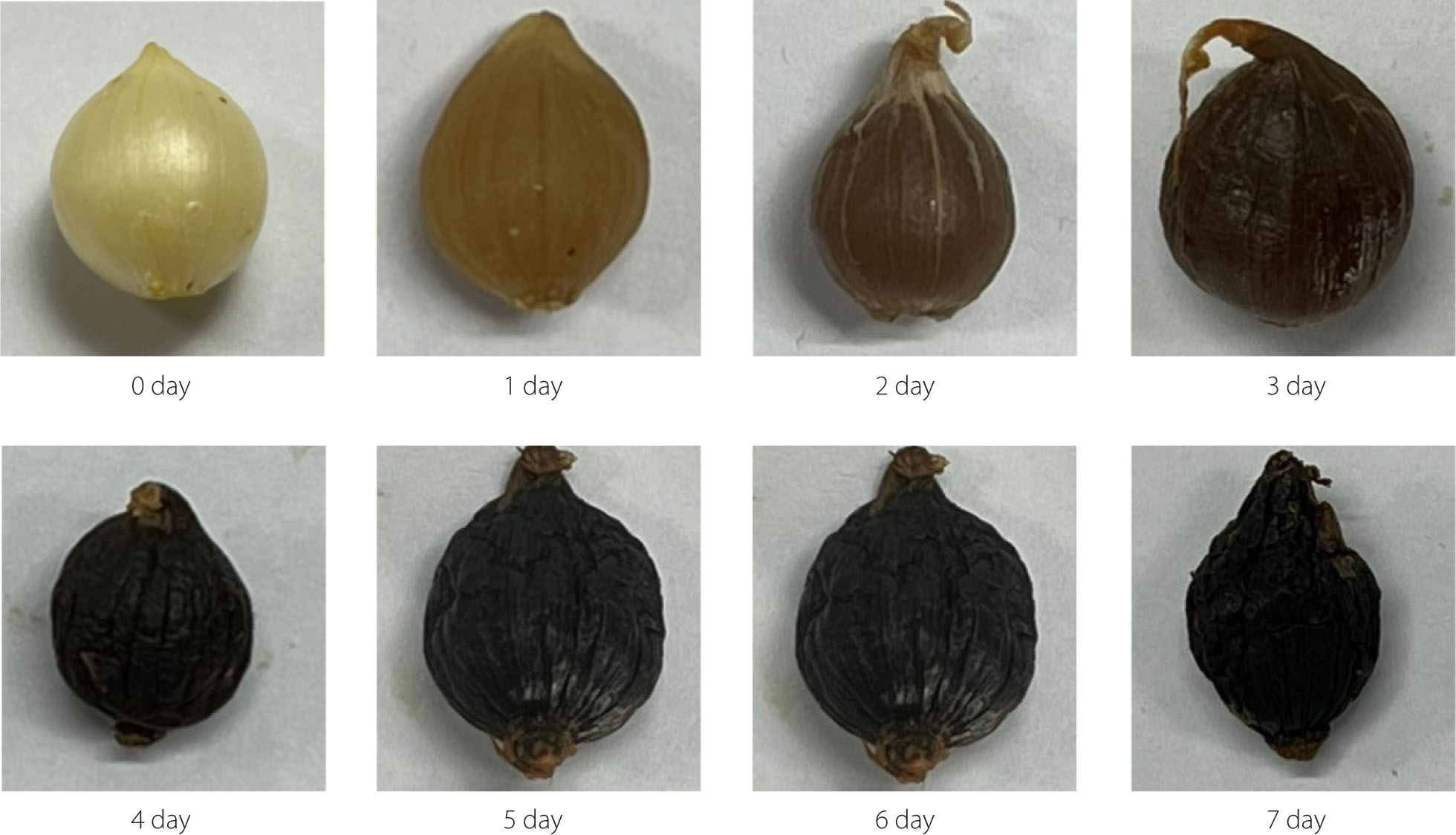
Various biochemical reactions, such as the Maillard reaction and enzymatic browning reactions, occurred during aging. Among them, the Maillard reaction is the most important, as it is responsible for the color and flavor of foods. During the final stages of the Maillard reaction, high-molecular-weight melanoidins (brown pigment) are synthesized through a series of complex transformations, namely molecular rearrangements, condensation reactions, and polymerization [Wu et al., 2021]. The browning intensity of black garlic products is directly proportional to the content of melanoidins [Wu et al., 2021]. Therefore, longer aging time increases the content of melanoidins and intensifies garlic’s black color. In addition to melanoidin, Maillard and caramelization reactions also produce 5-hydroxymethyl furfural, the content of which is also proportional to the aging time and browning intensity of garlic [Zhang et al., 2016]. These results demonstrate that an extended aging duration significantly enhances the browning intensity and black color of the product.
Physicochemical properties of Allium schoenoprasum L. bulbs
The pH value of the AS bulbs decreased significantly during 7 days of heat-induced aging (Figure 2A). In contrast, the TA value of the AS bulbs increased significantly over time. Several studies have observed similar trends during garlic aging [Tahir et al., 2022; Zhang et al., 2016]. Free alkaline amino groups of amino acids, peptides, and proteins are consumed in the Maillard reaction by reacting with reducing sugars, shifting the acid balance toward acidity. Furthermore, degradation of polysaccharides leads to an increase in the organic acid content, thus increasing the acidity of black garlic [Liang et al., 2015; Zhang et al., 2016]. The formation of organic acids not detected in fresh garlic, such as pyroglutamic, 3-hydroxypropionic, succinic, and formic acids, occurred during aging [Liang et al., 2015]. The low pH has its advantages as it helps stabilize the microbiological quality of black garlic [Ahmed & Wang, 2021].
Figure 2
pH and titratable acidity (A) and contents of total soluble solids and reducing sugars (B) of Allium schoenoprasum L. bulb during heat-induced aging. FW, fresh weight; DW, dry weight.
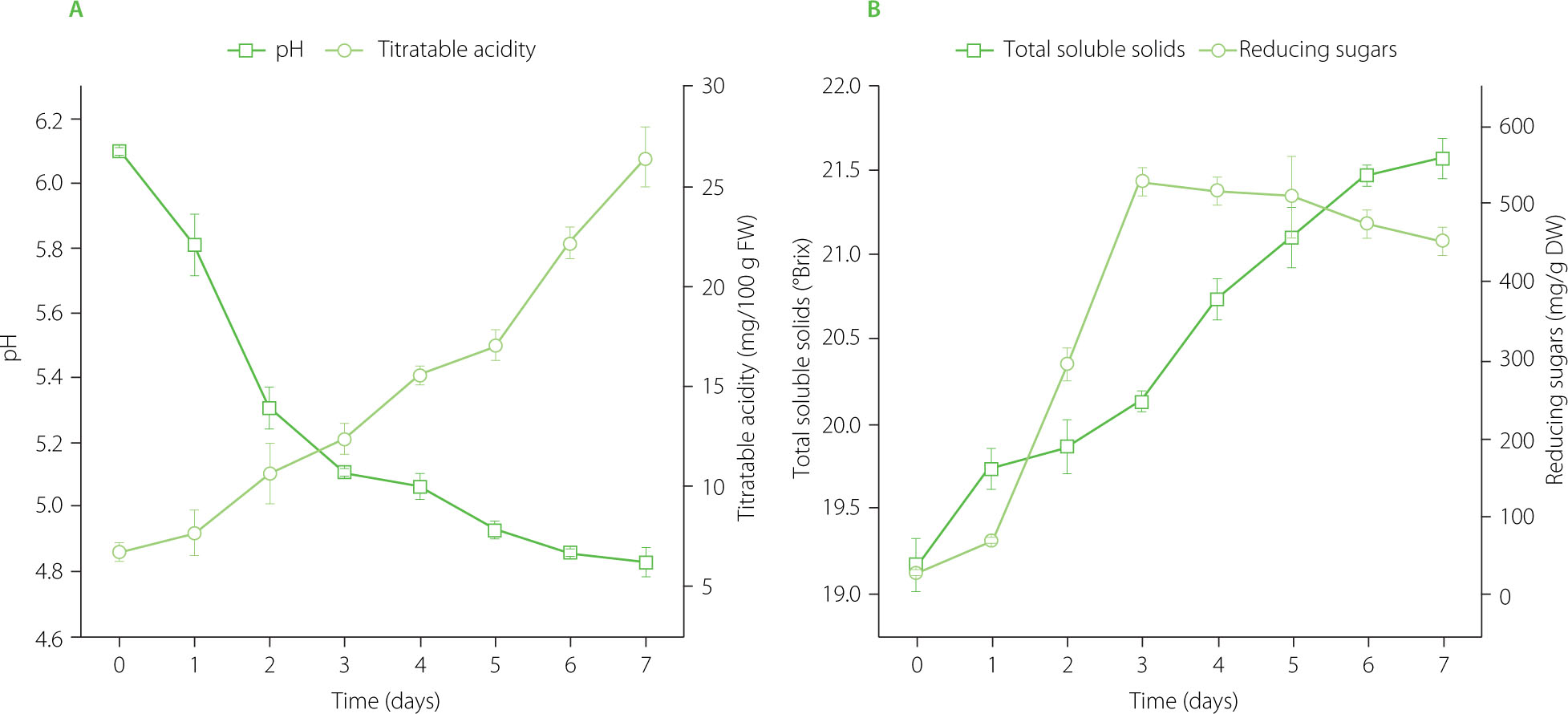
The TSS of the AS bulbs increased significantly over time of the aging process (Figure 2B). In turn, the RS content of the AS bulbs exhibited a remarkable increase from 31.4 mg/g DW at day 0 to a peak of 516.5 mg/g DW at day 3, followed by a significant decrease to 452.4 mg/g DW by day 7. The significant increase in RS content during aging is a direct consequence of the breakdown of complex polysaccharides into simpler compounds [Afzaal et al., 2021; Li et al., 2015]. This transformation also contributes to the observed increase in TSS [Afzaal et al., 2021]. Initially, fructans undergo enzymatic hydrolysis into oligosaccharides, disaccharides, and monosaccharides, catalyzed by endogenous fructan exohydrolase [Cheong et al., 2012]. Although high temperatures eventually deactivate this native enzyme, further polysaccharide cleavage is driven by non-enzymatic thermal degradation during prolonged aging. This sequential mechanism results in monosaccharides (fructose and glucose) becoming the predominant saccharide fraction, which significantly enhances the characteristic texture and sweetness of black garlic [Afzaal et al., 2021; Cheong et al., 2012; Liang et al., 2015]. Furthermore, these reducing sugars serve as essential precursors for the non-enzymatic Maillard reaction [Afzaal et al., 2021; Li et al., 2015; Liang et al., 2015]. While the degradation of complex macromolecules into simpler compounds may enhance in vitro bioaccessibility, further physiological validation is required to confirm the impact of these chemical modifications on in vivo digestion.
Texture properties of Allium schoenoprasum L. bulbs
The changes in texture parameters of AS bulbs during heat-induced aging are shown in Table 3. The hardness and gumminess values decreased significantly (p<0.05) with aging of the bulbs. In contrast, the springiness value increased over time. The cohesiveness and resilience values of AS decreased (p<0.05) during the first 2 days of aging. However, they showed an increasing trend (p<0.05) in the last days of aging.
Table 3
Texture properties of Allium schoenoprasum L. bulbs during heat-induced aging.
To the best of authors’ knowledge, no study has investigated the textural properties (springiness, cohesiveness, gumminess, and resilience) of AS bulbs during aging. However, Bedrníček et al. [2021] noted that black garlic samples had a jelly-like texture and were softer than fresh garlic. The data also showed that the hardness of garlic samples decreased 11-fold after aging. Because of high temperature during aging, the thermal degradation of polysaccharides led to a reduction in the hardness of black garlic, while significantly increased its softness and elasticity [Li et al., 2020]. In addition, the weakening of the cell structure is also related to the decrease in moisture content during aging [Utama et al., 2024]. Yuan et al. [2022] noted that the hardness of garlic samples decreased after the first day of aging, but gradually increased from day 5 to day 10. This suggests that the black garlic samples were over-dried, which resulted in excessive loss of moisture content, thus leading to an increase in hardness during aging. The results of this study indicate that aging made black AS bulbs softer, more flexible, and more rigid while reduced their hardness. This suggests that black AS samples have a desirable texture for culinary appeal and commercial potential.
Sensory properties of Allium schoenoprasum L. bulbs
Sensory properties of food have a significant influence on its overall quality. Because chemical and physicochemical changes occur continuously during the heat-induced aging process, a preliminary sensory evaluation of the AS samples was performed to monitor the development of their organoleptic properties. All sensory scores of the AS bulbs improved continuously during aging (Table 4). The color scores of AS samples at the early aging stage were significantly lower (p<0.05) than those at the later stage. This was because AS samples began to turn black after 3 days and wholly turned to a uniform black color after 7 days. The decrease in moisture content led to a gradual increase in the dry degree of AS bulbs. However, the increase in the dry degree of AS samples at the later aging stage was insignificant (p≥0.05). In addition, the degradation of polysaccharides during aging also made the AS samples become gummy, soft, and jelly-like in texture. Therefore, their texture scores were significantly increased during 7 days of aging. The increase in organic acids, reducing sugar content, and the decrease in allicin content (a compound responsible for pungent taste) resulted in the AS samples having a characteristic sweet and sour taste after aging, thus increasing their flavor and taste scores [Li et al., 2015; Li et al., 2020]. Finally, the results also showed an increase in the overall sensory quality of the AS bulbs after 7 days of aging. This finding demonstrated that the aging process mitigated the characteristic pungent taste present in fresh AS samples and successfully enhanced the overall sensory profile of the black AS samples.
Table 4
Sensory properties of Allium schoenoprasum L. bulbs during heat-induced aging.
Total phenolic and total flavonoid contents, and biological activity of Allium schoenoprasum L. bulbs
Contents of total phenolics and total flavonoids
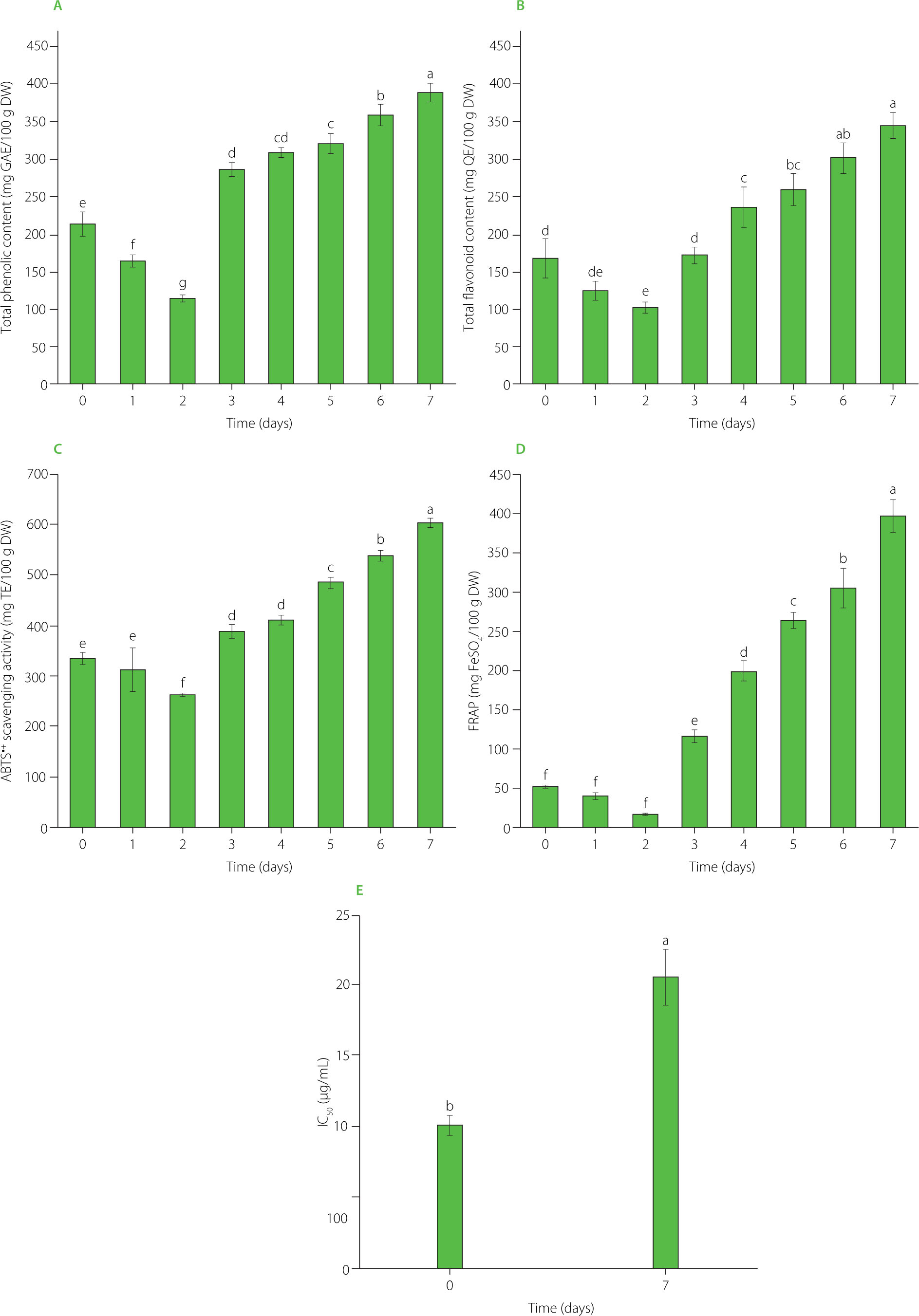
The results indicate that the TPC and TFC of AS bulbs were significantly affected by aging (Figure 3). At the early stage of aging, TPC decreased significantly (p<0.05). In contrast, a significant (p<0.05) increase in TPC was observed at the late stage of aging. Similarly, TFC significantly (p<0.05) decreased from day 0 to day 2, followed by a significant (p<0.05) increase from day 3 to day 7. Under the influence of high temperature, oxidation reactions are accelerated, and covalent bonds are cleaved. Thus, phenolic compounds in agricultural products are degraded [Nguyen et al., 2025]. In addition, high humidity at the initial stage of aging also leads to increased activity of polyphenol oxidase and peroxidase, resulting in a recued phenolic content [Sun & Wang, 2018]. However, the decrease in humidity and pH at the later stage of aging led to enzyme inactivation, thus limiting the degradation of phenolics in AS samples [Toledano-Medina et al., 2016]. Moreover, polysaccharide depolymerization occurred during aging. Subsequently, phenolic compounds, including flavonoids and phenolic acids, are released from cell wall structures.
Figure 3
Total phenolic content (A), total flavonoid content (B), 2,2’-azino-bis (3-ethylbenzothiazoline-6-sulfonic acid) radical cation (ABTS•+) scavenging activity (C), ferric reducing antioxidant power (FRAP) (D), and inhibition of bovine serum protein denaturation (E) of Allium schoenoprasum L. during heat-induced aging. Data are presented as the mean and standard deviation (n=3). Different lowercase letters (a–f) indicate statistically significant differences (p<0.05) between different aging times, as determined by Tukey’s test. GAE, gallic acid equivalents; QE, quercetin equivalents; TE, Trolox equivalents; IC50, half-maximal inhibitory concentration; DW, dry weight.
Antioxidant capacity
The content of bioactive compounds changes during aging, thus affecting the antioxidant capacity. The ABTS•+ scavenging activity of AS bulbs did not change significantly (p≥0.05) during the first two days of aging (Figure 3D). Similarly, the FRAP values showed no significant (p≥0.05) changes during the initial three days of the thermal process (Figure 3E). However, from day 3 to day 7, both ABTS•+ scavenging activity and FRAP increased significantly (p<0.05). The higher antioxidant capacity of AS bulbs after aging was consistent with results of previous studies on black garlic [Tahir et al., 2022]. The changes in the antioxidant capacity of AS samples over time followed a similar trend to the changes in TPC and TFC, indicating that phenolic compounds primarily influenced the antioxidant potential of AS bulbs. However, other AS bulb compounds could also affect their antioxidant capacity. The aging process leads to the conversion of allicin into water-soluble organosulfur compounds, thus increasing the antioxidant capacity of garlic [García-Villalón et al., 2016; Utama et al., 2024]. Moreover, melanoidins are known for their strong antioxidant capacity; longer aging times also lead to increased melanoidin content and antioxidant capacity of the garlic [González-Ramírez et al., 2022].
Anti-inflammatory capacity
Arthritis and inflammatory responses are closely related to the phenomenon of tissue protein denaturation [Aidoo et al., 2021]. The anti-inflammatory potential of fresh AS (day 0) and black AS (day 7) bulbs was evaluated through their capacity to inhibit the heat-induced denaturation of bovine serum albumin. As shown in Figure 3F, fresh AS bulbs exhibited significantly lower IC50 values (p<0.05) compared to black AS samples, indicating a reduction in specific anti-inflammatory potential following the thermal aging process. Interestingly, this trend contrasts with the observed enhancement in antioxidant capacity. In Allium species, anti-inflammatory activity is predominantly attributed to heat-sensitive organosulfur compounds, rather than phenolic compounds [Jeong et al., 2016]. Therefore, the severe thermal degradation of these organosulfur compounds during prolonged aging directly contributes to the reduced efficacy in preventing BSA denaturation. However, extrapolating these in vitro BSA denaturation results directly to in vivo systems is highly limited. Actual physiological anti-inflammatory efficacy depends on complex cellular immune responses and the gastrointestinal bioavailability of these compounds, necessitating further in vivo or cell-based model studies.
Pearson correlation
The correlations among the proximate composition, color parameters, physicochemical parameters, sensory scores, and antioxidant capacity of the AS bulbs during aging are illustrated in Figure 4. Exact correlation coefficients are detailed in Table S1 in Supplementary Materials. The IC50 values (representing antiinflammatory activity) were not included in the correlation matrix, as two sampling points (days 0 and 7) provide insufficient degrees of freedom for valid correlation modeling. The results demonstrated that moisture content was significantly negatively correlated with the sensory attributes and antioxidant capacities. Conversely, nutrient contents, such as crude fat, crude protein, ash, crude fiber, and carbohydrates, all exhibited positive correlations with these parameters. Among the sensory attributes, the sensory scores for color showed a significant negative correlation with the instrumental L*, a*, and b* values. Simultaneously, ∆E exhibited a significant positive correlation with the sensory color scores.
Figure 4
Pearson’s correlogram of parameters determined for Allium schoenoprasum L. bulbs during heat-induced aging. M, moisture; CF, crude fat; CP, crude protein; CFi, crude fiber; Car, carbohydrates; L*, darkness/lightness; a*, greenness/redness; b*, blueness/yellowness; ΔE, total color difference; TA, titratable acidity; TSS, total soluble solids; RS, reducing sugars; Ha, hardness; Sp, springiness; Co, cohesiveness; Gu, gumminess; Re, resilience; TPC, total phenolic content; TFC, total flavonoid content; Col, color; DD, dry degree; Te, texture; Fl, flavor; Tas, taste; OSQ, overall sensory quality; ABTS assay, 2,2’-azino-bis (3-ethylbenzothiazoline-6-sulfonic acid) assay; FRAP, ferric reducing antioxidant power. Correlations are significant at p≤0.05 (*) or at p≤0.01 (**).
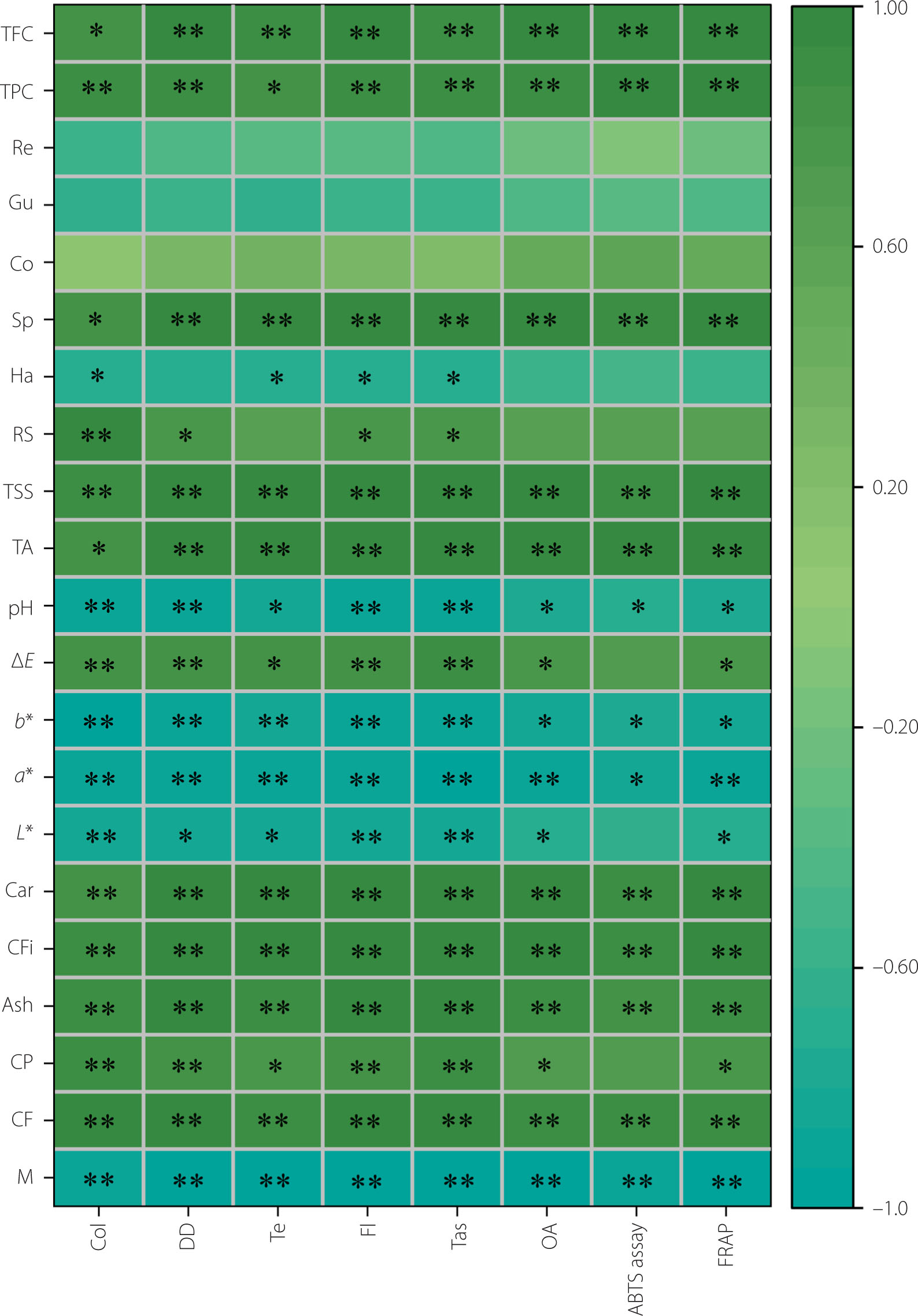
The results also indicated that moisture content correlated negatively with dry degree and texture, whereas springiness showed a significant positive correlation with these two parameters. Regarding flavor and taste, the sensory scores were significantly and positively correlated with reducing sugars, titratable acidity, carbohydrates, crude protein, crude fat, and TSS, while being negatively correlated with pH values.
Overall, the antioxidant capacities of AS were negatively correlated with L*, a*, and b* values, while showing a positive correlation with ∆E. Finally, TPC and TFC exhibited a strong positive correlation with the ABTS and FRAP assay results. These findings demonstrate that the accumulated phenolic compounds are highly effective at neutralizing free radicals and providing reducing power via electron donation [Karnjanapratum et al., 2021].
CONCLUSIONS
The changes in the chemical composition, physicochemical properties, sensory profiles, and biological activities of AS bulbs during the heat-induced aging were comprehensively determined in this study. The results demonstrated that aging reduced the moisture content, leading to the concentration of crude fat, protein, ash, and fiber, whereas carbohydrate levels significantly declined. The AS bulbs turned completely black after 7 days of treatment. The concurrent increases in reducing sugars, TSS, and titratable acidity, alongside the reduction in pH, significantly improved the sensory attributes of the aged samples. During the aging process, there was a significant increase in the content of phenolic compounds (TPC and TFC). As a result, the antioxidant capacity (ABTS•+ scavenging activity and FRAP) of the AS bulbs was significantly enhanced. However, compared to the fresh AS, the specific anti-inflammatory capacity of the aged samples decreased. Pearson’s correlation analysis confirmed that the improvement in sensory properties (color, flavor, and taste) was strongly associated with the decreases in instrumental color values (L*, a*, b*), as well as the increases in reducing sugars, titratable acidity, carbohydrates, crude protein, crude fat, and TSS. Additionally, the enhanced sensory texture scores were linked to decreases in moisture, hardness, gumminess, and resilience, and increases in springiness and cohesiveness. While this study provides a knowledge of the chemical and physicochemical changes occurring in AS bulbs during a 7-day aging period, the effects of different pretreatment methods should be further investigated to optimize the functional and nutritional quality of black AS.